

A Model for the Assessment of the Water Footprint …
93
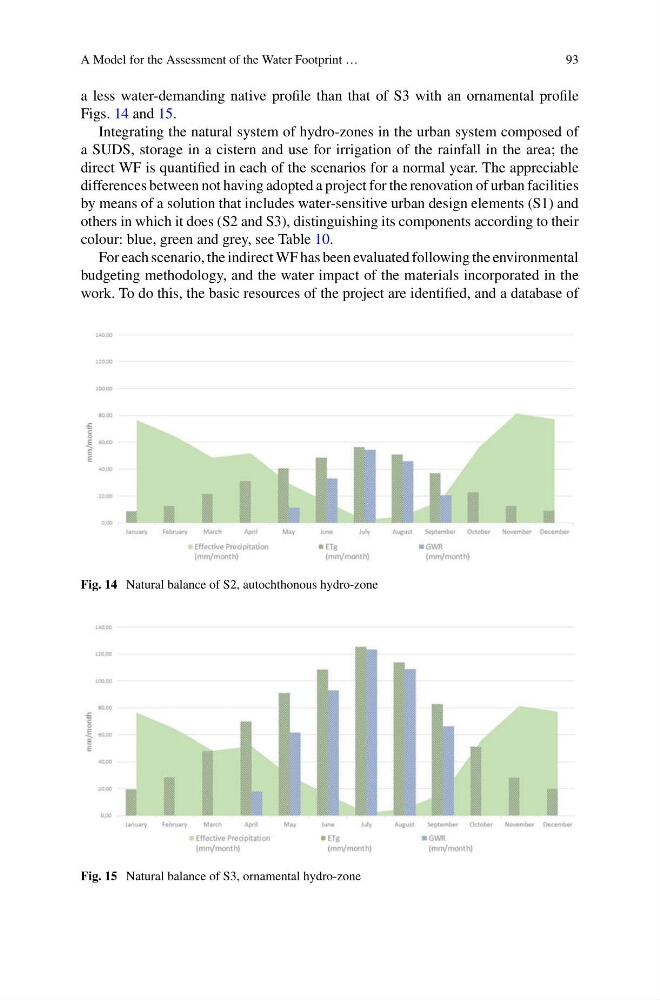
a less water-demanding native profile than that of S3 with an ornamental profile
Figs. 14 and 15.
Integrating the natural system of hydro-zones in the urban system composed of
a SUDS, storage in a cistern and use for irrigation of the rainfall in the area; the
direct WF is quantified in each of the scenarios for a normal year. The appreciable
differences between not having adopted a project for the renovation of urban facilities
by means of a solution that includes water-sensitive urban design elements (S1) and
others in which it does (S2 and S3), distinguishing its components according to their
colour: blue, green and grey, see Table 10.
For each scenario, the indirect WF has been evaluated following the environmental
budgeting methodology, and the water impact of the materials incorporated in the
work. To do this, the basic resources of the project are identified, and a database of
Fig. 14 Natural balance of S2, autochthonous hydro-zone
Fig. 15 Natural balance of S3, ornamental hydro-zone
93
a less water-demanding native profile than that of S3 with an ornamental profile
Figs. 14 and 15.
Integrating the natural system of hydro-zones in the urban system composed of
a SUDS, storage in a cistern and use for irrigation of the rainfall in the area; the
direct WF is quantified in each of the scenarios for a normal year. The appreciable
differences between not having adopted a project for the renovation of urban facilities
by means of a solution that includes water-sensitive urban design elements (S1) and
others in which it does (S2 and S3), distinguishing its components according to their
colour: blue, green and grey, see Table 10.
For each scenario, the indirect WF has been evaluated following the environmental
budgeting methodology, and the water impact of the materials incorporated in the
work. To do this, the basic resources of the project are identified, and a database of
Fig. 14 Natural balance of S2, autochthonous hydro-zone
Fig. 15 Natural balance of S3, ornamental hydro-zone