

15.6 Environmental Implication
341
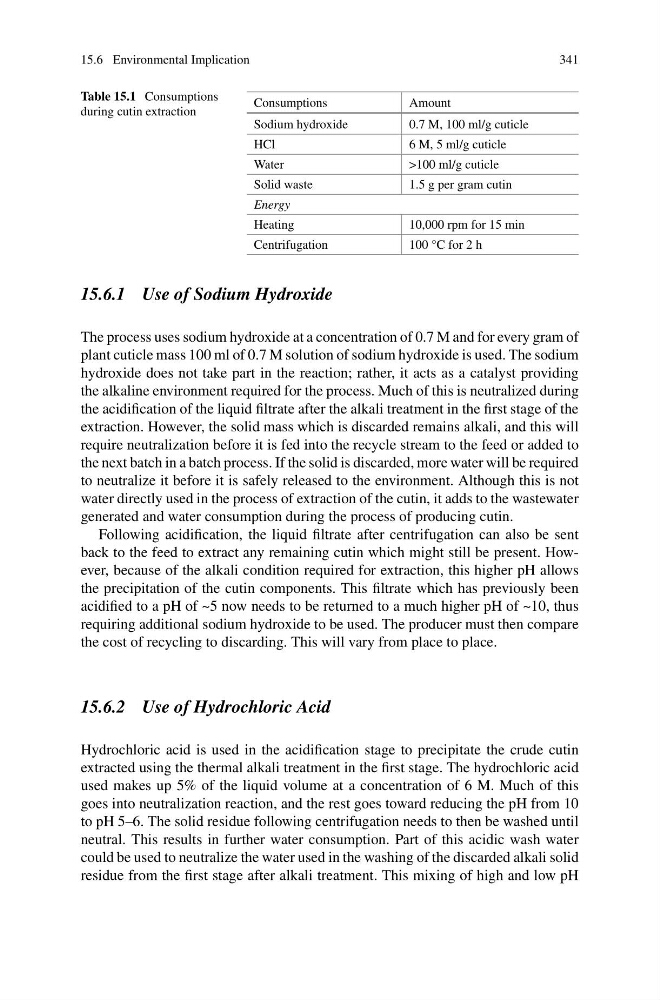
Table 15.1 Consumptions
during cutin extraction
Consumptions
Amount
Sodium hydroxide
0.7 M, 100 ml/g cuticle
HCl
6 M, 5 ml/g cuticle
Water
>100 ml/g cuticle
Solid waste
1.5 g per gram cutin
Energy
Heating
10,000 rpm for 15 min
Centrifugation
100 °C for 2 h
15.6.1 Use of Sodium Hydroxide
The process uses sodium hydroxide at a concentration of 0.7 M and for every gram of
plant cuticle mass 100 ml of 0.7 M solution of sodium hydroxide is used. The sodium
hydroxide does not take part in the reaction; rather, it acts as a catalyst providing
the alkaline environment required for the process. Much of this is neutralized during
the acidification of the liquid filtrate after the alkali treatment in the first stage of the
extraction. However, the solid mass which is discarded remains alkali, and this will
require neutralization before it is fed into the recycle stream to the feed or added to
the next batch in a batch process. If the solid is discarded, more water will be required
to neutralize it before it is safely released to the environment. Although this is not
water directly used in the process of extraction of the cutin, it adds to the wastewater
generated and water consumption during the process of producing cutin.
Following acidification, the liquid filtrate after centrifugation can also be sent
back to the feed to extract any remaining cutin which might still be present. However, because of the alkali condition required for extraction, this higher pH allows
the precipitation of the cutin components. This filtrate which has previously been
acidified to a pH of ~5 now needs to be returned to a much higher pH of ~10, thus
requiring additional sodium hydroxide to be used. The producer must then compare
the cost of recycling to discarding. This will vary from place to place.
15.6.2 Use of Hydrochloric Acid
Hydrochloric acid is used in the acidification stage to precipitate the crude cutin
extracted using the thermal alkali treatment in the first stage. The hydrochloric acid
used makes up 5% of the liquid volume at a concentration of 6 M. Much of this
goes into neutralization reaction, and the rest goes toward reducing the pH from 10
to pH 5–6. The solid residue following centrifugation needs to then be washed until
neutral. This results in further water consumption. Part of this acidic wash water
could be used to neutralize the water used in the washing of the discarded alkali solid
residue from the first stage after alkali treatment. This mixing of high and low pH
341
Table 15.1 Consumptions
during cutin extraction
Consumptions
Amount
Sodium hydroxide
0.7 M, 100 ml/g cuticle
HCl
6 M, 5 ml/g cuticle
Water
>100 ml/g cuticle
Solid waste
1.5 g per gram cutin
Energy
Heating
10,000 rpm for 15 min
Centrifugation
100 °C for 2 h
15.6.1 Use of Sodium Hydroxide
The process uses sodium hydroxide at a concentration of 0.7 M and for every gram of
plant cuticle mass 100 ml of 0.7 M solution of sodium hydroxide is used. The sodium
hydroxide does not take part in the reaction; rather, it acts as a catalyst providing
the alkaline environment required for the process. Much of this is neutralized during
the acidification of the liquid filtrate after the alkali treatment in the first stage of the
extraction. However, the solid mass which is discarded remains alkali, and this will
require neutralization before it is fed into the recycle stream to the feed or added to
the next batch in a batch process. If the solid is discarded, more water will be required
to neutralize it before it is safely released to the environment. Although this is not
water directly used in the process of extraction of the cutin, it adds to the wastewater
generated and water consumption during the process of producing cutin.
Following acidification, the liquid filtrate after centrifugation can also be sent
back to the feed to extract any remaining cutin which might still be present. However, because of the alkali condition required for extraction, this higher pH allows
the precipitation of the cutin components. This filtrate which has previously been
acidified to a pH of ~5 now needs to be returned to a much higher pH of ~10, thus
requiring additional sodium hydroxide to be used. The producer must then compare
the cost of recycling to discarding. This will vary from place to place.
15.6.2 Use of Hydrochloric Acid
Hydrochloric acid is used in the acidification stage to precipitate the crude cutin
extracted using the thermal alkali treatment in the first stage. The hydrochloric acid
used makes up 5% of the liquid volume at a concentration of 6 M. Much of this
goes into neutralization reaction, and the rest goes toward reducing the pH from 10
to pH 5–6. The solid residue following centrifugation needs to then be washed until
neutral. This results in further water consumption. Part of this acidic wash water
could be used to neutralize the water used in the washing of the discarded alkali solid
residue from the first stage after alkali treatment. This mixing of high and low pH