

340
15 Polyesters
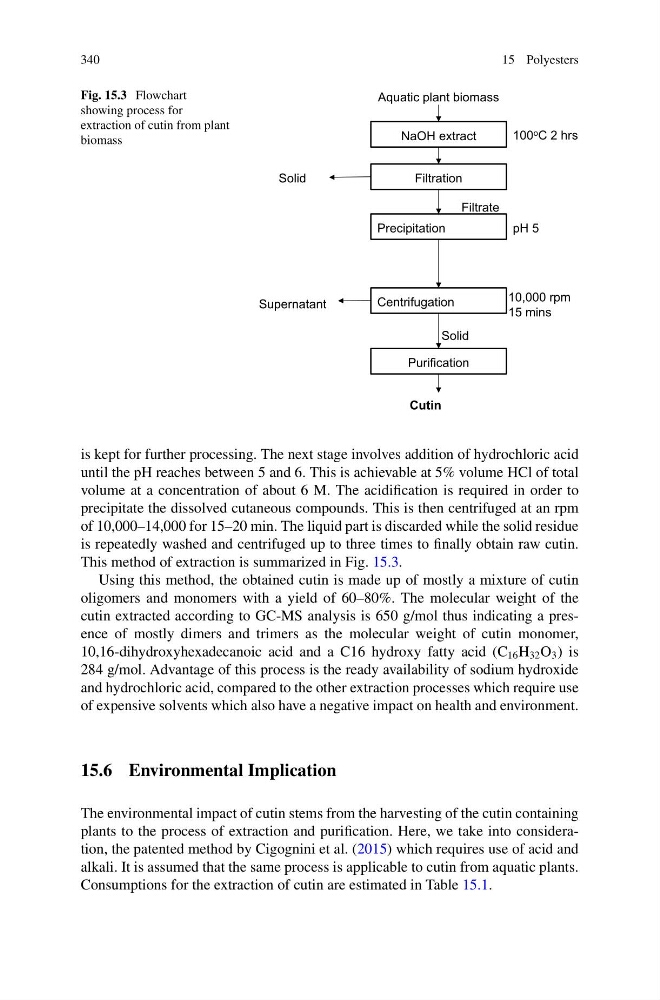
Fig. 15.3 Flowchart
showing process for
extraction of cutin from plant
biomass
Aquatic plant biomass
NaOH extract
Filtration
Precipitation
Centrifugation
Purification
Solid
pH 5
Filtrate
Cutin
Supernatant
Solid
10,000 rpm
15 mins
100 o C 2 hrs
is kept for further processing. The next stage involves addition of hydrochloric acid
until the pH reaches between 5 and 6. This is achievable at 5% volume HCl of total
volume at a concentration of about 6 M. The acidification is required in order to
precipitate the dissolved cutaneous compounds. This is then centrifuged at an rpm
of 10,000–14,000 for 15–20 min. The liquid part is discarded while the solid residue
is repeatedly washed and centrifuged up to three times to finally obtain raw cutin.
This method of extraction is summarized in Fig. 15.3.
Using this method, the obtained cutin is made up of mostly a mixture of cutin
oligomers and monomers with a yield of 60–80%. The molecular weight of the
cutin extracted according to GC-MS analysis is 650 g/mol thus indicating a presence of mostly dimers and trimers as the molecular weight of cutin monomer,
10,16-dihydroxyhexadecanoic acid and a C16 hydroxy fatty acid (C 16 H 32 O 3 ) is
284 g/mol. Advantage of this process is the ready availability of sodium hydroxide
and hydrochloric acid, compared to the other extraction processes which require use
of expensive solvents which also have a negative impact on health and environment.
15.6 Environmental Implication
The environmental impact of cutin stems from the harvesting of the cutin containing
plants to the process of extraction and purification. Here, we take into consideration, the patented method by Cigognini et al. (2015) which requires use of acid and
alkali. It is assumed that the same process is applicable to cutin from aquatic plants.
Consumptions for the extraction of cutin are estimated in Table 15.1.
15 Polyesters
Fig. 15.3 Flowchart
showing process for
extraction of cutin from plant
biomass
Aquatic plant biomass
NaOH extract
Filtration
Precipitation
Centrifugation
Purification
Solid
pH 5
Filtrate
Cutin
Supernatant
Solid
10,000 rpm
15 mins
100 o C 2 hrs
is kept for further processing. The next stage involves addition of hydrochloric acid
until the pH reaches between 5 and 6. This is achievable at 5% volume HCl of total
volume at a concentration of about 6 M. The acidification is required in order to
precipitate the dissolved cutaneous compounds. This is then centrifuged at an rpm
of 10,000–14,000 for 15–20 min. The liquid part is discarded while the solid residue
is repeatedly washed and centrifuged up to three times to finally obtain raw cutin.
This method of extraction is summarized in Fig. 15.3.
Using this method, the obtained cutin is made up of mostly a mixture of cutin
oligomers and monomers with a yield of 60–80%. The molecular weight of the
cutin extracted according to GC-MS analysis is 650 g/mol thus indicating a presence of mostly dimers and trimers as the molecular weight of cutin monomer,
10,16-dihydroxyhexadecanoic acid and a C16 hydroxy fatty acid (C 16 H 32 O 3 ) is
284 g/mol. Advantage of this process is the ready availability of sodium hydroxide
and hydrochloric acid, compared to the other extraction processes which require use
of expensive solvents which also have a negative impact on health and environment.
15.6 Environmental Implication
The environmental impact of cutin stems from the harvesting of the cutin containing
plants to the process of extraction and purification. Here, we take into consideration, the patented method by Cigognini et al. (2015) which requires use of acid and
alkali. It is assumed that the same process is applicable to cutin from aquatic plants.
Consumptions for the extraction of cutin are estimated in Table 15.1.