

314
14 Cellulose
Table 14.2 Cellulose content
is some aquatic plants and
algae
Aquatic resource
Cellulose (%) References
Water hyacinth
25
Thiripura and
Ramesh (2012)
Duckweed
55.2
Yadav et al. (2017)
Azolla
21.8–12.8
Miranda et al. (2016)
Green algae
20–30
Mihranyan (2010)
Red algae (Gelidium
elegans)
17.2
Chen et al. (2016)
Brown algae
(Sargassum
tenerrimum)
11
Siddhanta et al.
(2011)
transportation. Water hyacinth has a higher cellulose content than Azolla. It therefore
is an important aquatic source of cellulose.
Macroalgae cell walls consist of layers of cellulose in relatively large amounts
(Munoz et al. 2014). Green algae Cladophora is a seasonal light-sensitive aquatic
filamentous macroalgae that are submergent aquatic organisms. They bloom in a
variety of temperatures on rough rock surfaces. Brown algae are widely used as
a source of alginate, and the residue from the alginate extraction can be further
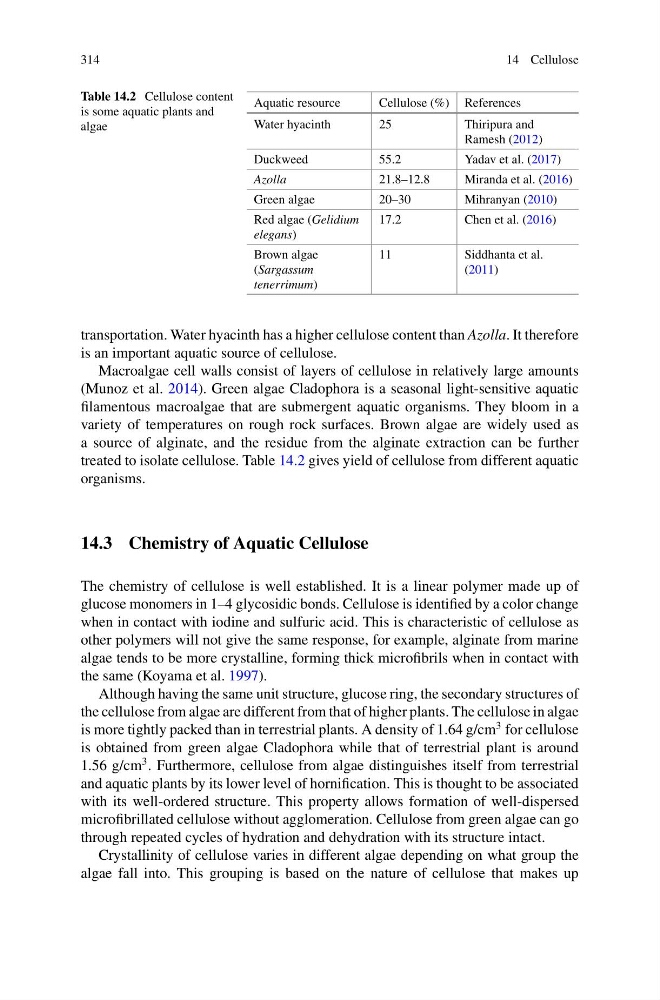
treated to isolate cellulose. Table 14.2 gives yield of cellulose from different aquatic
organisms.
14.3 Chemistry of Aquatic Cellulose
The chemistry of cellulose is well established. It is a linear polymer made up of
glucose monomers in 1–4 glycosidic bonds. Cellulose is identified by a color change
when in contact with iodine and sulfuric acid. This is characteristic of cellulose as
other polymers will not give the same response, for example, alginate from marine
algae tends to be more crystalline, forming thick microfibrils when in contact with
the same (Koyama et al. 1997).
Although having the same unit structure, glucose ring, the secondary structures of
the cellulose from algae are different from that of higher plants. The cellulose in algae
is more tightly packed than in terrestrial plants. A density of 1.64 g/cm
3 for cellulose
is obtained from green algae Cladophora while that of terrestrial plant is around
1.56 g/cm
3 . Furthermore, cellulose from algae distinguishes itself from terrestrial
and aquatic plants by its lower level of hornification. This is thought to be associated
with its well-ordered structure. This property allows formation of well-dispersed
microfibrillated cellulose without agglomeration. Cellulose from green algae can go
through repeated cycles of hydration and dehydration with its structure intact.
Crystallinity of cellulose varies in different algae depending on what group the
algae fall into. This grouping is based on the nature of cellulose that makes up
14 Cellulose
Table 14.2 Cellulose content
is some aquatic plants and
algae
Aquatic resource
Cellulose (%) References
Water hyacinth
25
Thiripura and
Ramesh (2012)
Duckweed
55.2
Yadav et al. (2017)
Azolla
21.8–12.8
Miranda et al. (2016)
Green algae
20–30
Mihranyan (2010)
Red algae (Gelidium
elegans)
17.2
Chen et al. (2016)
Brown algae
(Sargassum
tenerrimum)
11
Siddhanta et al.
(2011)
transportation. Water hyacinth has a higher cellulose content than Azolla. It therefore
is an important aquatic source of cellulose.
Macroalgae cell walls consist of layers of cellulose in relatively large amounts
(Munoz et al. 2014). Green algae Cladophora is a seasonal light-sensitive aquatic
filamentous macroalgae that are submergent aquatic organisms. They bloom in a
variety of temperatures on rough rock surfaces. Brown algae are widely used as
a source of alginate, and the residue from the alginate extraction can be further
treated to isolate cellulose. Table 14.2 gives yield of cellulose from different aquatic
organisms.
14.3 Chemistry of Aquatic Cellulose
The chemistry of cellulose is well established. It is a linear polymer made up of
glucose monomers in 1–4 glycosidic bonds. Cellulose is identified by a color change
when in contact with iodine and sulfuric acid. This is characteristic of cellulose as
other polymers will not give the same response, for example, alginate from marine
algae tends to be more crystalline, forming thick microfibrils when in contact with
the same (Koyama et al. 1997).
Although having the same unit structure, glucose ring, the secondary structures of
the cellulose from algae are different from that of higher plants. The cellulose in algae
is more tightly packed than in terrestrial plants. A density of 1.64 g/cm
3 for cellulose
is obtained from green algae Cladophora while that of terrestrial plant is around
1.56 g/cm
3 . Furthermore, cellulose from algae distinguishes itself from terrestrial
and aquatic plants by its lower level of hornification. This is thought to be associated
with its well-ordered structure. This property allows formation of well-dispersed
microfibrillated cellulose without agglomeration. Cellulose from green algae can go
through repeated cycles of hydration and dehydration with its structure intact.
Crystallinity of cellulose varies in different algae depending on what group the
algae fall into. This grouping is based on the nature of cellulose that makes up