

14.2 Occurrence in Nature
313
wide range of temperature conditions. It required little or no maintenance or care,
is endemic to most parts of the world and therefore occurs in abundance in nature.
Azolla can contain up to 35% cellulose by weight (Miranda et al. 2016), and it has
a symbiotic relationship with nitrogen-fixing bacteria known as Anabaena azollae.
This symbiotic relationship with A. azollae makes it possible for Azolla to grow in
water where nitrogen is not present (Kollah et al. 2016). Two most common Azolla
species are A. filiculoides and A. pinnata, and 7 species of Azolla have been identified.
Azolla has a rather unique composition of cellulose, hemicellulose starch and lipids
which is being explored as a universal biofuel feedstock (Miranda et al. 2016). This
implies that pyrolysis and hydrothermal liquefaction of Azolla biomass could result
in good yield of hydrocarbons, and the transesterification of the lipids would yield
biodiesel while the enzymatic hydrolysis of starch and cellulose would yield sugars
for bioethanol production (Miranda et al. 2016).
Duckweed is relatively well-explored aquatic plants, and they have been used
for over two decades for the remediation of industrial and municipal wastewater in
countries such as the USA, Bangladesh and Israel and in biofuel production. They
grow in slow flowing or stagnant water as floating plant. They grow best in warm
waters where they can grow all year round in some areas. Duckweeds can double in
size within 2–7 days and in as little as 20 h at optimal growth conditions. Duckweeds
have the unique property of being able to accumulate high levels of microelements
and heavy metals from wastewater (Basile et al. 2012). Although starch makes up a
higher percentage by mass in duckweed, they do contain a considerable amount of
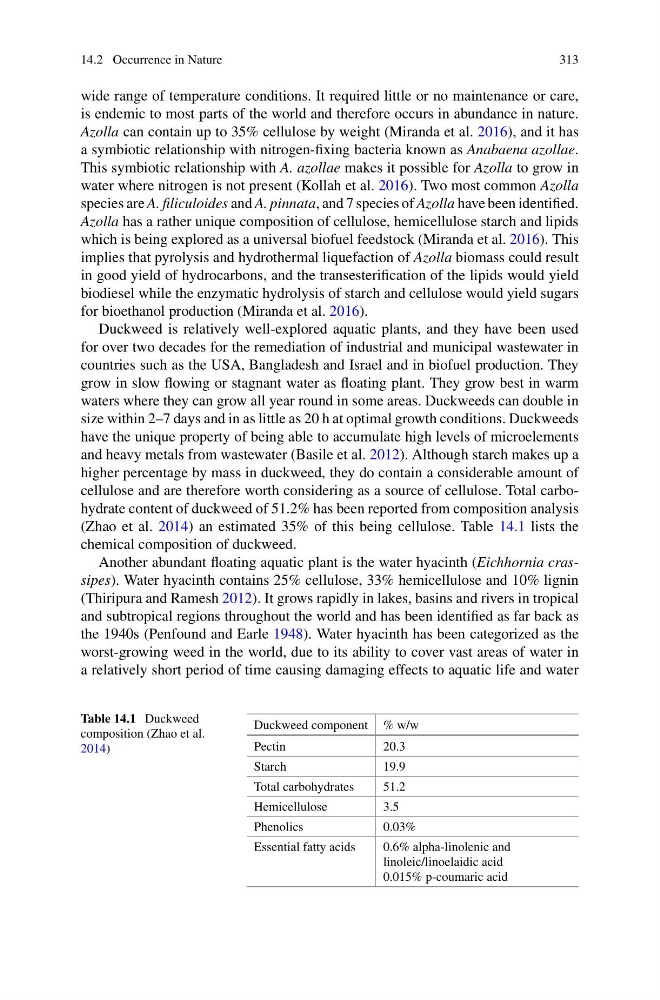
cellulose and are therefore worth considering as a source of cellulose. Total carbohydrate content of duckweed of 51.2% has been reported from composition analysis
(Zhao et al. 2014) an estimated 35% of this being cellulose. Table 14.1 lists the
chemical composition of duckweed.
Another abundant floating aquatic plant is the water hyacinth (Eichhornia crassipes). Water hyacinth contains 25% cellulose, 33% hemicellulose and 10% lignin
(Thiripura and Ramesh 2012). It grows rapidly in lakes, basins and rivers in tropical
and subtropical regions throughout the world and has been identified as far back as
the 1940s (Penfound and Earle 1948). Water hyacinth has been categorized as the
worst-growing weed in the world, due to its ability to cover vast areas of water in
a relatively short period of time causing damaging effects to aquatic life and water
Table 14.1 Duckweed
composition (Zhao et al.
2014)
Duckweed component % w/w
Pectin
20.3
Starch
19.9
Total carbohydrates
51.2
Hemicellulose
3.5
Phenolics
0.03%
Essential fatty acids
0.6% alpha-linolenic and
linoleic/linoelaidic acid
0.015% p-coumaric acid
313
wide range of temperature conditions. It required little or no maintenance or care,
is endemic to most parts of the world and therefore occurs in abundance in nature.
Azolla can contain up to 35% cellulose by weight (Miranda et al. 2016), and it has
a symbiotic relationship with nitrogen-fixing bacteria known as Anabaena azollae.
This symbiotic relationship with A. azollae makes it possible for Azolla to grow in
water where nitrogen is not present (Kollah et al. 2016). Two most common Azolla
species are A. filiculoides and A. pinnata, and 7 species of Azolla have been identified.
Azolla has a rather unique composition of cellulose, hemicellulose starch and lipids
which is being explored as a universal biofuel feedstock (Miranda et al. 2016). This
implies that pyrolysis and hydrothermal liquefaction of Azolla biomass could result
in good yield of hydrocarbons, and the transesterification of the lipids would yield
biodiesel while the enzymatic hydrolysis of starch and cellulose would yield sugars
for bioethanol production (Miranda et al. 2016).
Duckweed is relatively well-explored aquatic plants, and they have been used
for over two decades for the remediation of industrial and municipal wastewater in
countries such as the USA, Bangladesh and Israel and in biofuel production. They
grow in slow flowing or stagnant water as floating plant. They grow best in warm
waters where they can grow all year round in some areas. Duckweeds can double in
size within 2–7 days and in as little as 20 h at optimal growth conditions. Duckweeds
have the unique property of being able to accumulate high levels of microelements
and heavy metals from wastewater (Basile et al. 2012). Although starch makes up a
higher percentage by mass in duckweed, they do contain a considerable amount of
cellulose and are therefore worth considering as a source of cellulose. Total carbohydrate content of duckweed of 51.2% has been reported from composition analysis
(Zhao et al. 2014) an estimated 35% of this being cellulose. Table 14.1 lists the
chemical composition of duckweed.
Another abundant floating aquatic plant is the water hyacinth (Eichhornia crassipes). Water hyacinth contains 25% cellulose, 33% hemicellulose and 10% lignin
(Thiripura and Ramesh 2012). It grows rapidly in lakes, basins and rivers in tropical
and subtropical regions throughout the world and has been identified as far back as
the 1940s (Penfound and Earle 1948). Water hyacinth has been categorized as the
worst-growing weed in the world, due to its ability to cover vast areas of water in
a relatively short period of time causing damaging effects to aquatic life and water
Table 14.1 Duckweed
composition (Zhao et al.
2014)
Duckweed component % w/w
Pectin
20.3
Starch
19.9
Total carbohydrates
51.2
Hemicellulose
3.5
Phenolics
0.03%
Essential fatty acids
0.6% alpha-linolenic and
linoleic/linoelaidic acid
0.015% p-coumaric acid