

11.3 Chemistry of Some Aquatic Enzymes
241
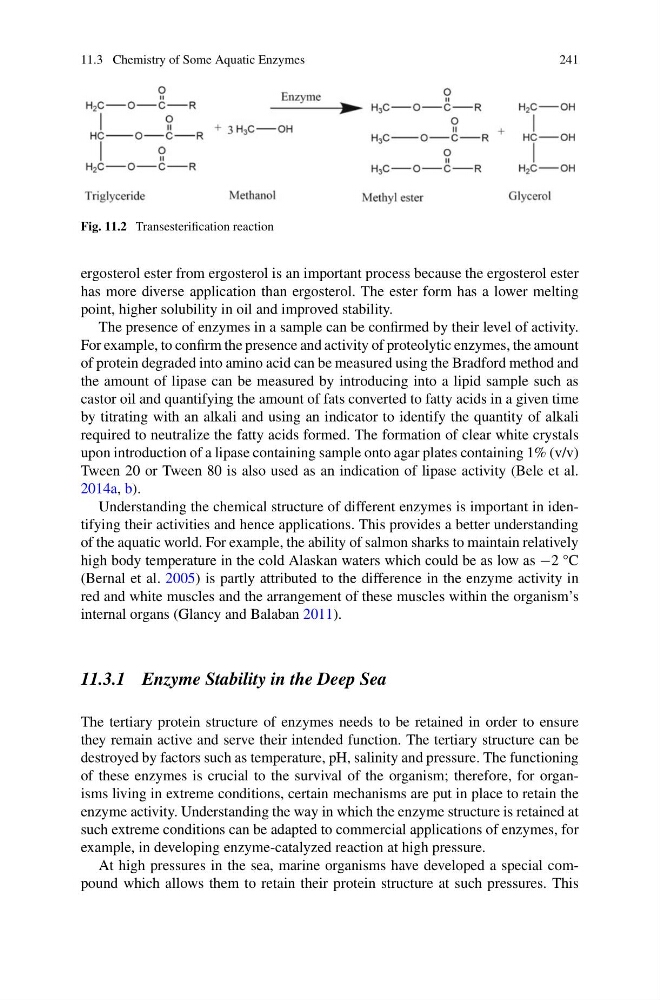
Fig. 11.2 Transesterification reaction
ergosterol ester from ergosterol is an important process because the ergosterol ester
has more diverse application than ergosterol. The ester form has a lower melting
point, higher solubility in oil and improved stability.
The presence of enzymes in a sample can be confirmed by their level of activity.
For example, to confirm the presence and activity of proteolytic enzymes, the amount
of protein degraded into amino acid can be measured using the Bradford method and
the amount of lipase can be measured by introducing into a lipid sample such as
castor oil and quantifying the amount of fats converted to fatty acids in a given time
by titrating with an alkali and using an indicator to identify the quantity of alkali
required to neutralize the fatty acids formed. The formation of clear white crystals
upon introduction of a lipase containing sample onto agar plates containing 1% (v/v)
Tween 20 or Tween 80 is also used as an indication of lipase activity (Bele et al.
2014a, b).
Understanding the chemical structure of different enzymes is important in identifying their activities and hence applications. This provides a better understanding
of the aquatic world. For example, the ability of salmon sharks to maintain relatively
high body temperature in the cold Alaskan waters which could be as low as −2 °C
(Bernal et al. 2005) is partly attributed to the difference in the enzyme activity in
red and white muscles and the arrangement of these muscles within the organism’s
internal organs (Glancy and Balaban 2011).
11.3.1 Enzyme Stability in the Deep Sea
The tertiary protein structure of enzymes needs to be retained in order to ensure
they remain active and serve their intended function. The tertiary structure can be
destroyed by factors such as temperature, pH, salinity and pressure. The functioning
of these enzymes is crucial to the survival of the organism; therefore, for organisms living in extreme conditions, certain mechanisms are put in place to retain the
enzyme activity. Understanding the way in which the enzyme structure is retained at
such extreme conditions can be adapted to commercial applications of enzymes, for
example, in developing enzyme-catalyzed reaction at high pressure.
At high pressures in the sea, marine organisms have developed a special compound which allows them to retain their protein structure at such pressures. This
241
Fig. 11.2 Transesterification reaction
ergosterol ester from ergosterol is an important process because the ergosterol ester
has more diverse application than ergosterol. The ester form has a lower melting
point, higher solubility in oil and improved stability.
The presence of enzymes in a sample can be confirmed by their level of activity.
For example, to confirm the presence and activity of proteolytic enzymes, the amount
of protein degraded into amino acid can be measured using the Bradford method and
the amount of lipase can be measured by introducing into a lipid sample such as
castor oil and quantifying the amount of fats converted to fatty acids in a given time
by titrating with an alkali and using an indicator to identify the quantity of alkali
required to neutralize the fatty acids formed. The formation of clear white crystals
upon introduction of a lipase containing sample onto agar plates containing 1% (v/v)
Tween 20 or Tween 80 is also used as an indication of lipase activity (Bele et al.
2014a, b).
Understanding the chemical structure of different enzymes is important in identifying their activities and hence applications. This provides a better understanding
of the aquatic world. For example, the ability of salmon sharks to maintain relatively
high body temperature in the cold Alaskan waters which could be as low as −2 °C
(Bernal et al. 2005) is partly attributed to the difference in the enzyme activity in
red and white muscles and the arrangement of these muscles within the organism’s
internal organs (Glancy and Balaban 2011).
11.3.1 Enzyme Stability in the Deep Sea
The tertiary protein structure of enzymes needs to be retained in order to ensure
they remain active and serve their intended function. The tertiary structure can be
destroyed by factors such as temperature, pH, salinity and pressure. The functioning
of these enzymes is crucial to the survival of the organism; therefore, for organisms living in extreme conditions, certain mechanisms are put in place to retain the
enzyme activity. Understanding the way in which the enzyme structure is retained at
such extreme conditions can be adapted to commercial applications of enzymes, for
example, in developing enzyme-catalyzed reaction at high pressure.
At high pressures in the sea, marine organisms have developed a special compound which allows them to retain their protein structure at such pressures. This