

240
11 Enzymes
fatty acids, glycerol and monoglycerides, while proteases cleave amide bonds to
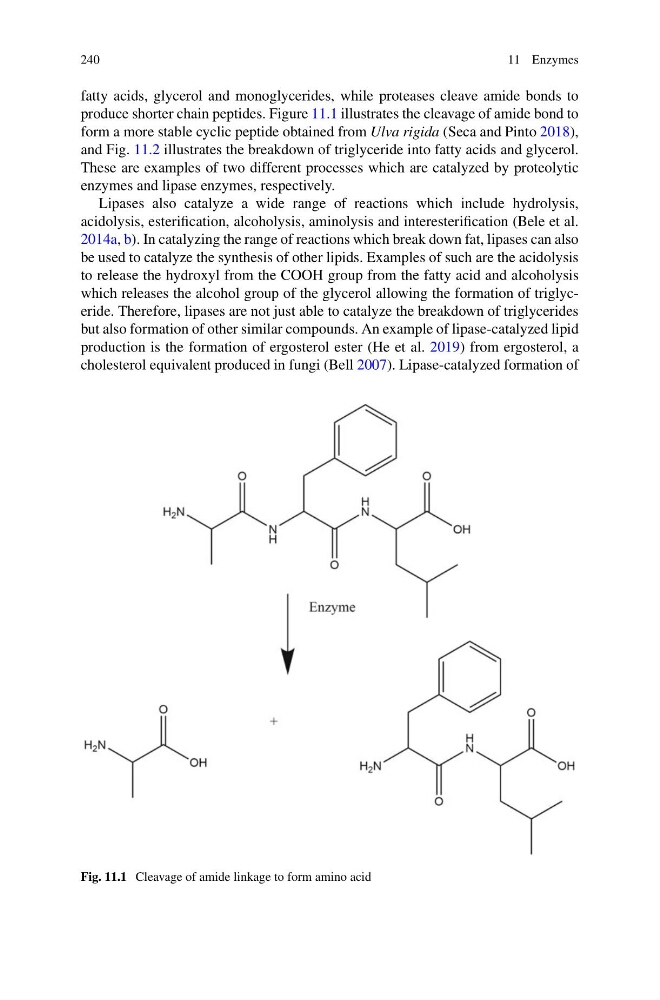
produce shorter chain peptides. Figure 11.1 illustrates the cleavage of amide bond to
form a more stable cyclic peptide obtained from Ulva rigida (Seca and Pinto 2018),
and Fig. 11.2 illustrates the breakdown of triglyceride into fatty acids and glycerol.
These are examples of two different processes which are catalyzed by proteolytic
enzymes and lipase enzymes, respectively.
Lipases also catalyze a wide range of reactions which include hydrolysis,
acidolysis, esterification, alcoholysis, aminolysis and interesterification (Bele et al.
2014a, b). In catalyzing the range of reactions which break down fat, lipases can also
be used to catalyze the synthesis of other lipids. Examples of such are the acidolysis
to release the hydroxyl from the COOH group from the fatty acid and alcoholysis
which releases the alcohol group of the glycerol allowing the formation of triglyceride. Therefore, lipases are not just able to catalyze the breakdown of triglycerides
but also formation of other similar compounds. An example of lipase-catalyzed lipid
production is the formation of ergosterol ester (He et al. 2019) from ergosterol, a
cholesterol equivalent produced in fungi (Bell 2007). Lipase-catalyzed formation of
Fig. 11.1 Cleavage of amide linkage to form amino acid
11 Enzymes
fatty acids, glycerol and monoglycerides, while proteases cleave amide bonds to
produce shorter chain peptides. Figure 11.1 illustrates the cleavage of amide bond to
form a more stable cyclic peptide obtained from Ulva rigida (Seca and Pinto 2018),
and Fig. 11.2 illustrates the breakdown of triglyceride into fatty acids and glycerol.
These are examples of two different processes which are catalyzed by proteolytic
enzymes and lipase enzymes, respectively.
Lipases also catalyze a wide range of reactions which include hydrolysis,
acidolysis, esterification, alcoholysis, aminolysis and interesterification (Bele et al.
2014a, b). In catalyzing the range of reactions which break down fat, lipases can also
be used to catalyze the synthesis of other lipids. Examples of such are the acidolysis
to release the hydroxyl from the COOH group from the fatty acid and alcoholysis
which releases the alcohol group of the glycerol allowing the formation of triglyceride. Therefore, lipases are not just able to catalyze the breakdown of triglycerides
but also formation of other similar compounds. An example of lipase-catalyzed lipid
production is the formation of ergosterol ester (He et al. 2019) from ergosterol, a
cholesterol equivalent produced in fungi (Bell 2007). Lipase-catalyzed formation of
Fig. 11.1 Cleavage of amide linkage to form amino acid