

engineered materials thus produced should also be nontoxic, recyclable, and biodegradable. Albeit NC materials meet these criteria, howbeit, few reports second a low
level of cellulose toxicity under certain experimental conditions, while surface
modification for environmental applications should be addressed with adequate
deliberation, especially if intended for use in drinking water treatment and filtration
(Ogonowski et al. 2018). Tailoring of the surface of NC can be achieved via
physical, chemical, or enzymatic methods. Hydrolase and oxidoreductase enzymes
are often used in the enzymatic surface modification, and this is an environmentally
benign approach (Araújo et al. 2008; Afrin and Karim 2017).
Moreover, the surface can be cationized, anionized, or hydrophobicized
depending on the pollutants in consideration by employing multiple methods,
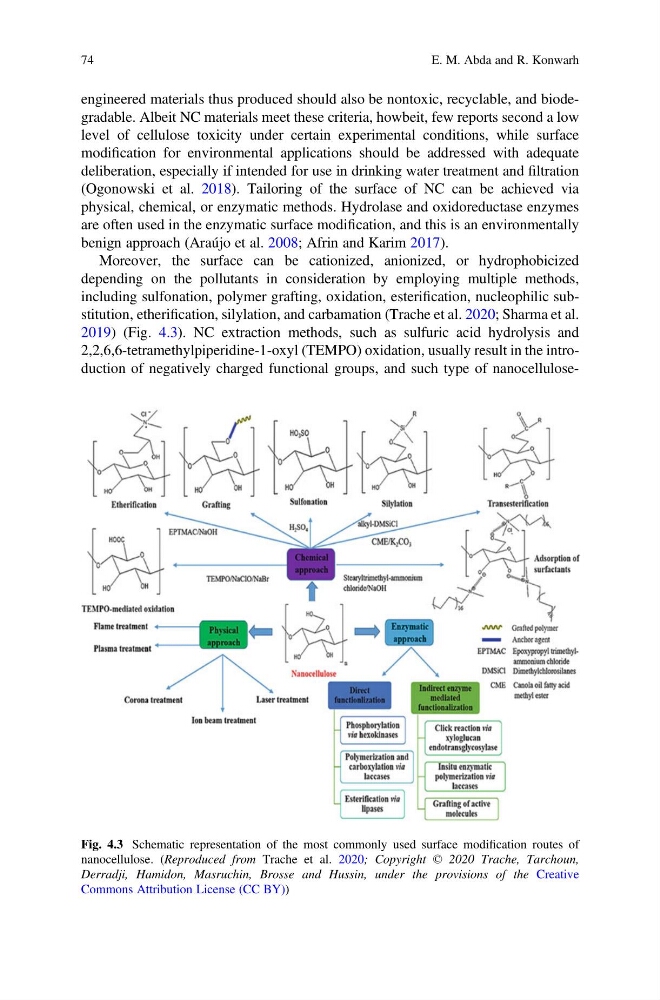
including sulfonation, polymer grafting, oxidation, esterification, nucleophilic substitution, etherification, silylation, and carbamation (Trache et al. 2020; Sharma et al.
2019) (Fig. 4.3). NC extraction methods, such as sulfuric acid hydrolysis and
2,2,6,6-tetramethylpiperidine-1-oxyl (TEMPO) oxidation, usually result in the introduction of negatively charged functional groups, and such type of nanocelluloseFig. 4.3 Schematic representation of the most commonly used surface modification routes of
nanocellulose. (Reproduced from Trache et al. 2020; Copyright © 2020 Trache, Tarchoun,
Derradji, Hamidon, Masruchin, Brosse and Hussin, under the provisions of the Creative
Commons Attribution License (CC BY))
74
E. M. Abda and R. Konwarh
level of cellulose toxicity under certain experimental conditions, while surface
modification for environmental applications should be addressed with adequate
deliberation, especially if intended for use in drinking water treatment and filtration
(Ogonowski et al. 2018). Tailoring of the surface of NC can be achieved via
physical, chemical, or enzymatic methods. Hydrolase and oxidoreductase enzymes
are often used in the enzymatic surface modification, and this is an environmentally
benign approach (Araújo et al. 2008; Afrin and Karim 2017).
Moreover, the surface can be cationized, anionized, or hydrophobicized
depending on the pollutants in consideration by employing multiple methods,
including sulfonation, polymer grafting, oxidation, esterification, nucleophilic substitution, etherification, silylation, and carbamation (Trache et al. 2020; Sharma et al.
2019) (Fig. 4.3). NC extraction methods, such as sulfuric acid hydrolysis and
2,2,6,6-tetramethylpiperidine-1-oxyl (TEMPO) oxidation, usually result in the introduction of negatively charged functional groups, and such type of nanocelluloseFig. 4.3 Schematic representation of the most commonly used surface modification routes of
nanocellulose. (Reproduced from Trache et al. 2020; Copyright © 2020 Trache, Tarchoun,
Derradji, Hamidon, Masruchin, Brosse and Hussin, under the provisions of the Creative
Commons Attribution License (CC BY))
74
E. M. Abda and R. Konwarh