

4 Surface Modification
In the previous sections, we have highlighted the outstanding features of cellulose
and NC. Another feature that has actually catapulted the applications of NC in
environmental remediation by multifold is the amenability for a diverse gamut of
surface modifications. Environmental remediation in the perspective of removal/
treatment of pollutants in wastewater, soil, air, and drinking water requires an
understanding of the behavior of the pollutants: they may be anionic, cationic,
polar, nonpolar, organic or inorganic substances, etc. So, the effective removal of
these pollutants depends on the interaction of these molecules with NC. NC is rich in
hydrophilic OH-group, and thereby, it opens up enough scope for surface modification to facilitate optimal interactions with foreign substances via electrostatic interaction, ion-exchange reaction, hydrophobic interaction, π-π interactions, and
hydrogen bonding (Hokkanen et al. 2016; Zhu et al. 2020; Chakrabarty and
Teramoto 2018; Lombardo and Thielemans 2018). Besides imparting ionic charges
to the surface of NC, surface modification overcomes the problem of aggregation
and enhances compatibility with other polymers. Furthermore, the surface
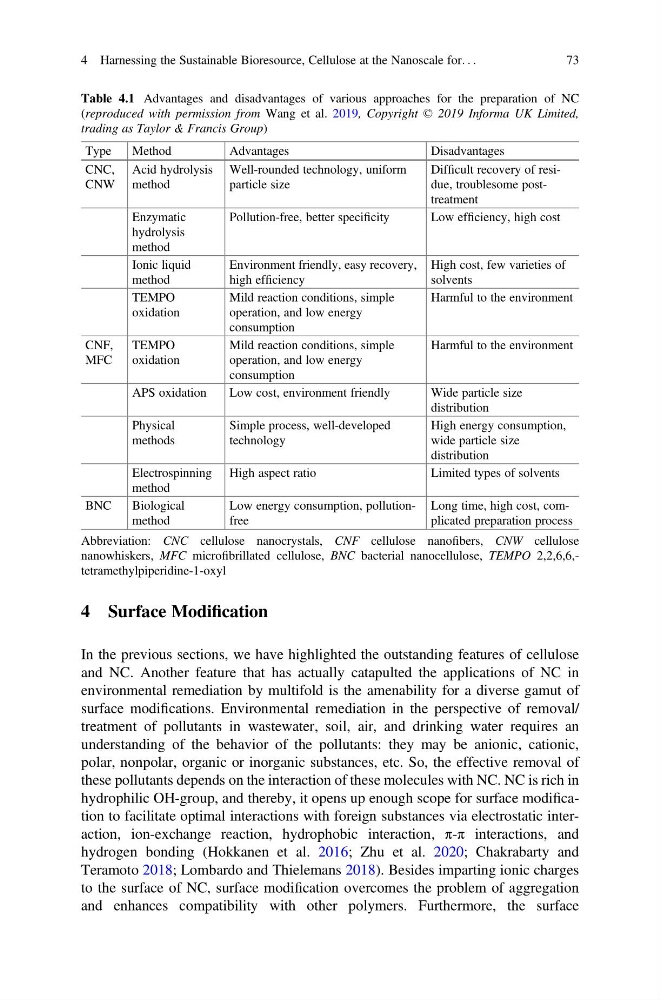
Table 4.1 Advantages and disadvantages of various approaches for the preparation of NC
(reproduced with permission from Wang et al. 2019, Copyright © 2019 Informa UK Limited,
trading as Taylor & Francis Group)
Type
Method
Advantages
Disadvantages
CNC,
CNW
Acid hydrolysis
method
Well-rounded technology, uniform
particle size
Difficult recovery of residue, troublesome posttreatment
Enzymatic
hydrolysis
method
Pollution-free, better specificity
Low efficiency, high cost
Ionic liquid
method
Environment friendly, easy recovery,
high efficiency
High cost, few varieties of
solvents
TEMPO
oxidation
Mild reaction conditions, simple
operation, and low energy
consumption
Harmful to the environment
CNF,
MFC
TEMPO
oxidation
Mild reaction conditions, simple
operation, and low energy
consumption
Harmful to the environment
APS oxidation
Low cost, environment friendly
Wide particle size
distribution
Physical
methods
Simple process, well-developed
technology
High energy consumption,
wide particle size
distribution
Electrospinning
method
High aspect ratio
Limited types of solvents
BNC
Biological
method
Low energy consumption, pollutionfree
Long time, high cost, complicated preparation process
Abbreviation: CNC cellulose nanocrystals, CNF cellulose nanofibers, CNW cellulose
nanowhiskers, MFC microfibrillated cellulose, BNC bacterial nanocellulose, TEMPO 2,2,6,6,tetramethylpiperidine-1-oxyl
4 Harnessing the Sustainable Bioresource, Cellulose at the Nanoscale for. . .
73
In the previous sections, we have highlighted the outstanding features of cellulose
and NC. Another feature that has actually catapulted the applications of NC in
environmental remediation by multifold is the amenability for a diverse gamut of
surface modifications. Environmental remediation in the perspective of removal/
treatment of pollutants in wastewater, soil, air, and drinking water requires an
understanding of the behavior of the pollutants: they may be anionic, cationic,
polar, nonpolar, organic or inorganic substances, etc. So, the effective removal of
these pollutants depends on the interaction of these molecules with NC. NC is rich in
hydrophilic OH-group, and thereby, it opens up enough scope for surface modification to facilitate optimal interactions with foreign substances via electrostatic interaction, ion-exchange reaction, hydrophobic interaction, π-π interactions, and
hydrogen bonding (Hokkanen et al. 2016; Zhu et al. 2020; Chakrabarty and
Teramoto 2018; Lombardo and Thielemans 2018). Besides imparting ionic charges
to the surface of NC, surface modification overcomes the problem of aggregation
and enhances compatibility with other polymers. Furthermore, the surface
Table 4.1 Advantages and disadvantages of various approaches for the preparation of NC
(reproduced with permission from Wang et al. 2019, Copyright © 2019 Informa UK Limited,
trading as Taylor & Francis Group)
Type
Method
Advantages
Disadvantages
CNC,
CNW
Acid hydrolysis
method
Well-rounded technology, uniform
particle size
Difficult recovery of residue, troublesome posttreatment
Enzymatic
hydrolysis
method
Pollution-free, better specificity
Low efficiency, high cost
Ionic liquid
method
Environment friendly, easy recovery,
high efficiency
High cost, few varieties of
solvents
TEMPO
oxidation
Mild reaction conditions, simple
operation, and low energy
consumption
Harmful to the environment
CNF,
MFC
TEMPO
oxidation
Mild reaction conditions, simple
operation, and low energy
consumption
Harmful to the environment
APS oxidation
Low cost, environment friendly
Wide particle size
distribution
Physical
methods
Simple process, well-developed
technology
High energy consumption,
wide particle size
distribution
Electrospinning
method
High aspect ratio
Limited types of solvents
BNC
Biological
method
Low energy consumption, pollutionfree
Long time, high cost, complicated preparation process
Abbreviation: CNC cellulose nanocrystals, CNF cellulose nanofibers, CNW cellulose
nanowhiskers, MFC microfibrillated cellulose, BNC bacterial nanocellulose, TEMPO 2,2,6,6,tetramethylpiperidine-1-oxyl
4 Harnessing the Sustainable Bioresource, Cellulose at the Nanoscale for. . .
73