

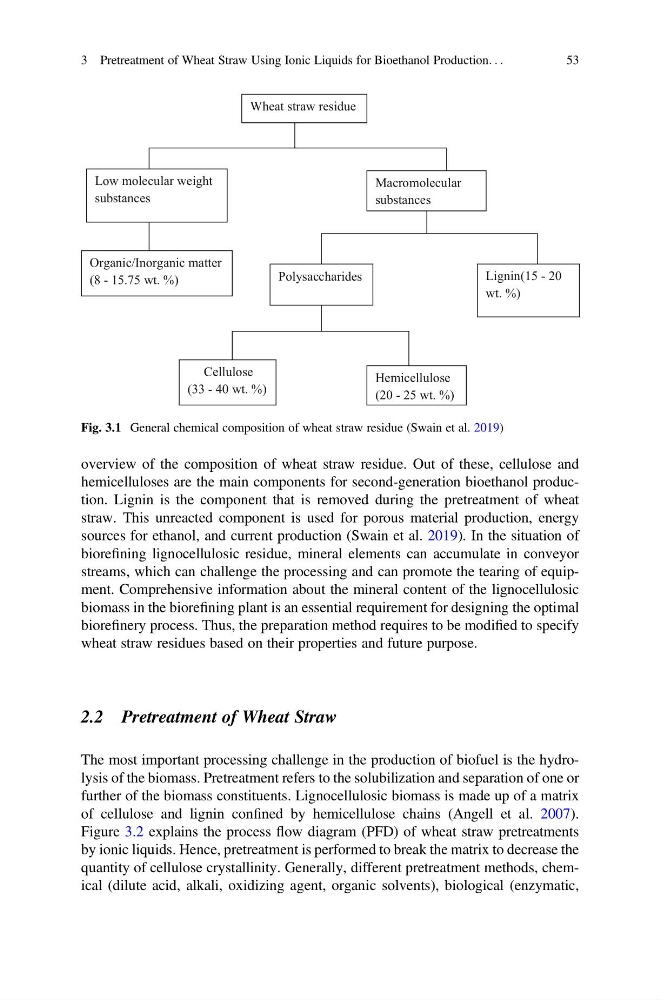
overview of the composition of wheat straw residue. Out of these, cellulose and
hemicelluloses are the main components for second-generation bioethanol production. Lignin is the component that is removed during the pretreatment of wheat
straw. This unreacted component is used for porous material production, energy
sources for ethanol, and current production (Swain et al. 2019). In the situation of
biorefining lignocellulosic residue, mineral elements can accumulate in conveyor
streams, which can challenge the processing and can promote the tearing of equipment. Comprehensive information about the mineral content of the lignocellulosic
biomass in the biorefining plant is an essential requirement for designing the optimal
biorefinery process. Thus, the preparation method requires to be modified to specify
wheat straw residues based on their properties and future purpose.
2.2 Pretreatment of Wheat Straw
The most important processing challenge in the production of biofuel is the hydrolysis of the biomass. Pretreatment refers to the solubilization and separation of one or
further of the biomass constituents. Lignocellulosic biomass is made up of a matrix
of cellulose and lignin confined by hemicellulose chains (Angell et al. 2007).
Figure 3.2 explains the process flow diagram (PFD) of wheat straw pretreatments
by ionic liquids. Hence, pretreatment is performed to break the matrix to decrease the
quantity of cellulose crystallinity. Generally, different pretreatment methods, chemical (dilute acid, alkali, oxidizing agent, organic solvents), biological (enzymatic,
Wheat straw residue
Macromolecular
substances
Lignin(15 - 20
wt. %)
Polysaccharides
Cellulose
(33 - 40 wt. %)
Hemicellulose
(20 - 25 wt. %)
Low molecular weight
substances
Organic/Inorganic matter
(8 - 15.75 wt. %)
Fig. 3.1 General chemical composition of wheat straw residue (Swain et al. 2019)
3 Pretreatment of Wheat Straw Using Ionic Liquids for Bioethanol Production. . .
53
hemicelluloses are the main components for second-generation bioethanol production. Lignin is the component that is removed during the pretreatment of wheat
straw. This unreacted component is used for porous material production, energy
sources for ethanol, and current production (Swain et al. 2019). In the situation of
biorefining lignocellulosic residue, mineral elements can accumulate in conveyor
streams, which can challenge the processing and can promote the tearing of equipment. Comprehensive information about the mineral content of the lignocellulosic
biomass in the biorefining plant is an essential requirement for designing the optimal
biorefinery process. Thus, the preparation method requires to be modified to specify
wheat straw residues based on their properties and future purpose.
2.2 Pretreatment of Wheat Straw
The most important processing challenge in the production of biofuel is the hydrolysis of the biomass. Pretreatment refers to the solubilization and separation of one or
further of the biomass constituents. Lignocellulosic biomass is made up of a matrix
of cellulose and lignin confined by hemicellulose chains (Angell et al. 2007).
Figure 3.2 explains the process flow diagram (PFD) of wheat straw pretreatments
by ionic liquids. Hence, pretreatment is performed to break the matrix to decrease the
quantity of cellulose crystallinity. Generally, different pretreatment methods, chemical (dilute acid, alkali, oxidizing agent, organic solvents), biological (enzymatic,
Wheat straw residue
Macromolecular
substances
Lignin(15 - 20
wt. %)
Polysaccharides
Cellulose
(33 - 40 wt. %)
Hemicellulose
(20 - 25 wt. %)
Low molecular weight
substances
Organic/Inorganic matter
(8 - 15.75 wt. %)
Fig. 3.1 General chemical composition of wheat straw residue (Swain et al. 2019)
3 Pretreatment of Wheat Straw Using Ionic Liquids for Bioethanol Production. . .
53