

2.5 Hairy Roots in Other Environmental Applications
In view of the increased demand for SMs, particularly as drug precursors, there is a
need to develop new strategies for production. Production of genetically stable
HRCs from many plant species has opened up the possibilities for fundamental
studies and a lot of feasible applications of biotechnology. Since the main obstacle
with in vitro cell cultures is that the transformants are genetically unstable from
generation to generation, tend to produce low yields of SM and time-consuming
process (Giri and Narasu 2000). HRCs importance for SMs in pharmaceutical,
cosmetics, and various fields is increased. In this respect, hairy or transformed root
cultures have plenty of advantages compared to the normal ones such as genetic and
biochemical stability and need only regular media (Pitta–Alvarez et al. 2000). The
SMs formed by HRCs are the same as those usually synthesized in mother plants
with a higher yield (Karuppusamy 2009). Many reports are available on the importance of HRCs in SMs production and other applications (Boobalan and
Kamalanathan 2020; Makhzoum et al. 2013; Moola and Diana 2019; Shi et al.
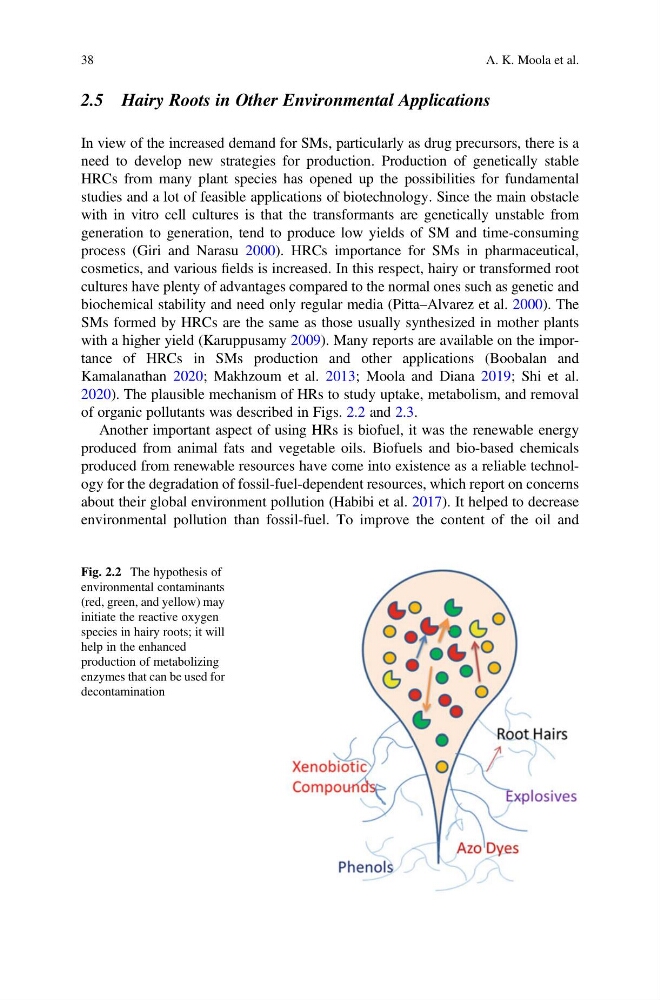
2020). The plausible mechanism of HRs to study uptake, metabolism, and removal
of organic pollutants was described in Figs. 2.2 and 2.3.
Another important aspect of using HRs is biofuel, it was the renewable energy
produced from animal fats and vegetable oils. Biofuels and bio-based chemicals
produced from renewable resources have come into existence as a reliable technology for the degradation of fossil-fuel-dependent resources, which report on concerns
about their global environment pollution (Habibi et al. 2017). It helped to decrease
environmental pollution than fossil-fuel. To improve the content of the oil and
Fig. 2.2 The hypothesis of
environmental contaminants
(red, green, and yellow) may
initiate the reactive oxygen
species in hairy roots; it will
help in the enhanced
production of metabolizing
enzymes that can be used for
decontamination
38
A. K. Moola et al.
In view of the increased demand for SMs, particularly as drug precursors, there is a
need to develop new strategies for production. Production of genetically stable
HRCs from many plant species has opened up the possibilities for fundamental
studies and a lot of feasible applications of biotechnology. Since the main obstacle
with in vitro cell cultures is that the transformants are genetically unstable from
generation to generation, tend to produce low yields of SM and time-consuming
process (Giri and Narasu 2000). HRCs importance for SMs in pharmaceutical,
cosmetics, and various fields is increased. In this respect, hairy or transformed root
cultures have plenty of advantages compared to the normal ones such as genetic and
biochemical stability and need only regular media (Pitta–Alvarez et al. 2000). The
SMs formed by HRCs are the same as those usually synthesized in mother plants
with a higher yield (Karuppusamy 2009). Many reports are available on the importance of HRCs in SMs production and other applications (Boobalan and
Kamalanathan 2020; Makhzoum et al. 2013; Moola and Diana 2019; Shi et al.
2020). The plausible mechanism of HRs to study uptake, metabolism, and removal
of organic pollutants was described in Figs. 2.2 and 2.3.
Another important aspect of using HRs is biofuel, it was the renewable energy
produced from animal fats and vegetable oils. Biofuels and bio-based chemicals
produced from renewable resources have come into existence as a reliable technology for the degradation of fossil-fuel-dependent resources, which report on concerns
about their global environment pollution (Habibi et al. 2017). It helped to decrease
environmental pollution than fossil-fuel. To improve the content of the oil and
Fig. 2.2 The hypothesis of
environmental contaminants
(red, green, and yellow) may
initiate the reactive oxygen
species in hairy roots; it will
help in the enhanced
production of metabolizing
enzymes that can be used for
decontamination
38
A. K. Moola et al.