

melanogaster model insect and RNA interference pathway genes were also identified
for all insects within highly variable environmental RNAi (Cooper et al. 2019).
Insect Control Through HIGS (Host-Induced Gene Silencing)
Different transgenic crops express dsRNAs with homology to genes encoding
pathogenicity of, viruses, fungi, bacteria oomycetes, insects nematodes, and (Cai
et al. 2018; Rosa et al. 2018). The double-stranded RNAs are synthesized via the
host plant and finally perform in the target organism as a host-induced gene silencing
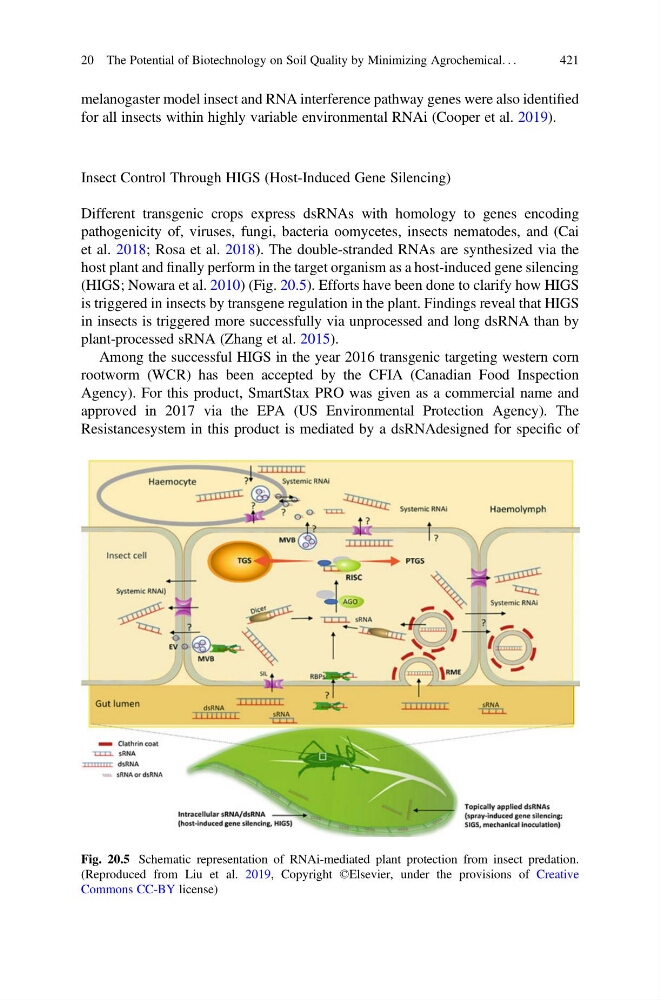
(HIGS; Nowara et al. 2010) (Fig. 20.5). Efforts have been done to clarify how HIGS
is triggered in insects by transgene regulation in the plant. Findings reveal that HIGS
in insects is triggered more successfully via unprocessed and long dsRNA than by
plant-processed sRNA (Zhang et al. 2015).
Among the successful HIGS in the year 2016 transgenic targeting western corn
rootworm (WCR) has been accepted by the CFIA (Canadian Food Inspection
Agency). For this product, SmartStax PRO was given as a commercial name and
approved in 2017 via the EPA (US Environmental Protection Agency). The
Resistancesystem in this product is mediated by a dsRNAdesigned for specific of
Fig. 20.5 Schematic representation of RNAi-mediated plant protection from insect predation.
(Reproduced from Liu et al. 2019, Copyright ©Elsevier, under the provisions of Creative
Commons CC-BY license)
20 The Potential of Biotechnology on Soil Quality by Minimizing Agrochemical. . .
421
for all insects within highly variable environmental RNAi (Cooper et al. 2019).
Insect Control Through HIGS (Host-Induced Gene Silencing)
Different transgenic crops express dsRNAs with homology to genes encoding
pathogenicity of, viruses, fungi, bacteria oomycetes, insects nematodes, and (Cai
et al. 2018; Rosa et al. 2018). The double-stranded RNAs are synthesized via the
host plant and finally perform in the target organism as a host-induced gene silencing
(HIGS; Nowara et al. 2010) (Fig. 20.5). Efforts have been done to clarify how HIGS
is triggered in insects by transgene regulation in the plant. Findings reveal that HIGS
in insects is triggered more successfully via unprocessed and long dsRNA than by
plant-processed sRNA (Zhang et al. 2015).
Among the successful HIGS in the year 2016 transgenic targeting western corn
rootworm (WCR) has been accepted by the CFIA (Canadian Food Inspection
Agency). For this product, SmartStax PRO was given as a commercial name and
approved in 2017 via the EPA (US Environmental Protection Agency). The
Resistancesystem in this product is mediated by a dsRNAdesigned for specific of
Fig. 20.5 Schematic representation of RNAi-mediated plant protection from insect predation.
(Reproduced from Liu et al. 2019, Copyright ©Elsevier, under the provisions of Creative
Commons CC-BY license)
20 The Potential of Biotechnology on Soil Quality by Minimizing Agrochemical. . .
421