

oxidizing Fe
2+ and S
. Furthermore, Fe
3+ and H 2 SO 4 are used to dissolve Cu
2+ from
the chalcopyrite. No additional electron donors are required. Also, these processes
can be mediated using a pure or mixed culture of microbes that can exploit both S
and Fe
2+ . In the bioleaching of vanadium from spent catalyst, vanadium is in the
form of a metal oxide. Wang et al. (2018) observed that the influence of the ironmediated mechanism was pointedly low in vanadium bioleaching. Due to the
possibility of thermodynamic interaction, Cu
may react with H
+ and Fe
3+ . However, the efficiency of Cu bioleaching under an iron-mediated pathway was much
higher than that of the sulfur-mediated pathway. Another study, carried out by Wang
et al. (2016), showed that a mixed pathway was not particularly effective for the
dissolution of Cu
.
Consequently, prior to metal bioleaching from e-waste, the properties and composition of each type of e-waste and the target metals to be leached should be
investigated (Haanela and Johnson 2014). These prerequisite studies help to understand the process and choose appropriate bioleaching pathway (Urbieta et al. 2015;
Liang et al. 2012). This is especially true of non-acidophilic microorganisms which
utilize organic carbon as an energy source but can mobilize some metals from
e-waste. For an instance, HCN-forming microbes can mobilize Ag as [Ag(CN) 2 ]
from PCB (Chen et al. 2011).
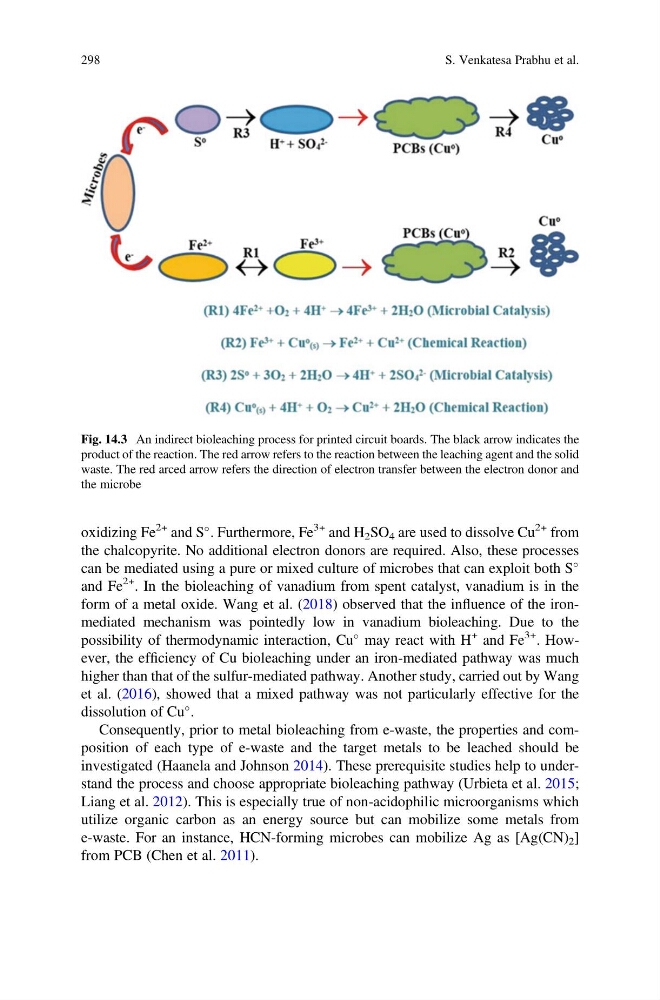
Fig. 14.3 An indirect bioleaching process for printed circuit boards. The black arrow indicates the
product of the reaction. The red arrow refers to the reaction between the leaching agent and the solid
waste. The red arced arrow refers the direction of electron transfer between the electron donor and
the microbe
298
S. Venkatesa Prabhu et al.
2+ and S
. Furthermore, Fe
3+ and H 2 SO 4 are used to dissolve Cu
2+ from
the chalcopyrite. No additional electron donors are required. Also, these processes
can be mediated using a pure or mixed culture of microbes that can exploit both S
and Fe
2+ . In the bioleaching of vanadium from spent catalyst, vanadium is in the
form of a metal oxide. Wang et al. (2018) observed that the influence of the ironmediated mechanism was pointedly low in vanadium bioleaching. Due to the
possibility of thermodynamic interaction, Cu
may react with H
+ and Fe
3+ . However, the efficiency of Cu bioleaching under an iron-mediated pathway was much
higher than that of the sulfur-mediated pathway. Another study, carried out by Wang
et al. (2016), showed that a mixed pathway was not particularly effective for the
dissolution of Cu
.
Consequently, prior to metal bioleaching from e-waste, the properties and composition of each type of e-waste and the target metals to be leached should be
investigated (Haanela and Johnson 2014). These prerequisite studies help to understand the process and choose appropriate bioleaching pathway (Urbieta et al. 2015;
Liang et al. 2012). This is especially true of non-acidophilic microorganisms which
utilize organic carbon as an energy source but can mobilize some metals from
e-waste. For an instance, HCN-forming microbes can mobilize Ag as [Ag(CN) 2 ]
from PCB (Chen et al. 2011).
Fig. 14.3 An indirect bioleaching process for printed circuit boards. The black arrow indicates the
product of the reaction. The red arrow refers to the reaction between the leaching agent and the solid
waste. The red arced arrow refers the direction of electron transfer between the electron donor and
the microbe
298
S. Venkatesa Prabhu et al.