

(Marhual et al. 2008). Formation of an organic film of extracellular polymeric
substances (EPS) has a significant influence on mineral-microbe interactions in
mediating the reaction between the microorganisms and the surfaces of minerals
(Bryner and Anderson 1957). The primary constituents in the EPS are proteins,
sugars, redox-active components, and lipids (Elbehti et al. 2000). However, additional research is still required to better understand the direct mechanism for
bioleaching (Huo et al. 2015).
In indirect mechanisms of bioleaching, three bioleaching pathways are considered. Indirect bioleaching toward a S-mediated reaction can be accomplished by the
oxidation of reduced sulfur catalyzed using sulfur-oxidizing autotrophs or S- and
Fe-oxidizing autotrophs to produce sulfuric acid. This results in media acidification
producing solubilization of the metals present in e-waste (Gan et al. 2015; Appia
et al. 1999). The indirect mechanism, mediated by Fe, includes two steps. In the first
step, soluble ferrous iron (Fe
2+ ) present in the reaction medium serves as an electron
donor by oxidizing it to ferric iron (Fe
3+ ). This is catalyzed by Fe-oxidizing
autotrophs or Fe- and S-oxidizing autotrophs. In the second step, the solid metals
are then oxidized by liberated electrons that leads to solubilization. In a mixed
bioleaching mechanism, ferrous iron and reduced sulfur act as electron donors.
Wang et al. (2009) reported that the synergistic influence of Fe-oxidizing and
S-oxidizing autotrophs together has been found quite effective compared to that of
the Fe- or S-oxidizing autotrophs alone in bioleaching process. This approach
focused on leaching elemental copper (Cu
) from printed circuit boards (PCBs).
Various metals exist in different forms in numerous types of e-waste. For instance,
copper is present in PCBs in the form of Cu
, and indium is found in liquid crystal
displays (LCD) as metal oxides (Vlasceanu et al. 2000; Baker and Dopson 2007).
Some researchers speculated that the metals in various forms should have different
ideal bioleaching pathways. Cu
recovery from PCBs is the best example (Fig. 14.3).
In the case of chalcopyrite bioleaching, chalcopyrite is partially dissolved by chemical means at a low pH. Acidophilic autotrophs generate Fe
3+ and H 2 SO 4 by
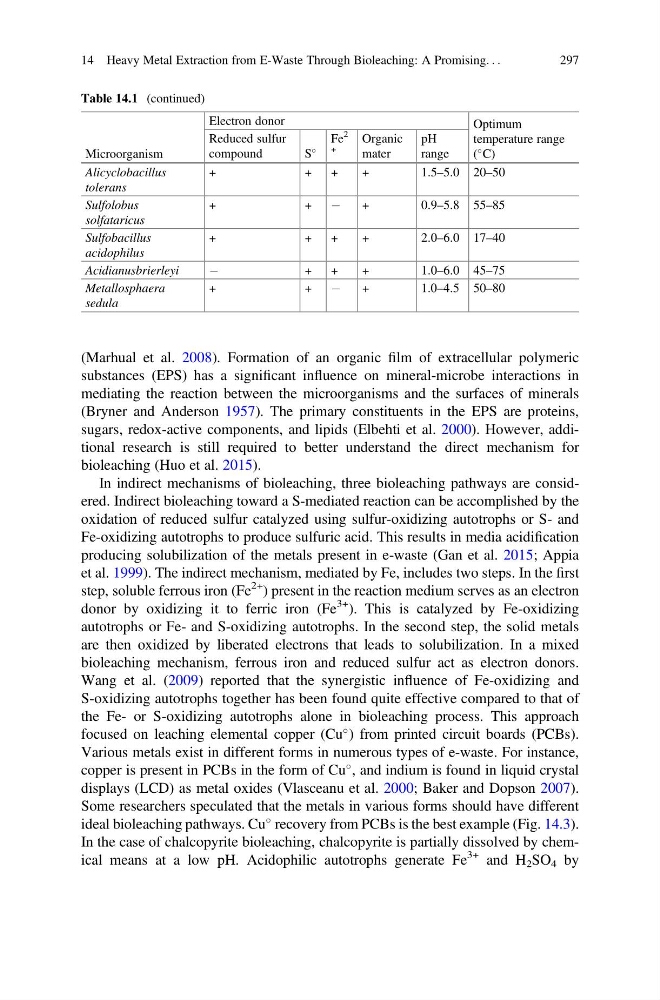
Table 14.1 (continued)
Microorganism
Electron donor
Optimum
temperature range
(
C)
Reduced sulfur
compound
S
Fe
2
+
Organic
mater
pH
range
Alicyclobacillus
tolerans
+
+ +
+
1.5–5.0 20–50
Sulfolobus
solfataricus
+
+ À
+
0.9–5.8 55–85
Sulfobacillus
acidophilus
+
+ +
+
2.0–6.0 17–40
Acidianusbrierleyi
À
+ +
+
1.0–6.0 45–75
Metallosphaera
sedula
+
+ À
+
1.0–4.5 50–80
14 Heavy Metal Extraction from E-Waste Through Bioleaching: A Promising. . .
297
substances (EPS) has a significant influence on mineral-microbe interactions in
mediating the reaction between the microorganisms and the surfaces of minerals
(Bryner and Anderson 1957). The primary constituents in the EPS are proteins,
sugars, redox-active components, and lipids (Elbehti et al. 2000). However, additional research is still required to better understand the direct mechanism for
bioleaching (Huo et al. 2015).
In indirect mechanisms of bioleaching, three bioleaching pathways are considered. Indirect bioleaching toward a S-mediated reaction can be accomplished by the
oxidation of reduced sulfur catalyzed using sulfur-oxidizing autotrophs or S- and
Fe-oxidizing autotrophs to produce sulfuric acid. This results in media acidification
producing solubilization of the metals present in e-waste (Gan et al. 2015; Appia
et al. 1999). The indirect mechanism, mediated by Fe, includes two steps. In the first
step, soluble ferrous iron (Fe
2+ ) present in the reaction medium serves as an electron
donor by oxidizing it to ferric iron (Fe
3+ ). This is catalyzed by Fe-oxidizing
autotrophs or Fe- and S-oxidizing autotrophs. In the second step, the solid metals
are then oxidized by liberated electrons that leads to solubilization. In a mixed
bioleaching mechanism, ferrous iron and reduced sulfur act as electron donors.
Wang et al. (2009) reported that the synergistic influence of Fe-oxidizing and
S-oxidizing autotrophs together has been found quite effective compared to that of
the Fe- or S-oxidizing autotrophs alone in bioleaching process. This approach
focused on leaching elemental copper (Cu
) from printed circuit boards (PCBs).
Various metals exist in different forms in numerous types of e-waste. For instance,
copper is present in PCBs in the form of Cu
, and indium is found in liquid crystal
displays (LCD) as metal oxides (Vlasceanu et al. 2000; Baker and Dopson 2007).
Some researchers speculated that the metals in various forms should have different
ideal bioleaching pathways. Cu
recovery from PCBs is the best example (Fig. 14.3).
In the case of chalcopyrite bioleaching, chalcopyrite is partially dissolved by chemical means at a low pH. Acidophilic autotrophs generate Fe
3+ and H 2 SO 4 by
Table 14.1 (continued)
Microorganism
Electron donor
Optimum
temperature range
(
C)
Reduced sulfur
compound
S
Fe
2
+
Organic
mater
pH
range
Alicyclobacillus
tolerans
+
+ +
+
1.5–5.0 20–50
Sulfolobus
solfataricus
+
+ À
+
0.9–5.8 55–85
Sulfobacillus
acidophilus
+
+ +
+
2.0–6.0 17–40
Acidianusbrierleyi
À
+ +
+
1.0–6.0 45–75
Metallosphaera
sedula
+
+ À
+
1.0–4.5 50–80
14 Heavy Metal Extraction from E-Waste Through Bioleaching: A Promising. . .
297