

symmetric vibrational COOÀ frequencies (plausibly attributed to that of terminal
amino acid) was noted (Lin et al. 2005). Also Han et al. (2007, 2008) had proposed
the participation of the carboxylate group in complexation and sequestration of Cr
(III), generated post bio-reduction of Cr(VI) by the microalgal isolate, Chlorella
miniata. The peaks at 1260 and 1034 cm
À1 corresponded to P¼O and C–O bonds of
polysaccharides, respectively (Benning et al. 2004). The role of C–O bond in
microalgal polysaccharides for biosorption of chromium (Han et al. 2007, 2008)
and grape-stalk lignin for adsorption of copper and nickel ions (Villaescusa et al.
2004) have proposed previously. Post Cr(VI) treatment, the intensity of the peak in
the region 3200–3500 cm
À1 appeared augmented, suggesting a rise in the number of
the free hydroxyl groups on the microalgal biomass. This perhaps bracketed together
with the possible hydrolysis of the microalgal polysaccharides to smaller saccharides
(oligo-, di-, mono-saccharides) due to the low pH used in the protocol (Han et al.
2007). Furthermore, the appearance of a new peak at 944 cm
À1 in the spectrum for
metal treated biomass was indicative of the presence of metal–O bond (Holman et al.
1999). The FTIR spectra were indicative of the complexation of the heavy metal
with electronegative functional groups of amino, carboxyl, hydroxyl, and carbonyl
groups in the microalgal biosorbents.
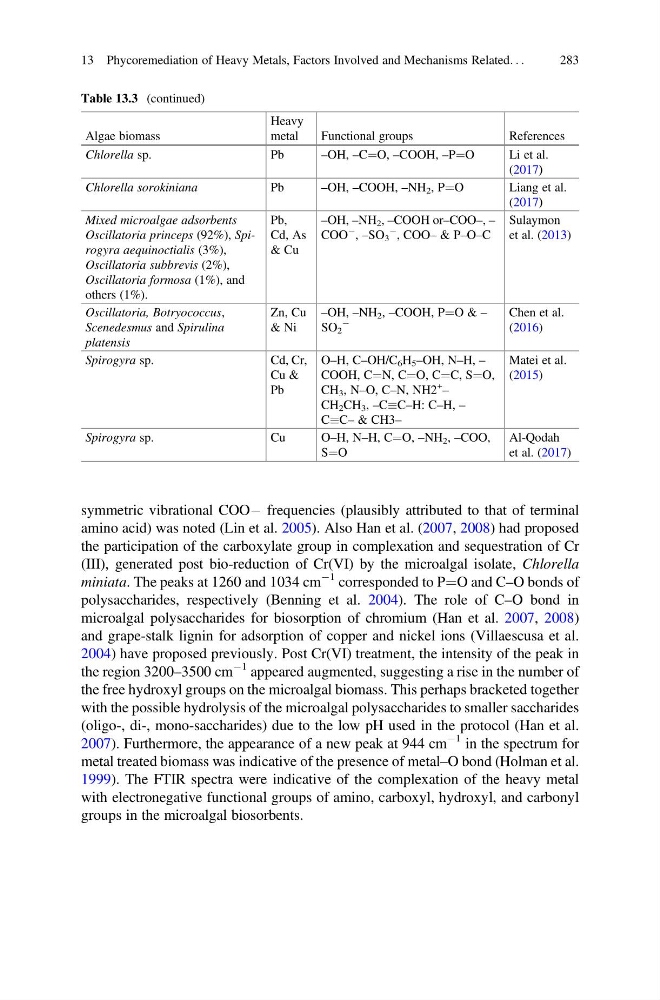
Table 13.3 (continued)
Algae biomass
Heavy
metal
Functional groups
References
Chlorella sp.
Pb
–OH, –C¼O, –COOH, –P¼O
Li et al.
(2017)
Chlorella sorokiniana
Pb
–OH, –COOH, –NH 2 , P¼O
Liang et al.
(2017)
Mixed microalgae adsorbents
Oscillatoria princeps (92%), Spirogyra aequinoctialis (3%),
Oscillatoria subbrevis (2%),
Oscillatoria formosa (1%), and
others (1%).
Pb,
Cd, As
& Cu
–OH, –NH 2 , –COOH or–COO–, –
COO
À
, –SO 3
À
, COO– & P–O–C
Sulaymon
et al. (2013)
Oscillatoria, Botryococcus,
Scenedesmus and Spirulina
platensis
Zn, Cu
& Ni
–OH, –NH 2 , –COOH, P¼O & –
SO 2
À
Chen et al.
(2016)
Spirogyra sp.
Cd, Cr,
Cu &
Pb
O–H, C–OH/C 6 H 5 –OH, N–H, –
COOH, C¼N, C¼O, C¼C, S¼O,
CH 3 , N–O, C–N, NH2
+ –
CH 2 CH 3 , –CC–H: C–H, –
CC– & CH3–
Matei et al.
(2015)
Spirogyra sp.
Cu
O–H, N–H, C¼O, –NH 2 , –COO,
S¼O
Al-Qodah
et al. (2017)
13 Phycoremediation of Heavy Metals, Factors Involved and Mechanisms Related. . .
283
amino acid) was noted (Lin et al. 2005). Also Han et al. (2007, 2008) had proposed
the participation of the carboxylate group in complexation and sequestration of Cr
(III), generated post bio-reduction of Cr(VI) by the microalgal isolate, Chlorella
miniata. The peaks at 1260 and 1034 cm
À1 corresponded to P¼O and C–O bonds of
polysaccharides, respectively (Benning et al. 2004). The role of C–O bond in
microalgal polysaccharides for biosorption of chromium (Han et al. 2007, 2008)
and grape-stalk lignin for adsorption of copper and nickel ions (Villaescusa et al.
2004) have proposed previously. Post Cr(VI) treatment, the intensity of the peak in
the region 3200–3500 cm
À1 appeared augmented, suggesting a rise in the number of
the free hydroxyl groups on the microalgal biomass. This perhaps bracketed together
with the possible hydrolysis of the microalgal polysaccharides to smaller saccharides
(oligo-, di-, mono-saccharides) due to the low pH used in the protocol (Han et al.
2007). Furthermore, the appearance of a new peak at 944 cm
À1 in the spectrum for
metal treated biomass was indicative of the presence of metal–O bond (Holman et al.
1999). The FTIR spectra were indicative of the complexation of the heavy metal
with electronegative functional groups of amino, carboxyl, hydroxyl, and carbonyl
groups in the microalgal biosorbents.
Table 13.3 (continued)
Algae biomass
Heavy
metal
Functional groups
References
Chlorella sp.
Pb
–OH, –C¼O, –COOH, –P¼O
Li et al.
(2017)
Chlorella sorokiniana
Pb
–OH, –COOH, –NH 2 , P¼O
Liang et al.
(2017)
Mixed microalgae adsorbents
Oscillatoria princeps (92%), Spirogyra aequinoctialis (3%),
Oscillatoria subbrevis (2%),
Oscillatoria formosa (1%), and
others (1%).
Pb,
Cd, As
& Cu
–OH, –NH 2 , –COOH or–COO–, –
COO
À
, –SO 3
À
, COO– & P–O–C
Sulaymon
et al. (2013)
Oscillatoria, Botryococcus,
Scenedesmus and Spirulina
platensis
Zn, Cu
& Ni
–OH, –NH 2 , –COOH, P¼O & –
SO 2
À
Chen et al.
(2016)
Spirogyra sp.
Cd, Cr,
Cu &
Pb
O–H, C–OH/C 6 H 5 –OH, N–H, –
COOH, C¼N, C¼O, C¼C, S¼O,
CH 3 , N–O, C–N, NH2
+ –
CH 2 CH 3 , –CC–H: C–H, –
CC– & CH3–
Matei et al.
(2015)
Spirogyra sp.
Cu
O–H, N–H, C¼O, –NH 2 , –COO,
S¼O
Al-Qodah
et al. (2017)
13 Phycoremediation of Heavy Metals, Factors Involved and Mechanisms Related. . .
283