

9 Factors Influencing Phycoremediation of Heavy Metals
Adsorption has been regarded as the main mechanism for metal ion removal via algal
sorbent, nevertheless, various factors are influencing the biosorption potential of
heavy metal phycoremediation, such as pH, algae dose, contact time, temperature,
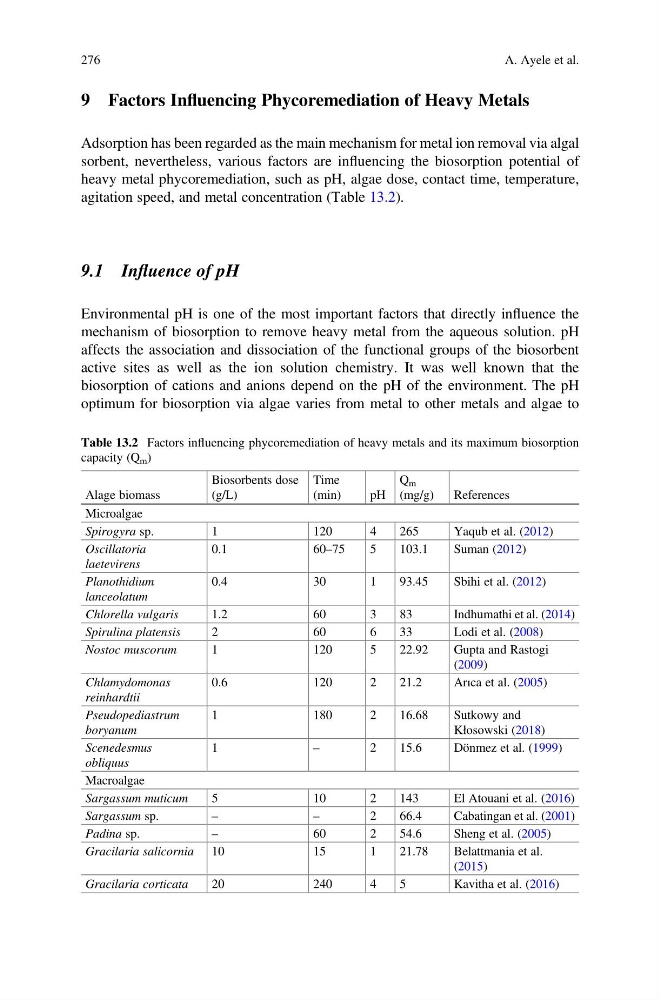
agitation speed, and metal concentration (Table 13.2).
9.1 Influence of pH
Environmental pH is one of the most important factors that directly influence the
mechanism of biosorption to remove heavy metal from the aqueous solution. pH
affects the association and dissociation of the functional groups of the biosorbent
active sites as well as the ion solution chemistry. It was well known that the
biosorption of cations and anions depend on the pH of the environment. The pH
optimum for biosorption via algae varies from metal to other metals and algae to
Table 13.2 Factors influencing phycoremediation of heavy metals and its maximum biosorption
capacity (Q m )
Alage biomass
Biosorbents dose
(g/L)
Time
(min)
pH
Q m
(mg/g)
References
Microalgae
Spirogyra sp.
1
120
4
265
Yaqub et al. (2012)
Oscillatoria
laetevirens
0.1
60–75
5
103.1
Suman (2012)
Planothidium
lanceolatum
0.4
30
1
93.45
Sbihi et al. (2012)
Chlorella vulgaris
1.2
60
3
83
Indhumathi et al. (2014)
Spirulina platensis
2
60
6
33
Lodi et al. (2008)
Nostoc muscorum
1
120
5
22.92
Gupta and Rastogi
(2009)
Chlamydomonas
reinhardtii
0.6
120
2
21.2
Arıca et al. (2005)
Pseudopediastrum
boryanum
1
180
2
16.68
Sutkowy and
Kłosowski (2018)
Scenedesmus
obliquus
1
–
2
15.6
Dönmez et al. (1999)
Macroalgae
Sargassum muticum
5
10
2
143
El Atouani et al. (2016)
Sargassum sp.
–
–
2
66.4
Cabatingan et al. (2001)
Padina sp.
–
60
2
54.6
Sheng et al. (2005)
Gracilaria salicornia 10
15
1
21.78
Belattmania et al.
(2015)
Gracilaria corticata
20
240
4
5
Kavitha et al. (2016)
276
A. Ayele et al.
Adsorption has been regarded as the main mechanism for metal ion removal via algal
sorbent, nevertheless, various factors are influencing the biosorption potential of
heavy metal phycoremediation, such as pH, algae dose, contact time, temperature,
agitation speed, and metal concentration (Table 13.2).
9.1 Influence of pH
Environmental pH is one of the most important factors that directly influence the
mechanism of biosorption to remove heavy metal from the aqueous solution. pH
affects the association and dissociation of the functional groups of the biosorbent
active sites as well as the ion solution chemistry. It was well known that the
biosorption of cations and anions depend on the pH of the environment. The pH
optimum for biosorption via algae varies from metal to other metals and algae to
Table 13.2 Factors influencing phycoremediation of heavy metals and its maximum biosorption
capacity (Q m )
Alage biomass
Biosorbents dose
(g/L)
Time
(min)
pH
Q m
(mg/g)
References
Microalgae
Spirogyra sp.
1
120
4
265
Yaqub et al. (2012)
Oscillatoria
laetevirens
0.1
60–75
5
103.1
Suman (2012)
Planothidium
lanceolatum
0.4
30
1
93.45
Sbihi et al. (2012)
Chlorella vulgaris
1.2
60
3
83
Indhumathi et al. (2014)
Spirulina platensis
2
60
6
33
Lodi et al. (2008)
Nostoc muscorum
1
120
5
22.92
Gupta and Rastogi
(2009)
Chlamydomonas
reinhardtii
0.6
120
2
21.2
Arıca et al. (2005)
Pseudopediastrum
boryanum
1
180
2
16.68
Sutkowy and
Kłosowski (2018)
Scenedesmus
obliquus
1
–
2
15.6
Dönmez et al. (1999)
Macroalgae
Sargassum muticum
5
10
2
143
El Atouani et al. (2016)
Sargassum sp.
–
–
2
66.4
Cabatingan et al. (2001)
Padina sp.
–
60
2
54.6
Sheng et al. (2005)
Gracilaria salicornia 10
15
1
21.78
Belattmania et al.
(2015)
Gracilaria corticata
20
240
4
5
Kavitha et al. (2016)
276
A. Ayele et al.