

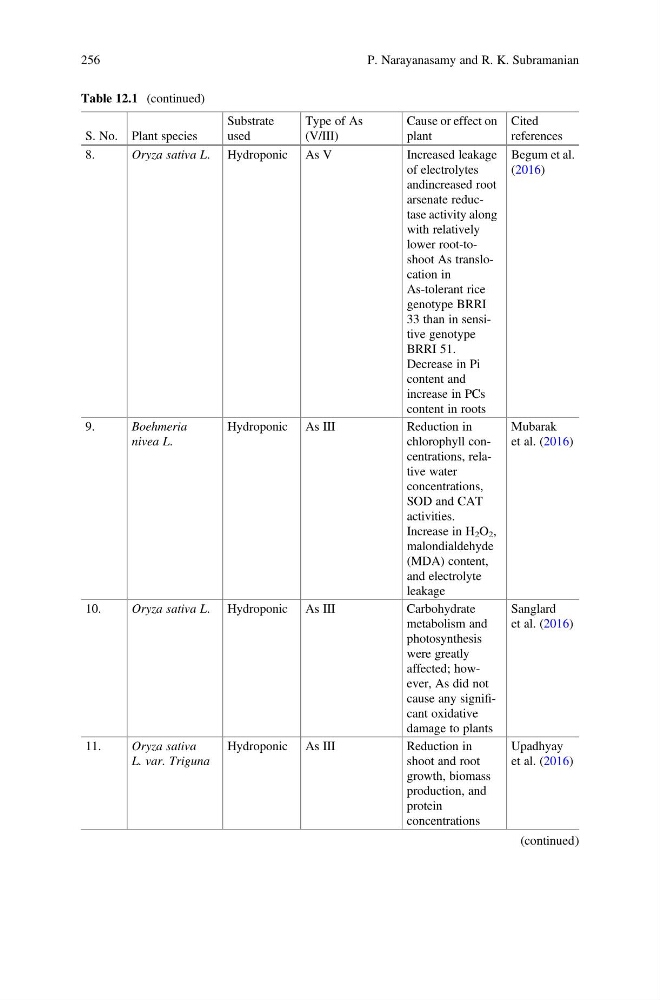
Table 12.1 (continued)
S. No. Plant species
Substrate
used
Type of As
(V/III)
Cause or effect on
plant
Cited
references
8.
Oryza sativa L. Hydroponic As V
Increased leakage
of electrolytes
andincreased root
arsenate reductase activity along
with relatively
lower root-toshoot As translocation in
As-tolerant rice
genotype BRRI
33 than in sensitive genotype
BRRI 51.
Decrease in Pi
content and
increase in PCs
content in roots
Begum et al.
(2016)
9.
Boehmeria
nivea L.
Hydroponic As III
Reduction in
chlorophyll concentrations, relative water
concentrations,
SOD and CAT
activities.
Increase in H 2 O 2 ,
malondialdehyde
(MDA) content,
and electrolyte
leakage
Mubarak
et al. (2016)
10.
Oryza sativa L. Hydroponic As III
Carbohydrate
metabolism and
photosynthesis
were greatly
affected; however, As did not
cause any significant oxidative
damage to plants
Sanglard
et al. (2016)
11.
Oryza sativa
L. var. Triguna
Hydroponic As III
Reduction in
shoot and root
growth, biomass
production, and
protein
concentrations
Upadhyay
et al. (2016)
(continued)
256
P. Narayanasamy and R. K. Subramanian
S. No. Plant species
Substrate
used
Type of As
(V/III)
Cause or effect on
plant
Cited
references
8.
Oryza sativa L. Hydroponic As V
Increased leakage
of electrolytes
andincreased root
arsenate reductase activity along
with relatively
lower root-toshoot As translocation in
As-tolerant rice
genotype BRRI
33 than in sensitive genotype
BRRI 51.
Decrease in Pi
content and
increase in PCs
content in roots
Begum et al.
(2016)
9.
Boehmeria
nivea L.
Hydroponic As III
Reduction in
chlorophyll concentrations, relative water
concentrations,
SOD and CAT
activities.
Increase in H 2 O 2 ,
malondialdehyde
(MDA) content,
and electrolyte
leakage
Mubarak
et al. (2016)
10.
Oryza sativa L. Hydroponic As III
Carbohydrate
metabolism and
photosynthesis
were greatly
affected; however, As did not
cause any significant oxidative
damage to plants
Sanglard
et al. (2016)
11.
Oryza sativa
L. var. Triguna
Hydroponic As III
Reduction in
shoot and root
growth, biomass
production, and
protein
concentrations
Upadhyay
et al. (2016)
(continued)
256
P. Narayanasamy and R. K. Subramanian