

can degrade various types of synthetic colors, such as azo, triphenyl, methane,
silicone, phthalocyanine, and heterocyclic compounds. The lignolytic and
non-lignolytic fungi were used by many researchers to decolorize the dyes present
in the wastewater (Singh et al. 2010). Among them, the lignolytic white-rot fungi are
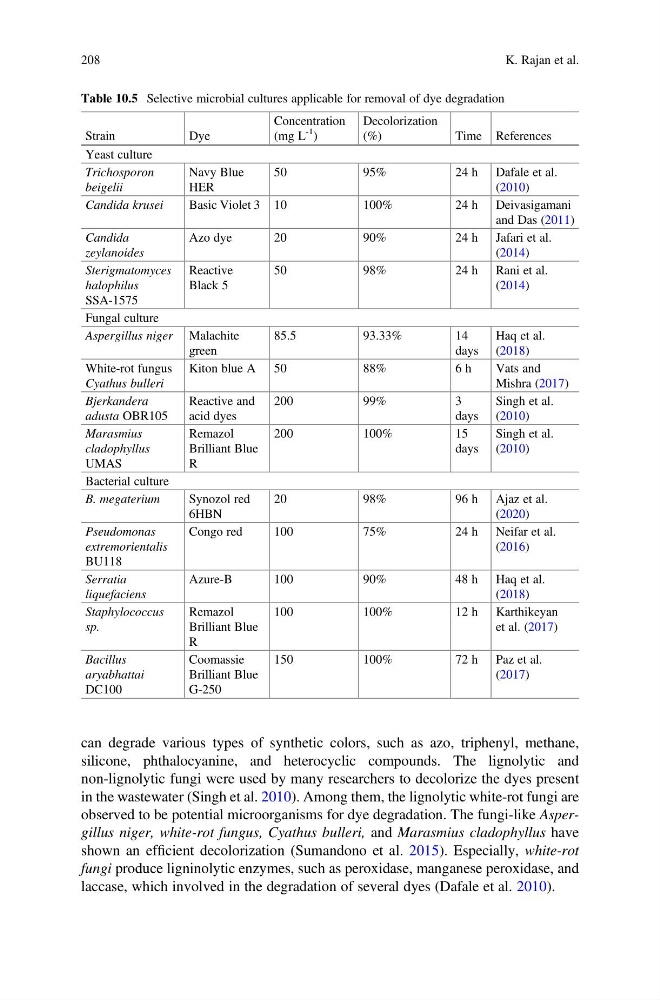
observed to be potential microorganisms for dye degradation. The fungi-like Aspergillus niger, white-rot fungus, Cyathus bulleri, and Marasmius cladophyllus have
shown an efficient decolorization (Sumandono et al. 2015). Especially, white-rot
fungi produce ligninolytic enzymes, such as peroxidase, manganese peroxidase, and
laccase, which involved in the degradation of several dyes (Dafale et al. 2010).
Table 10.5 Selective microbial cultures applicable for removal of dye degradation
Strain
Dye
Concentration
(mg L
-1
)
Decolorization
(%)
Time References
Yeast culture
Trichosporon
beigelii
Navy Blue
HER
50
95%
24 h Dafale et al.
(2010)
Candida krusei
Basic Violet 3 10
100%
24 h Deivasigamani
and Das (2011)
Candida
zeylanoides
Azo dye
20
90%
24 h Jafari et al.
(2014)
Sterigmatomyces
halophilus
SSA-1575
Reactive
Black 5
50
98%
24 h Rani et al.
(2014)
Fungal culture
Aspergillus niger Malachite
green
85.5
93.33%
14
days
Haq et al.
(2018)
White-rot fungus
Cyathus bulleri
Kiton blue A 50
88%
6 h
Vats and
Mishra (2017)
Bjerkandera
adusta OBR105
Reactive and
acid dyes
200
99%
3
days
Singh et al.
(2010)
Marasmius
cladophyllus
UMAS
Remazol
Brilliant Blue
R
200
100%
15
days
Singh et al.
(2010)
Bacterial culture
B. megaterium
Synozol red
6HBN
20
98%
96 h Ajaz et al.
(2020)
Pseudomonas
extremorientalis
BU118
Congo red
100
75%
24 h Neifar et al.
(2016)
Serratia
liquefaciens
Azure-B
100
90%
48 h Haq et al.
(2018)
Staphylococcus
sp.
Remazol
Brilliant Blue
R
100
100%
12 h Karthikeyan
et al. (2017)
Bacillus
aryabhattai
DC100
Coomassie
Brilliant Blue
G-250
150
100%
72 h Paz et al.
(2017)
208
K. Rajan et al.
silicone, phthalocyanine, and heterocyclic compounds. The lignolytic and
non-lignolytic fungi were used by many researchers to decolorize the dyes present
in the wastewater (Singh et al. 2010). Among them, the lignolytic white-rot fungi are
observed to be potential microorganisms for dye degradation. The fungi-like Aspergillus niger, white-rot fungus, Cyathus bulleri, and Marasmius cladophyllus have
shown an efficient decolorization (Sumandono et al. 2015). Especially, white-rot
fungi produce ligninolytic enzymes, such as peroxidase, manganese peroxidase, and
laccase, which involved in the degradation of several dyes (Dafale et al. 2010).
Table 10.5 Selective microbial cultures applicable for removal of dye degradation
Strain
Dye
Concentration
(mg L
-1
)
Decolorization
(%)
Time References
Yeast culture
Trichosporon
beigelii
Navy Blue
HER
50
95%
24 h Dafale et al.
(2010)
Candida krusei
Basic Violet 3 10
100%
24 h Deivasigamani
and Das (2011)
Candida
zeylanoides
Azo dye
20
90%
24 h Jafari et al.
(2014)
Sterigmatomyces
halophilus
SSA-1575
Reactive
Black 5
50
98%
24 h Rani et al.
(2014)
Fungal culture
Aspergillus niger Malachite
green
85.5
93.33%
14
days
Haq et al.
(2018)
White-rot fungus
Cyathus bulleri
Kiton blue A 50
88%
6 h
Vats and
Mishra (2017)
Bjerkandera
adusta OBR105
Reactive and
acid dyes
200
99%
3
days
Singh et al.
(2010)
Marasmius
cladophyllus
UMAS
Remazol
Brilliant Blue
R
200
100%
15
days
Singh et al.
(2010)
Bacterial culture
B. megaterium
Synozol red
6HBN
20
98%
96 h Ajaz et al.
(2020)
Pseudomonas
extremorientalis
BU118
Congo red
100
75%
24 h Neifar et al.
(2016)
Serratia
liquefaciens
Azure-B
100
90%
48 h Haq et al.
(2018)
Staphylococcus
sp.
Remazol
Brilliant Blue
R
100
100%
12 h Karthikeyan
et al. (2017)
Bacillus
aryabhattai
DC100
Coomassie
Brilliant Blue
G-250
150
100%
72 h Paz et al.
(2017)
208
K. Rajan et al.