

(Brahmbhatt and Jasrai 2016). Interestingly, a recent finding has shown that the use
of natural-born algae and duckweed plants for the treatment of textile wastewaters is
quite successful (Sekomo et al. 2014). From the review of short literature survey,
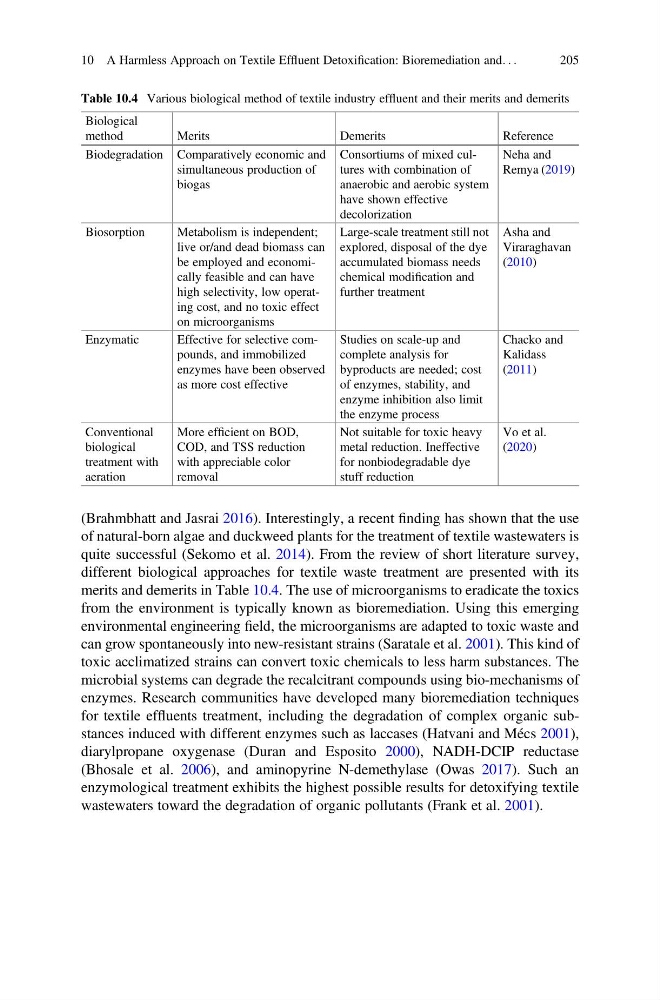
different biological approaches for textile waste treatment are presented with its
merits and demerits in Table 10.4. The use of microorganisms to eradicate the toxics
from the environment is typically known as bioremediation. Using this emerging
environmental engineering field, the microorganisms are adapted to toxic waste and
can grow spontaneously into new-resistant strains (Saratale et al. 2001). This kind of
toxic acclimatized strains can convert toxic chemicals to less harm substances. The
microbial systems can degrade the recalcitrant compounds using bio-mechanisms of
enzymes. Research communities have developed many bioremediation techniques
for textile effluents treatment, including the degradation of complex organic substances induced with different enzymes such as laccases (Hatvani and Mécs 2001),
diarylpropane oxygenase (Duran and Esposito 2000), NADH-DCIP reductase
(Bhosale et al. 2006), and aminopyrine N-demethylase (Owas 2017). Such an
enzymological treatment exhibits the highest possible results for detoxifying textile
wastewaters toward the degradation of organic pollutants (Frank et al. 2001).
Table 10.4 Various biological method of textile industry effluent and their merits and demerits
Biological
method
Merits
Demerits
Reference
Biodegradation Comparatively economic and
simultaneous production of
biogas
Consortiums of mixed cultures with combination of
anaerobic and aerobic system
have shown effective
decolorization
Neha and
Remya (2019)
Biosorption
Metabolism is independent;
live or/and dead biomass can
be employed and economically feasible and can have
high selectivity, low operating cost, and no toxic effect
on microorganisms
Large-scale treatment still not
explored, disposal of the dye
accumulated biomass needs
chemical modification and
further treatment
Asha and
Viraraghavan
(2010)
Enzymatic
Effective for selective compounds, and immobilized
enzymes have been observed
as more cost effective
Studies on scale-up and
complete analysis for
byproducts are needed; cost
of enzymes, stability, and
enzyme inhibition also limit
the enzyme process
Chacko and
Kalidass
(2011)
Conventional
biological
treatment with
aeration
More efficient on BOD,
COD, and TSS reduction
with appreciable color
removal
Not suitable for toxic heavy
metal reduction. Ineffective
for nonbiodegradable dye
stuff reduction
Vo et al.
(2020)
10 A Harmless Approach on Textile Effluent Detoxification: Bioremediation and. . .
205
of natural-born algae and duckweed plants for the treatment of textile wastewaters is
quite successful (Sekomo et al. 2014). From the review of short literature survey,
different biological approaches for textile waste treatment are presented with its
merits and demerits in Table 10.4. The use of microorganisms to eradicate the toxics
from the environment is typically known as bioremediation. Using this emerging
environmental engineering field, the microorganisms are adapted to toxic waste and
can grow spontaneously into new-resistant strains (Saratale et al. 2001). This kind of
toxic acclimatized strains can convert toxic chemicals to less harm substances. The
microbial systems can degrade the recalcitrant compounds using bio-mechanisms of
enzymes. Research communities have developed many bioremediation techniques
for textile effluents treatment, including the degradation of complex organic substances induced with different enzymes such as laccases (Hatvani and Mécs 2001),
diarylpropane oxygenase (Duran and Esposito 2000), NADH-DCIP reductase
(Bhosale et al. 2006), and aminopyrine N-demethylase (Owas 2017). Such an
enzymological treatment exhibits the highest possible results for detoxifying textile
wastewaters toward the degradation of organic pollutants (Frank et al. 2001).
Table 10.4 Various biological method of textile industry effluent and their merits and demerits
Biological
method
Merits
Demerits
Reference
Biodegradation Comparatively economic and
simultaneous production of
biogas
Consortiums of mixed cultures with combination of
anaerobic and aerobic system
have shown effective
decolorization
Neha and
Remya (2019)
Biosorption
Metabolism is independent;
live or/and dead biomass can
be employed and economically feasible and can have
high selectivity, low operating cost, and no toxic effect
on microorganisms
Large-scale treatment still not
explored, disposal of the dye
accumulated biomass needs
chemical modification and
further treatment
Asha and
Viraraghavan
(2010)
Enzymatic
Effective for selective compounds, and immobilized
enzymes have been observed
as more cost effective
Studies on scale-up and
complete analysis for
byproducts are needed; cost
of enzymes, stability, and
enzyme inhibition also limit
the enzyme process
Chacko and
Kalidass
(2011)
Conventional
biological
treatment with
aeration
More efficient on BOD,
COD, and TSS reduction
with appreciable color
removal
Not suitable for toxic heavy
metal reduction. Ineffective
for nonbiodegradable dye
stuff reduction
Vo et al.
(2020)
10 A Harmless Approach on Textile Effluent Detoxification: Bioremediation and. . .
205