

filtration. This method depends on the type and concentration of the metals present in
the wastewater. Sodium or calcium hydroxides are extensively applied for hydroxide
precipitation to convert dissolved metals into solid particles (Holkar et al. 2016).
Oxidation can be successfully exploited for color degradation. In this process,
biologically produced oxygen and ozone, sodium hypochlorite, hydrogen peroxide,
and strong acids are used as oxidation agents. The mechanism of degradation
through oxidation is known to create smaller breakable molecules by oxidation.
However, conventional oxidation reaction could not oxidize toxic organic dyes
completely. This drawback could be overcome using the advanced oxidation processes (AOPs) with some additional cost expenses. Nano-filtration can be used for
complete eradication of color discharges present in the textile effluents. In this
process, the membranes consisting of low-molecular-weight organic complexes,
divalent ions, and wide monovalent ions are employed that can hydrolyze the
reactive dyes and auxiliary dyes (Ellouze et al. 2012). However, high expensive
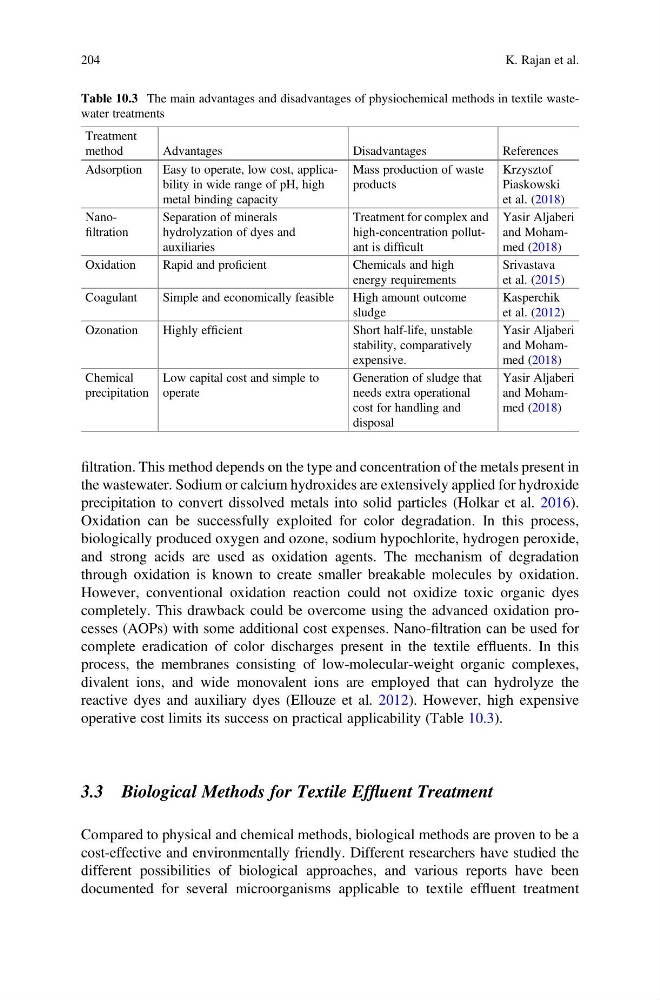
operative cost limits its success on practical applicability (Table 10.3).
3.3 Biological Methods for Textile Effluent Treatment
Compared to physical and chemical methods, biological methods are proven to be a
cost-effective and environmentally friendly. Different researchers have studied the
different possibilities of biological approaches, and various reports have been
documented for several microorganisms applicable to textile effluent treatment
Table 10.3 The main advantages and disadvantages of physiochemical methods in textile wastewater treatments
Treatment
method
Advantages
Disadvantages
References
Adsorption
Easy to operate, low cost, applicability in wide range of pH, high
metal binding capacity
Mass production of waste
products
Krzysztof
Piaskowski
et al. (2018)
Nanofiltration
Separation of minerals
hydrolyzation of dyes and
auxiliaries
Treatment for complex and
high-concentration pollutant is difficult
Yasir Aljaberi
and Mohammed (2018)
Oxidation
Rapid and proficient
Chemicals and high
energy requirements
Srivastava
et al. (2015)
Coagulant
Simple and economically feasible High amount outcome
sludge
Kasperchik
et al. (2012)
Ozonation
Highly efficient
Short half-life, unstable
stability, comparatively
expensive.
Yasir Aljaberi
and Mohammed (2018)
Chemical
precipitation
Low capital cost and simple to
operate
Generation of sludge that
needs extra operational
cost for handling and
disposal
Yasir Aljaberi
and Mohammed (2018)
204
K. Rajan et al.
the wastewater. Sodium or calcium hydroxides are extensively applied for hydroxide
precipitation to convert dissolved metals into solid particles (Holkar et al. 2016).
Oxidation can be successfully exploited for color degradation. In this process,
biologically produced oxygen and ozone, sodium hypochlorite, hydrogen peroxide,
and strong acids are used as oxidation agents. The mechanism of degradation
through oxidation is known to create smaller breakable molecules by oxidation.
However, conventional oxidation reaction could not oxidize toxic organic dyes
completely. This drawback could be overcome using the advanced oxidation processes (AOPs) with some additional cost expenses. Nano-filtration can be used for
complete eradication of color discharges present in the textile effluents. In this
process, the membranes consisting of low-molecular-weight organic complexes,
divalent ions, and wide monovalent ions are employed that can hydrolyze the
reactive dyes and auxiliary dyes (Ellouze et al. 2012). However, high expensive
operative cost limits its success on practical applicability (Table 10.3).
3.3 Biological Methods for Textile Effluent Treatment
Compared to physical and chemical methods, biological methods are proven to be a
cost-effective and environmentally friendly. Different researchers have studied the
different possibilities of biological approaches, and various reports have been
documented for several microorganisms applicable to textile effluent treatment
Table 10.3 The main advantages and disadvantages of physiochemical methods in textile wastewater treatments
Treatment
method
Advantages
Disadvantages
References
Adsorption
Easy to operate, low cost, applicability in wide range of pH, high
metal binding capacity
Mass production of waste
products
Krzysztof
Piaskowski
et al. (2018)
Nanofiltration
Separation of minerals
hydrolyzation of dyes and
auxiliaries
Treatment for complex and
high-concentration pollutant is difficult
Yasir Aljaberi
and Mohammed (2018)
Oxidation
Rapid and proficient
Chemicals and high
energy requirements
Srivastava
et al. (2015)
Coagulant
Simple and economically feasible High amount outcome
sludge
Kasperchik
et al. (2012)
Ozonation
Highly efficient
Short half-life, unstable
stability, comparatively
expensive.
Yasir Aljaberi
and Mohammed (2018)
Chemical
precipitation
Low capital cost and simple to
operate
Generation of sludge that
needs extra operational
cost for handling and
disposal
Yasir Aljaberi
and Mohammed (2018)
204
K. Rajan et al.