

substances, which protect the cotton fabric from the UV rays. Though not all
materials require the same finishing processes, different types of chemicals and
chemical reactions will lead to the final effect. Effluents from this unit contain low
levels of BOD and COD and reasonable suspended solids. When such kind of
discharges from finishing processes pose to be toxic, that may cause skin issues
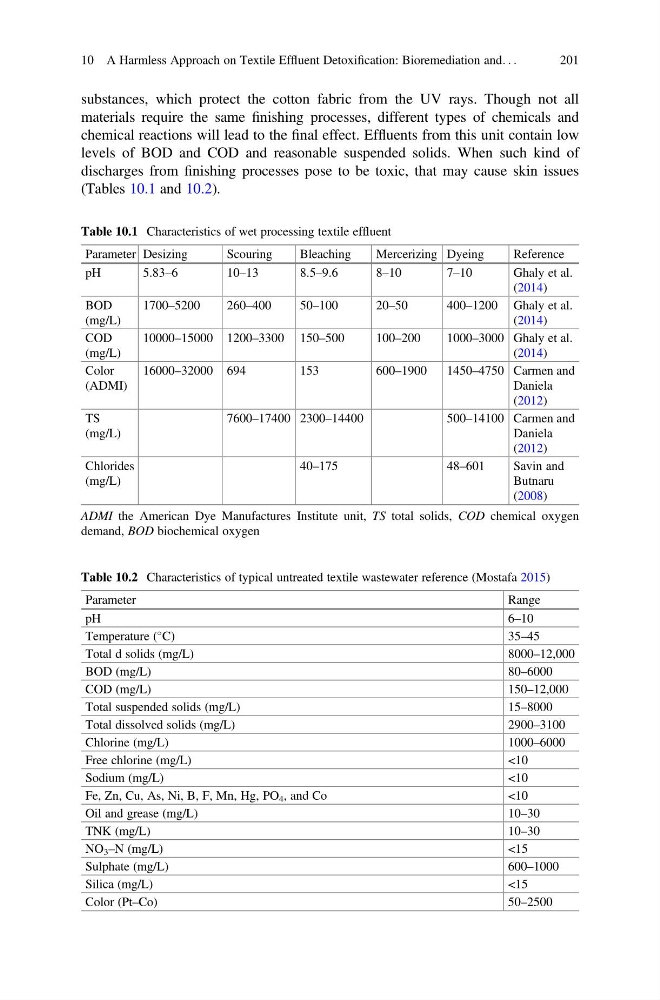
(Tables 10.1 and 10.2).
Table 10.1 Characteristics of wet processing textile effluent
Parameter Desizing
Scouring
Bleaching
Mercerizing Dyeing
Reference
pH
5.83–6
1 0 –13
8.5–9.6
8–10
7–10
Ghaly et al.
(2014)
BOD
(mg/L)
1700–5200
260–400
50–100
20–50
400–1200 Ghaly et al.
(2014)
COD
(mg/L)
10000–15000 1200–3300 150–500
100–200
1000–3000 Ghaly et al.
(2014)
Color
(ADMI)
16000–32000 694
153
600–1900
1450–4750 Carmen and
Daniela
(2012)
TS
(mg/L)
7600–17400 2300–14400
500–14100 Carmen and
Daniela
(2012)
Chlorides
(mg/L)
40–175
48–601
Savin and
Butnaru
(2008)
ADMI the American Dye Manufactures Institute unit, TS total solids, COD chemical oxygen
demand, BOD biochemical oxygen
Table 10.2 Characteristics of typical untreated textile wastewater reference (Mostafa 2015)
Parameter
Range
pH
6–10
Temperature (
C)
35–45
Total d solids (mg/L)
8000–12,000
BOD (mg/L)
80–6000
COD (mg/L)
150–12,000
Total suspended solids (mg/L)
15–8000
Total dissolved solids (mg/L)
2900–3100
Chlorine (mg/L)
1000–6000
Free chlorine (mg/L)
<10
Sodium (mg/L)
<10
Fe, Zn, Cu, As, Ni, B, F, Mn, Hg, PO 4 , and Co
<10
Oil and grease (mg/L)
10–30
TNK (mg/L)
10–30
NO 3 –N (mg/L)
<15
Sulphate (mg/L)
600–1000
Silica (mg/L)
<15
Color (Pt–Co)
50–2500
10 A Harmless Approach on Textile Effluent Detoxification: Bioremediation and. . .
201
materials require the same finishing processes, different types of chemicals and
chemical reactions will lead to the final effect. Effluents from this unit contain low
levels of BOD and COD and reasonable suspended solids. When such kind of
discharges from finishing processes pose to be toxic, that may cause skin issues
(Tables 10.1 and 10.2).
Table 10.1 Characteristics of wet processing textile effluent
Parameter Desizing
Scouring
Bleaching
Mercerizing Dyeing
Reference
pH
5.83–6
1 0 –13
8.5–9.6
8–10
7–10
Ghaly et al.
(2014)
BOD
(mg/L)
1700–5200
260–400
50–100
20–50
400–1200 Ghaly et al.
(2014)
COD
(mg/L)
10000–15000 1200–3300 150–500
100–200
1000–3000 Ghaly et al.
(2014)
Color
(ADMI)
16000–32000 694
153
600–1900
1450–4750 Carmen and
Daniela
(2012)
TS
(mg/L)
7600–17400 2300–14400
500–14100 Carmen and
Daniela
(2012)
Chlorides
(mg/L)
40–175
48–601
Savin and
Butnaru
(2008)
ADMI the American Dye Manufactures Institute unit, TS total solids, COD chemical oxygen
demand, BOD biochemical oxygen
Table 10.2 Characteristics of typical untreated textile wastewater reference (Mostafa 2015)
Parameter
Range
pH
6–10
Temperature (
C)
35–45
Total d solids (mg/L)
8000–12,000
BOD (mg/L)
80–6000
COD (mg/L)
150–12,000
Total suspended solids (mg/L)
15–8000
Total dissolved solids (mg/L)
2900–3100
Chlorine (mg/L)
1000–6000
Free chlorine (mg/L)
<10
Sodium (mg/L)
<10
Fe, Zn, Cu, As, Ni, B, F, Mn, Hg, PO 4 , and Co
<10
Oil and grease (mg/L)
10–30
TNK (mg/L)
10–30
NO 3 –N (mg/L)
<15
Sulphate (mg/L)
600–1000
Silica (mg/L)
<15
Color (Pt–Co)
50–2500
10 A Harmless Approach on Textile Effluent Detoxification: Bioremediation and. . .
201