

bandages should undergo microbial finish. Keeping this view, textiles undergo
numerous finishing processes to reach those standards. In addition, various
chemicals and chemical reactions are involved in textile wet processing for efficient
textile products (Gulzar et al. 2018).
2.1 Pretreatment Process
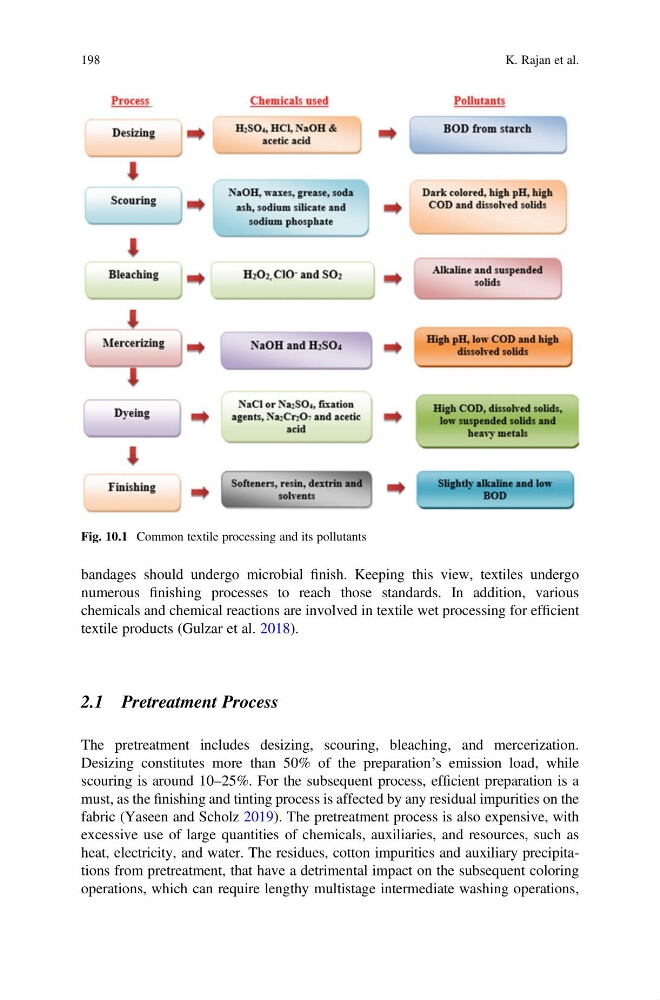
The pretreatment includes desizing, scouring, bleaching, and mercerization.
Desizing constitutes more than 50% of the preparation’s emission load, while
scouring is around 10–25%. For the subsequent process, efficient preparation is a
must, as the finishing and tinting process is affected by any residual impurities on the
fabric (Yaseen and Scholz 2019). The pretreatment process is also expensive, with
excessive use of large quantities of chemicals, auxiliaries, and resources, such as
heat, electricity, and water. The residues, cotton impurities and auxiliary precipitations from pretreatment, that have a detrimental impact on the subsequent coloring
operations, which can require lengthy multistage intermediate washing operations,
Fig. 10.1 Common textile processing and its pollutants
198
K. Rajan et al.
numerous finishing processes to reach those standards. In addition, various
chemicals and chemical reactions are involved in textile wet processing for efficient
textile products (Gulzar et al. 2018).
2.1 Pretreatment Process
The pretreatment includes desizing, scouring, bleaching, and mercerization.
Desizing constitutes more than 50% of the preparation’s emission load, while
scouring is around 10–25%. For the subsequent process, efficient preparation is a
must, as the finishing and tinting process is affected by any residual impurities on the
fabric (Yaseen and Scholz 2019). The pretreatment process is also expensive, with
excessive use of large quantities of chemicals, auxiliaries, and resources, such as
heat, electricity, and water. The residues, cotton impurities and auxiliary precipitations from pretreatment, that have a detrimental impact on the subsequent coloring
operations, which can require lengthy multistage intermediate washing operations,
Fig. 10.1 Common textile processing and its pollutants
198
K. Rajan et al.