

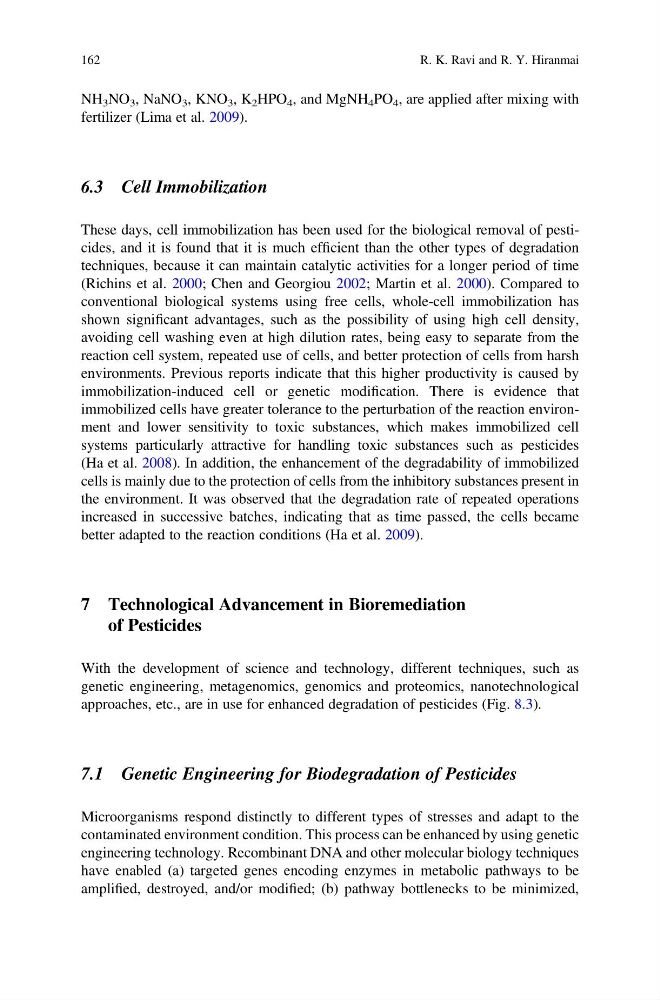
NH 3 NO 3 , NaNO 3 , KNO 3 , K 2 HPO 4 , and MgNH 4 PO 4 , are applied after mixing with
fertilizer (Lima et al. 2009).
6.3 Cell Immobilization
These days, cell immobilization has been used for the biological removal of pesticides, and it is found that it is much efficient than the other types of degradation
techniques, because it can maintain catalytic activities for a longer period of time
(Richins et al. 2000; Chen and Georgiou 2002; Martin et al. 2000). Compared to
conventional biological systems using free cells, whole-cell immobilization has
shown significant advantages, such as the possibility of using high cell density,
avoiding cell washing even at high dilution rates, being easy to separate from the
reaction cell system, repeated use of cells, and better protection of cells from harsh
environments. Previous reports indicate that this higher productivity is caused by
immobilization-induced cell or genetic modification. There is evidence that
immobilized cells have greater tolerance to the perturbation of the reaction environment and lower sensitivity to toxic substances, which makes immobilized cell
systems particularly attractive for handling toxic substances such as pesticides
(Ha et al. 2008). In addition, the enhancement of the degradability of immobilized
cells is mainly due to the protection of cells from the inhibitory substances present in
the environment. It was observed that the degradation rate of repeated operations
increased in successive batches, indicating that as time passed, the cells became
better adapted to the reaction conditions (Ha et al. 2009).
7 Technological Advancement in Bioremediation
of Pesticides
With the development of science and technology, different techniques, such as
genetic engineering, metagenomics, genomics and proteomics, nanotechnological
approaches, etc., are in use for enhanced degradation of pesticides (Fig. 8.3).
7.1 Genetic Engineering for Biodegradation of Pesticides
Microorganisms respond distinctly to different types of stresses and adapt to the
contaminated environment condition. This process can be enhanced by using genetic
engineering technology. Recombinant DNA and other molecular biology techniques
have enabled (a) targeted genes encoding enzymes in metabolic pathways to be
amplified, destroyed, and/or modified; (b) pathway bottlenecks to be minimized,
162
R. K. Ravi and R. Y. Hiranmai
fertilizer (Lima et al. 2009).
6.3 Cell Immobilization
These days, cell immobilization has been used for the biological removal of pesticides, and it is found that it is much efficient than the other types of degradation
techniques, because it can maintain catalytic activities for a longer period of time
(Richins et al. 2000; Chen and Georgiou 2002; Martin et al. 2000). Compared to
conventional biological systems using free cells, whole-cell immobilization has
shown significant advantages, such as the possibility of using high cell density,
avoiding cell washing even at high dilution rates, being easy to separate from the
reaction cell system, repeated use of cells, and better protection of cells from harsh
environments. Previous reports indicate that this higher productivity is caused by
immobilization-induced cell or genetic modification. There is evidence that
immobilized cells have greater tolerance to the perturbation of the reaction environment and lower sensitivity to toxic substances, which makes immobilized cell
systems particularly attractive for handling toxic substances such as pesticides
(Ha et al. 2008). In addition, the enhancement of the degradability of immobilized
cells is mainly due to the protection of cells from the inhibitory substances present in
the environment. It was observed that the degradation rate of repeated operations
increased in successive batches, indicating that as time passed, the cells became
better adapted to the reaction conditions (Ha et al. 2009).
7 Technological Advancement in Bioremediation
of Pesticides
With the development of science and technology, different techniques, such as
genetic engineering, metagenomics, genomics and proteomics, nanotechnological
approaches, etc., are in use for enhanced degradation of pesticides (Fig. 8.3).
7.1 Genetic Engineering for Biodegradation of Pesticides
Microorganisms respond distinctly to different types of stresses and adapt to the
contaminated environment condition. This process can be enhanced by using genetic
engineering technology. Recombinant DNA and other molecular biology techniques
have enabled (a) targeted genes encoding enzymes in metabolic pathways to be
amplified, destroyed, and/or modified; (b) pathway bottlenecks to be minimized,
162
R. K. Ravi and R. Y. Hiranmai