

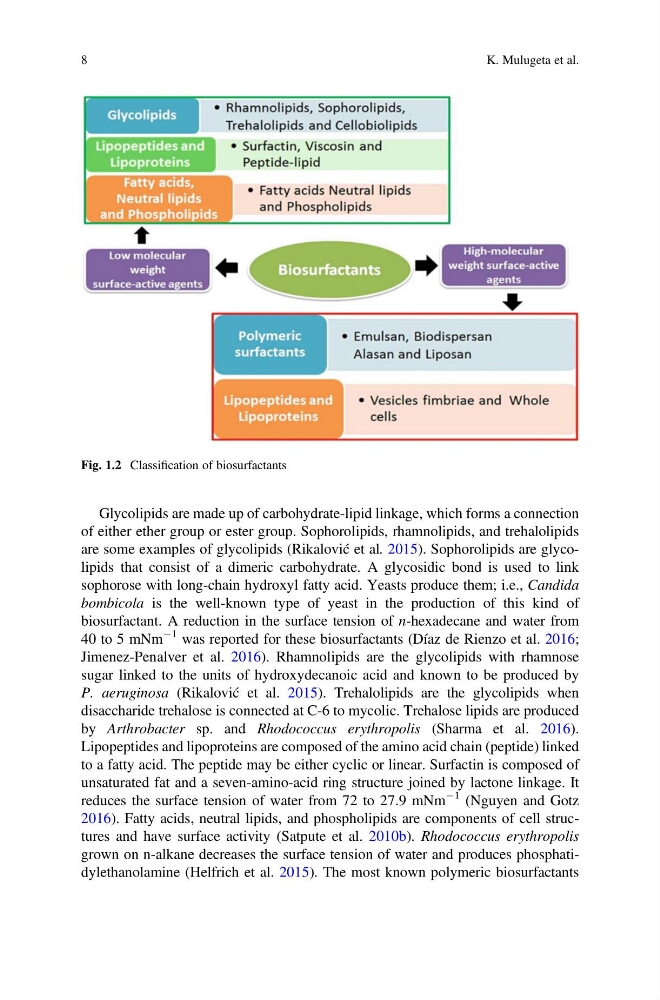
Glycolipids are made up of carbohydrate-lipid linkage, which forms a connection
of either ether group or ester group. Sophorolipids, rhamnolipids, and trehalolipids
are some examples of glycolipids (Rikalović et al. 2015). Sophorolipids are glycolipids that consist of a dimeric carbohydrate. A glycosidic bond is used to link
sophorose with long-chain hydroxyl fatty acid. Yeasts produce them; i.e., Candida
bombicola is the well-known type of yeast in the production of this kind of
biosurfactant. A reduction in the surface tension of n-hexadecane and water from
40 to 5 mNm
À1 was reported for these biosurfactants (Díaz de Rienzo et al. 2016;
Jimenez-Penalver et al. 2016). Rhamnolipids are the glycolipids with rhamnose
sugar linked to the units of hydroxydecanoic acid and known to be produced by
P. aeruginosa (Rikalović et al. 2015). Trehalolipids are the glycolipids when
disaccharide trehalose is connected at C-6 to mycolic. Trehalose lipids are produced
by Arthrobacter sp. and Rhodococcus erythropolis (Sharma et al. 2016).
Lipopeptides and lipoproteins are composed of the amino acid chain (peptide) linked
to a fatty acid. The peptide may be either cyclic or linear. Surfactin is composed of
unsaturated fat and a seven-amino-acid ring structure joined by lactone linkage. It
reduces the surface tension of water from 72 to 27.9 mNm
À1 (Nguyen and Gotz
2016). Fatty acids, neutral lipids, and phospholipids are components of cell structures and have surface activity (Satpute et al. 2010b). Rhodococcus erythropolis
grown on n-alkane decreases the surface tension of water and produces phosphatidylethanolamine (Helfrich et al. 2015). The most known polymeric biosurfactants
Fig. 1.2 Classification of biosurfactants
8
K. Mulugeta et al.
of either ether group or ester group. Sophorolipids, rhamnolipids, and trehalolipids
are some examples of glycolipids (Rikalović et al. 2015). Sophorolipids are glycolipids that consist of a dimeric carbohydrate. A glycosidic bond is used to link
sophorose with long-chain hydroxyl fatty acid. Yeasts produce them; i.e., Candida
bombicola is the well-known type of yeast in the production of this kind of
biosurfactant. A reduction in the surface tension of n-hexadecane and water from
40 to 5 mNm
À1 was reported for these biosurfactants (Díaz de Rienzo et al. 2016;
Jimenez-Penalver et al. 2016). Rhamnolipids are the glycolipids with rhamnose
sugar linked to the units of hydroxydecanoic acid and known to be produced by
P. aeruginosa (Rikalović et al. 2015). Trehalolipids are the glycolipids when
disaccharide trehalose is connected at C-6 to mycolic. Trehalose lipids are produced
by Arthrobacter sp. and Rhodococcus erythropolis (Sharma et al. 2016).
Lipopeptides and lipoproteins are composed of the amino acid chain (peptide) linked
to a fatty acid. The peptide may be either cyclic or linear. Surfactin is composed of
unsaturated fat and a seven-amino-acid ring structure joined by lactone linkage. It
reduces the surface tension of water from 72 to 27.9 mNm
À1 (Nguyen and Gotz
2016). Fatty acids, neutral lipids, and phospholipids are components of cell structures and have surface activity (Satpute et al. 2010b). Rhodococcus erythropolis
grown on n-alkane decreases the surface tension of water and produces phosphatidylethanolamine (Helfrich et al. 2015). The most known polymeric biosurfactants
Fig. 1.2 Classification of biosurfactants
8
K. Mulugeta et al.