

3.2 Solar Disinfection
The use of sunlight is an ancient practice for many centuries. In developing countries, it is considered as a low-cost, simple technique for safe drinking water. The
water is to be filled in a transparent glass or plastic bottle and is exposed to sunlight
for a few hours. It is reported that many microbes are eliminated by solar disinfection. There are two pathways in solar disinfection to inactivate microbes. Figure 6.4
shows the direct and indirect effects of sunlight exposure.
The efficacy of this process depends on several factors. The factors that affect the
performance are organic compounds (humic acids), inorganic salt, dissolved oxygen, light intensity, temperature, and type of container (Davies and Evison 1991). In
literature, Entamoeba histolytica and cysts of Giardia spp. are inactivated by
sunlight exposure (e.g., within 10 min at 56
C) (Ciochetti and Metcalf 1984). The
temperature is achieved with a solar hot box cooker. Thus, solar disinfection is not
applicable all over the world, but it may be appropriate for sunny places in which
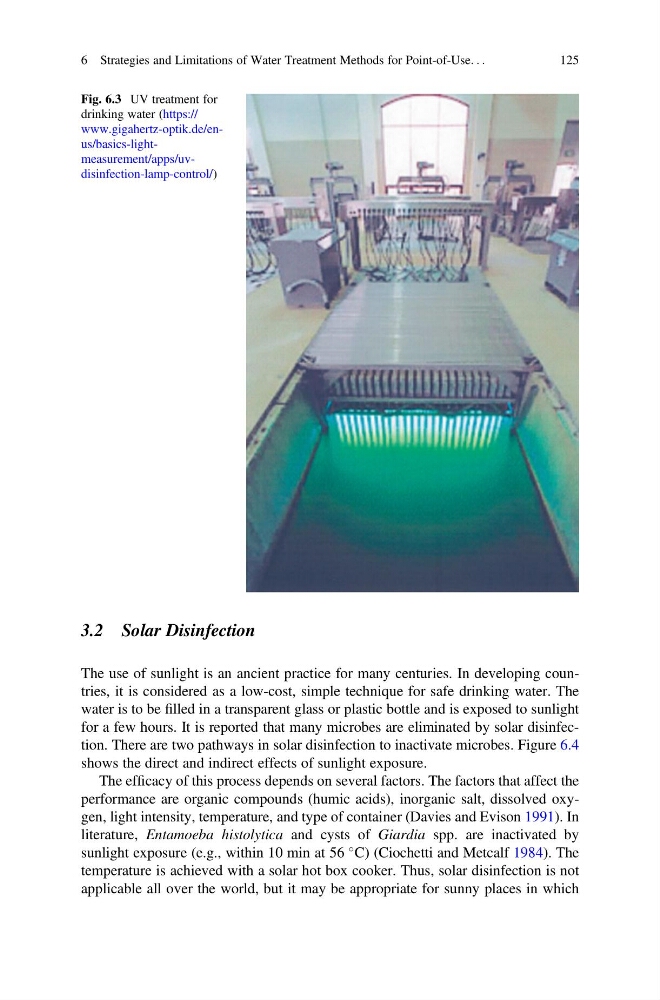
Fig. 6.3 UV treatment for
drinking water (https://
measurement/apps/uvdisinfection-lamp-control/)
6 Strategies and Limitations of Water Treatment Methods for Point-of-Use. . .
125
The use of sunlight is an ancient practice for many centuries. In developing countries, it is considered as a low-cost, simple technique for safe drinking water. The
water is to be filled in a transparent glass or plastic bottle and is exposed to sunlight
for a few hours. It is reported that many microbes are eliminated by solar disinfection. There are two pathways in solar disinfection to inactivate microbes. Figure 6.4
shows the direct and indirect effects of sunlight exposure.
The efficacy of this process depends on several factors. The factors that affect the
performance are organic compounds (humic acids), inorganic salt, dissolved oxygen, light intensity, temperature, and type of container (Davies and Evison 1991). In
literature, Entamoeba histolytica and cysts of Giardia spp. are inactivated by
sunlight exposure (e.g., within 10 min at 56
C) (Ciochetti and Metcalf 1984). The
temperature is achieved with a solar hot box cooker. Thus, solar disinfection is not
applicable all over the world, but it may be appropriate for sunny places in which
Fig. 6.3 UV treatment for
drinking water (https://
measurement/apps/uvdisinfection-lamp-control/)
6 Strategies and Limitations of Water Treatment Methods for Point-of-Use. . .
125