

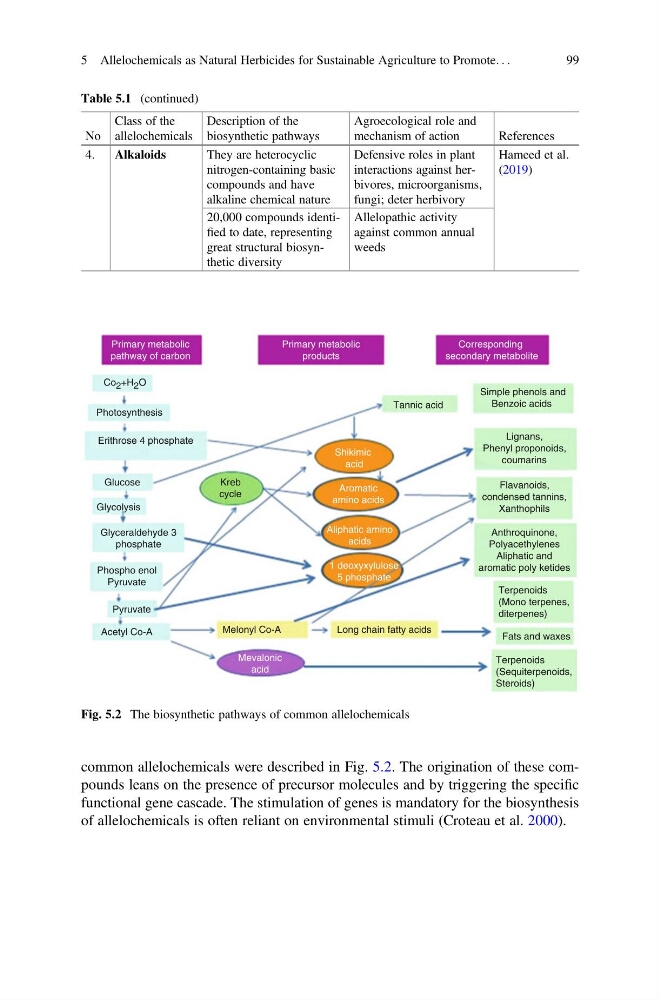
common allelochemicals were described in Fig. 5.2. The origination of these compounds leans on the presence of precursor molecules and by triggering the specific
functional gene cascade. The stimulation of genes is mandatory for the biosynthesis
of allelochemicals is often reliant on environmental stimuli (Croteau et al. 2000).
Table 5.1 (continued)
No
Class of the
allelochemicals
Description of the
biosynthetic pathways
Agroecological role and
mechanism of action
References
4.
Alkaloids
They are heterocyclic
nitrogen-containing basic
compounds and have
alkaline chemical nature
Defensive roles in plant
interactions against herbivores, microorganisms,
fungi; deter herbivory
Hameed et al.
(2019)
20,000 compounds identified to date, representing
great structural biosynthetic diversity
Allelopathic activity
against common annual
weeds
Simple phenols and
Benzoic acids
Lignans,
Phenyl proponoids,
coumarins
Flavanoids,
condensed tannins,
Xanthophils
Anthroquinone,
Polyacethylenes
Aliphatic and
aromatic poly ketides
Terpenoids
(Mono terpenes,
diterpenes)
Terpenoids
(Sequiterpenoids,
Steroids)
Fats and waxes
Long chain fatty acids
Melonyl Co-A
Mevalonic
acid
Tannic acid
Shikimic
acid
Aromatic
amino acids
Aliphatic amino
acids
1 deoxyxylulose
5 phosphate
Kreb
cycle
Acetyl Co-A
Pyruvate
Phospho enol
Pyruvate
Glyceraldehyde 3
phosphate
Erithrose 4 phosphate
Primary metabolic
pathway of carbon
Primary metabolic
products
Corresponding
secondary metabolite
Photosynthesis
Co 2 +H 2 O
Glycolysis
Glucose
Fig. 5.2 The biosynthetic pathways of common allelochemicals
5 Allelochemicals as Natural Herbicides for Sustainable Agriculture to Promote. . .
99
functional gene cascade. The stimulation of genes is mandatory for the biosynthesis
of allelochemicals is often reliant on environmental stimuli (Croteau et al. 2000).
Table 5.1 (continued)
No
Class of the
allelochemicals
Description of the
biosynthetic pathways
Agroecological role and
mechanism of action
References
4.
Alkaloids
They are heterocyclic
nitrogen-containing basic
compounds and have
alkaline chemical nature
Defensive roles in plant
interactions against herbivores, microorganisms,
fungi; deter herbivory
Hameed et al.
(2019)
20,000 compounds identified to date, representing
great structural biosynthetic diversity
Allelopathic activity
against common annual
weeds
Simple phenols and
Benzoic acids
Lignans,
Phenyl proponoids,
coumarins
Flavanoids,
condensed tannins,
Xanthophils
Anthroquinone,
Polyacethylenes
Aliphatic and
aromatic poly ketides
Terpenoids
(Mono terpenes,
diterpenes)
Terpenoids
(Sequiterpenoids,
Steroids)
Fats and waxes
Long chain fatty acids
Melonyl Co-A
Mevalonic
acid
Tannic acid
Shikimic
acid
Aromatic
amino acids
Aliphatic amino
acids
1 deoxyxylulose
5 phosphate
Kreb
cycle
Acetyl Co-A
Pyruvate
Phospho enol
Pyruvate
Glyceraldehyde 3
phosphate
Erithrose 4 phosphate
Primary metabolic
pathway of carbon
Primary metabolic
products
Corresponding
secondary metabolite
Photosynthesis
Co 2 +H 2 O
Glycolysis
Glucose
Fig. 5.2 The biosynthetic pathways of common allelochemicals
5 Allelochemicals as Natural Herbicides for Sustainable Agriculture to Promote. . .
99