

58
Algae
with the peptidoglycan layer; this membrane exhibits a number of evaginations representing sites
of extrusion of material from the cytoplasm through the wall into the slime. The cell wall of
genera such as Prochloron is comparable with that of the cyanobacteria in structure and contains
muramic acid.
Eukariotic algal cell wall is always formed outside the plasmalemma and is in many respects
comparable to that of higher plants. It is present in the Rhodophyta, Eustigmatophyceae
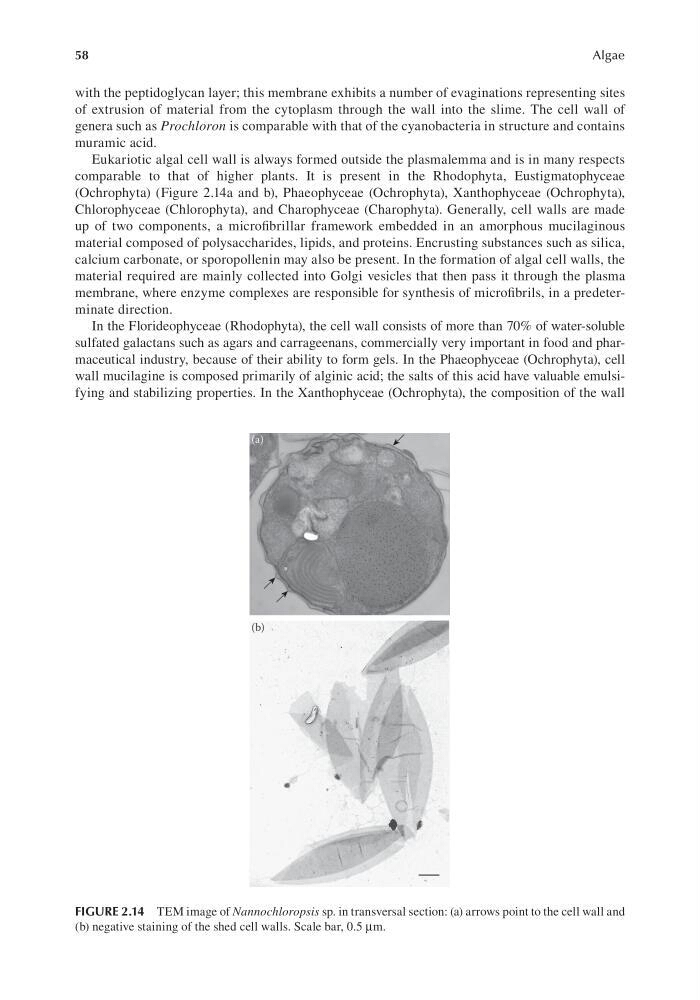
(Ochrophyta) (Figure 2.14a and b), Phaeophyceae (Ochrophyta), Xanthophyceae (Ochrophyta),
Chlorophyceae (Chlorophyta), and Charophyceae (Charophyta). Generally, cell walls are made
up of two components, a microfibrillar framework embedded in an amorphous mucilaginous
material composed of polysaccharides, lipids, and proteins. Encrusting substances such as silica,
calcium carbonate, or sporopollenin may also be present. In the formation of algal cell walls, the
material required are mainly collected into Golgi vesicles that then pass it through the plasma
membrane, where enzyme complexes are responsible for synthesis of microfibrils, in a predeterminate direction.
In the Florideophyceae (Rhodophyta), the cell wall consists of more than 70% of water-soluble
sulfated galactans such as agars and carrageenans, commercially very important in food and pharmaceutical industry, because of their ability to form gels. In the Phaeophyceae (Ochrophyta), cell
wall mucilagine is composed primarily of alginic acid; the salts of this acid have valuable emulsifying and stabilizing properties. In the Xanthophyceae (Ochrophyta), the composition of the wall
FIGURE 2.14 TEM image of Nannochloropsis sp. in transversal section: (a) arrows point to the cell wall and
(b) negative staining of the shed cell walls. Scale bar, 0.5 μm.
Algae
with the peptidoglycan layer; this membrane exhibits a number of evaginations representing sites
of extrusion of material from the cytoplasm through the wall into the slime. The cell wall of
genera such as Prochloron is comparable with that of the cyanobacteria in structure and contains
muramic acid.
Eukariotic algal cell wall is always formed outside the plasmalemma and is in many respects
comparable to that of higher plants. It is present in the Rhodophyta, Eustigmatophyceae
(Ochrophyta) (Figure 2.14a and b), Phaeophyceae (Ochrophyta), Xanthophyceae (Ochrophyta),
Chlorophyceae (Chlorophyta), and Charophyceae (Charophyta). Generally, cell walls are made
up of two components, a microfibrillar framework embedded in an amorphous mucilaginous
material composed of polysaccharides, lipids, and proteins. Encrusting substances such as silica,
calcium carbonate, or sporopollenin may also be present. In the formation of algal cell walls, the
material required are mainly collected into Golgi vesicles that then pass it through the plasma
membrane, where enzyme complexes are responsible for synthesis of microfibrils, in a predeterminate direction.
In the Florideophyceae (Rhodophyta), the cell wall consists of more than 70% of water-soluble
sulfated galactans such as agars and carrageenans, commercially very important in food and pharmaceutical industry, because of their ability to form gels. In the Phaeophyceae (Ochrophyta), cell
wall mucilagine is composed primarily of alginic acid; the salts of this acid have valuable emulsifying and stabilizing properties. In the Xanthophyceae (Ochrophyta), the composition of the wall
FIGURE 2.14 TEM image of Nannochloropsis sp. in transversal section: (a) arrows point to the cell wall and
(b) negative staining of the shed cell walls. Scale bar, 0.5 μm.