

22
Algae
SUMMARIES OF THE 11 ALGAL PHYLA
Historically, the major groups of algae were classified on the basis of pigmentation, chemical
nature of photosynthetic storage product, photosynthetic membrane (thylakoids) organization and
other features of the chloroplasts, chemistry and structure of the cell wall, number, arrangement,
and ultrastructure of flagella (if any), occurrence of any other special features, and sexual cycles.
Recently revised classifications incorporate advances resulting from the widespread use of phylogenomic-scale phylogenetic analyses and massively increased taxon sampling in rRNA phylogenies. All these studies tend to assess the internal genetic coherence of the major phyla such as
Cyanobacteria, Glaucophyta, Rhodophyta, Chlorophyta, Charophyta, Haptophyta, Cryptophyta,
Ochrophyta, Cercozoa, Myzozoa, and Euglenozoa, confirming that these divisions are nonartificial.
Table 1.4 attempts to summarize the main characteristics of the different algal groups.
cyanobacTeria
All blue-green algae (Figures 1.1a and 1.34) and prochlorophytes (Figure 1.35) are nonmotile
Gram-negative eubacteria. In structural diversity, blue-green algae range from unicells to branched
and unbranched filaments to unspecialized colonial aggregations and are possibly the most widely
distributed of any group of algae. They are planktonic, occasionally forming blooms in eutrophic
lakes and an important component of the picoplankton in both marine and freshwater systems; benthic, as dense mats on soil or in mud flats and hot springs, as the “black zone” high on the seashore,
and as relatively inconspicuous components in most soils; and symbiotic in diatoms, ferns, lichens,
cycads, sponges, and other systems. Numerically, these organisms dominate the ocean ecosystems.
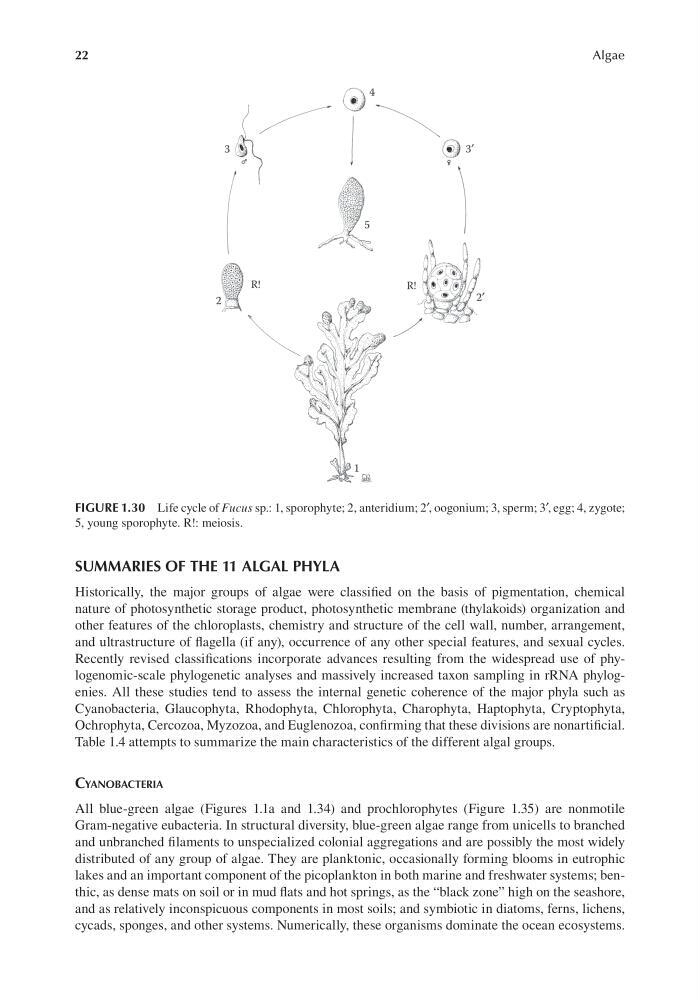
FIGURE 1.30 Life cycle of Fucus sp.: 1, sporophyte; 2, anteridium; 2′, oogonium; 3, sperm; 3′, egg; 4, zygote;
5, young sporophyte. R!: meiosis.
Algae
SUMMARIES OF THE 11 ALGAL PHYLA
Historically, the major groups of algae were classified on the basis of pigmentation, chemical
nature of photosynthetic storage product, photosynthetic membrane (thylakoids) organization and
other features of the chloroplasts, chemistry and structure of the cell wall, number, arrangement,
and ultrastructure of flagella (if any), occurrence of any other special features, and sexual cycles.
Recently revised classifications incorporate advances resulting from the widespread use of phylogenomic-scale phylogenetic analyses and massively increased taxon sampling in rRNA phylogenies. All these studies tend to assess the internal genetic coherence of the major phyla such as
Cyanobacteria, Glaucophyta, Rhodophyta, Chlorophyta, Charophyta, Haptophyta, Cryptophyta,
Ochrophyta, Cercozoa, Myzozoa, and Euglenozoa, confirming that these divisions are nonartificial.
Table 1.4 attempts to summarize the main characteristics of the different algal groups.
cyanobacTeria
All blue-green algae (Figures 1.1a and 1.34) and prochlorophytes (Figure 1.35) are nonmotile
Gram-negative eubacteria. In structural diversity, blue-green algae range from unicells to branched
and unbranched filaments to unspecialized colonial aggregations and are possibly the most widely
distributed of any group of algae. They are planktonic, occasionally forming blooms in eutrophic
lakes and an important component of the picoplankton in both marine and freshwater systems; benthic, as dense mats on soil or in mud flats and hot springs, as the “black zone” high on the seashore,
and as relatively inconspicuous components in most soils; and symbiotic in diatoms, ferns, lichens,
cycads, sponges, and other systems. Numerically, these organisms dominate the ocean ecosystems.
FIGURE 1.30 Life cycle of Fucus sp.: 1, sporophyte; 2, anteridium; 2′, oogonium; 3, sperm; 3′, egg; 4, zygote;
5, young sporophyte. R!: meiosis.