

13
General Overview
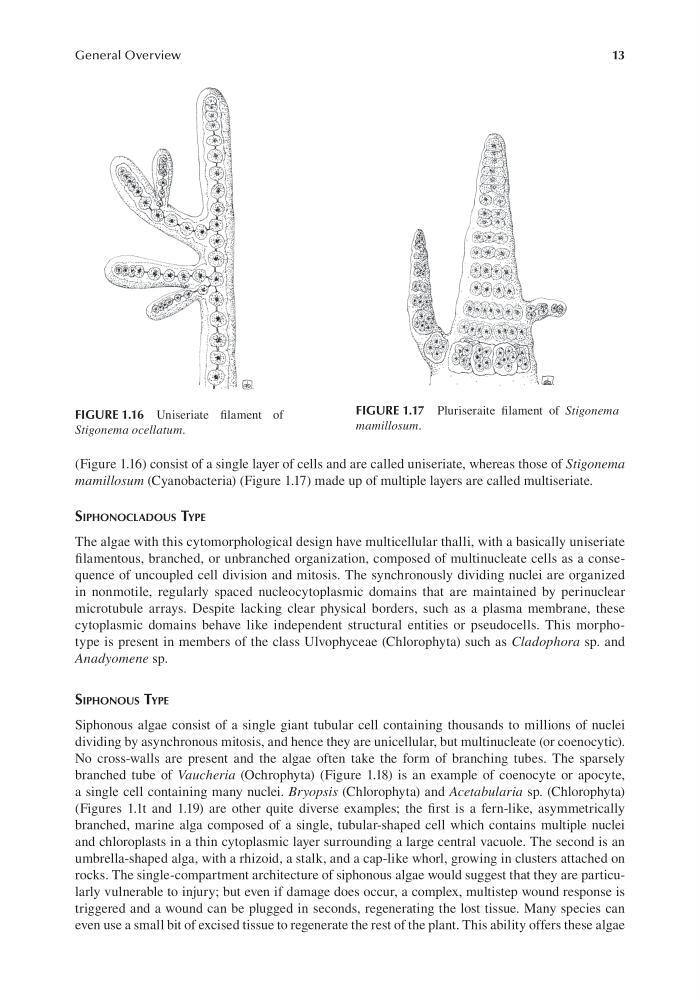
(Figure 1.16) consist of a single layer of cells and are called uniseriate, whereas those of Stigonema
mamillosum (Cyanobacteria) (Figure 1.17) made up of multiple layers are called multiseriate.
siphonocladoUs Type
The algae with this cytomorphological design have multicellular thalli, with a basically uniseriate
filamentous, branched, or unbranched organization, composed of multinucleate cells as a consequence of uncoupled cell division and mitosis. The synchronously dividing nuclei are organized
in nonmotile, regularly spaced nucleocytoplasmic domains that are maintained by perinuclear
microtubule arrays. Despite lacking clear physical borders, such as a plasma membrane, these
cytoplasmic domains behave like independent structural entities or pseudocells. This morphotype is present in members of the class Ulvophyceae (Chlorophyta) such as Cladophora sp. and
Anadyomene sp.
siphonoUs Type
Siphonous algae consist of a single giant tubular cell containing thousands to millions of nuclei
dividing by asynchronous mitosis, and hence they are unicellular, but multinucleate (or coenocytic).
No cross-walls are present and the algae often take the form of branching tubes. The sparsely
branched tube of Vaucheria (Ochrophyta) (Figure 1.18) is an example of coenocyte or apocyte,
a single cell containing many nuclei. Bryopsis (Chlorophyta) and Acetabularia sp. (Chlorophyta)
(Figures 1.1t and 1.19) are other quite diverse examples; the first is a fern-like, asymmetrically
branched, marine alga composed of a single, tubular-shaped cell which contains multiple nuclei
and chloroplasts in a thin cytoplasmic layer surrounding a large central vacuole. The second is an
umbrella-shaped alga, with a rhizoid, a stalk, and a cap-like whorl, growing in clusters attached on
rocks. The single-compartment architecture of siphonous algae would suggest that they are particularly vulnerable to injury; but even if damage does occur, a complex, multistep wound response is
triggered and a wound can be plugged in seconds, regenerating the lost tissue. Many species can
even use a small bit of excised tissue to regenerate the rest of the plant. This ability offers these algae
FIGURE 1.16 Uniseriate filament of
Stigonema ocellatum.
FIGURE 1.17 Pluriseraite filament of Stigonema
mamillosum.
General Overview
(Figure 1.16) consist of a single layer of cells and are called uniseriate, whereas those of Stigonema
mamillosum (Cyanobacteria) (Figure 1.17) made up of multiple layers are called multiseriate.
siphonocladoUs Type
The algae with this cytomorphological design have multicellular thalli, with a basically uniseriate
filamentous, branched, or unbranched organization, composed of multinucleate cells as a consequence of uncoupled cell division and mitosis. The synchronously dividing nuclei are organized
in nonmotile, regularly spaced nucleocytoplasmic domains that are maintained by perinuclear
microtubule arrays. Despite lacking clear physical borders, such as a plasma membrane, these
cytoplasmic domains behave like independent structural entities or pseudocells. This morphotype is present in members of the class Ulvophyceae (Chlorophyta) such as Cladophora sp. and
Anadyomene sp.
siphonoUs Type
Siphonous algae consist of a single giant tubular cell containing thousands to millions of nuclei
dividing by asynchronous mitosis, and hence they are unicellular, but multinucleate (or coenocytic).
No cross-walls are present and the algae often take the form of branching tubes. The sparsely
branched tube of Vaucheria (Ochrophyta) (Figure 1.18) is an example of coenocyte or apocyte,
a single cell containing many nuclei. Bryopsis (Chlorophyta) and Acetabularia sp. (Chlorophyta)
(Figures 1.1t and 1.19) are other quite diverse examples; the first is a fern-like, asymmetrically
branched, marine alga composed of a single, tubular-shaped cell which contains multiple nuclei
and chloroplasts in a thin cytoplasmic layer surrounding a large central vacuole. The second is an
umbrella-shaped alga, with a rhizoid, a stalk, and a cap-like whorl, growing in clusters attached on
rocks. The single-compartment architecture of siphonous algae would suggest that they are particularly vulnerable to injury; but even if damage does occur, a complex, multistep wound response is
triggered and a wound can be plugged in seconds, regenerating the lost tissue. Many species can
even use a small bit of excised tissue to regenerate the rest of the plant. This ability offers these algae
FIGURE 1.16 Uniseriate filament of
Stigonema ocellatum.
FIGURE 1.17 Pluriseraite filament of Stigonema
mamillosum.