

120
Algae
(Figure 2.82). Phycobiliproteins are accessory pigment for the operation of photosystem II also in
Glaucophyta, Cryptophyta, and Rhodophyta.
The thylakoid membranes of Prochloron are organized into stacked and unstacked regions reminiscent of the grana and stromal lamellae of higher plant chloroplasts. They differ from other cyanobacteria in that they contain chlorophyll a/b light-harvesting systems rather than phycobiliproteins
organized in the phycobilisomes.
Glaucophyta
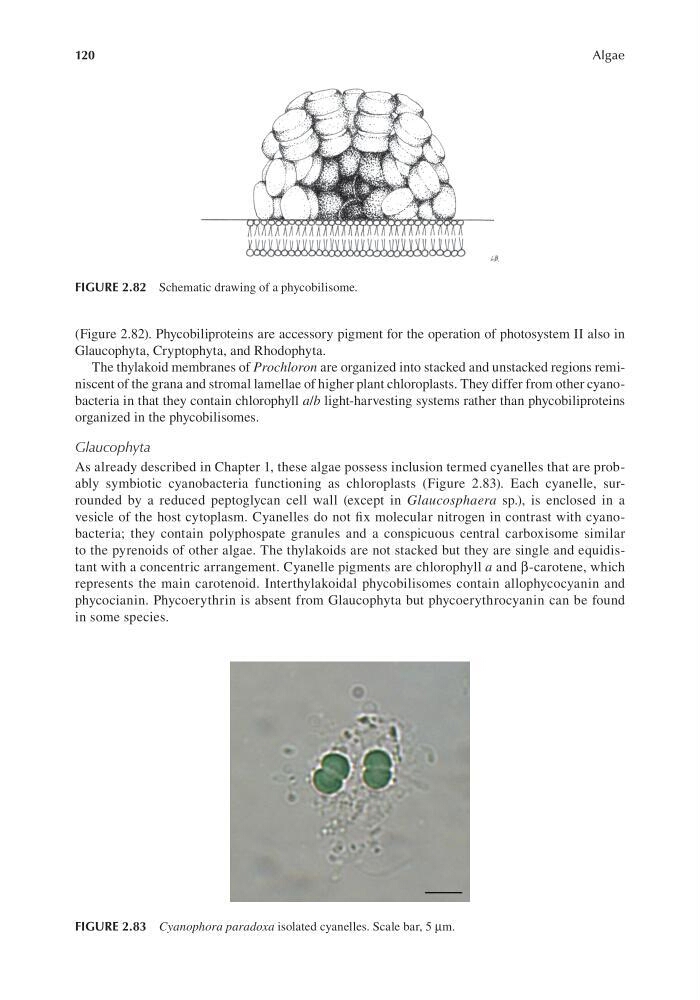
As already described in Chapter 1, these algae possess inclusion termed cyanelles that are probably symbiotic cyanobacteria functioning as chloroplasts (Figure 2.83). Each cyanelle, surrounded by a reduced peptoglycan cell wall (except in Glaucosphaera sp.), is enclosed in a
vesicle of the host cytoplasm. Cyanelles do not fix molecular nitrogen in contrast with cyanobacteria; they contain polyphospate granules and a conspicuous central carboxisome similar
to the pyrenoids of other algae. The thylakoids are not stacked but they are single and equidistant with a concentric arrangement. Cyanelle pigments are chlorophyll a and β-carotene, which
represents the main carotenoid. Interthylakoidal phycobilisomes contain allophycocyanin and
phycocianin. Phycoerythrin is absent from Glaucophyta but phycoerythrocyanin can be found
in some species.
FIGURE 2.82 Schematic drawing of a phycobilisome.
FIGURE 2.83 Cyanophora paradoxa isolated cyanelles. Scale bar, 5 μm.
Algae
(Figure 2.82). Phycobiliproteins are accessory pigment for the operation of photosystem II also in
Glaucophyta, Cryptophyta, and Rhodophyta.
The thylakoid membranes of Prochloron are organized into stacked and unstacked regions reminiscent of the grana and stromal lamellae of higher plant chloroplasts. They differ from other cyanobacteria in that they contain chlorophyll a/b light-harvesting systems rather than phycobiliproteins
organized in the phycobilisomes.
Glaucophyta
As already described in Chapter 1, these algae possess inclusion termed cyanelles that are probably symbiotic cyanobacteria functioning as chloroplasts (Figure 2.83). Each cyanelle, surrounded by a reduced peptoglycan cell wall (except in Glaucosphaera sp.), is enclosed in a
vesicle of the host cytoplasm. Cyanelles do not fix molecular nitrogen in contrast with cyanobacteria; they contain polyphospate granules and a conspicuous central carboxisome similar
to the pyrenoids of other algae. The thylakoids are not stacked but they are single and equidistant with a concentric arrangement. Cyanelle pigments are chlorophyll a and β-carotene, which
represents the main carotenoid. Interthylakoidal phycobilisomes contain allophycocyanin and
phycocianin. Phycoerythrin is absent from Glaucophyta but phycoerythrocyanin can be found
in some species.
FIGURE 2.82 Schematic drawing of a phycobilisome.
FIGURE 2.83 Cyanophora paradoxa isolated cyanelles. Scale bar, 5 μm.