

83
Anatomy
squamata (Mamiellophyceae), due to the reduction in one of the two flagella, and due to its lack of
roots, a 4–3–0–(7–12) system in Nephroselmis (Nephroselmidophyceae), and a 4–6–4–6 system in
Mesostigma (Mesostigmatophyceae). When four microtubular roots are present, as in Pyramimonas,
they extend up to the sides of the flagellar pit toward the anterior of the cell, where they join the
microtubules of the cytoskeleton, which radiate from the flagellar region below the membrane. An
elaborate system of nonstriated fibers connects the basal bodies, which are associated with one or
more rhizoplasts. These contractile structures extend from the proximal ends of the basal bodies
down to the chloroplast, where they branch over the chloroplast surface and get in contact with it.
Some tetraflagellate members of this class possess a synistosome, a fibrous band longitudinally
striated connecting two of the basal bodies, and an asymmetrical structure termed lateral fibrous
band, which forms an arc on one side of the four basal bodies. Proximal connective fibers may be
present between the basal bodies. The microtubular root system of flagellate Chlorophyceae has the
X–2–X–2 pattern except in the stephanokont reproductive cells of Oedogoniales. The roots diverge
from the basal bodies and run beneath the cell membrane toward the posterior of the cell. Fibrous
roots are generally present and associated with the 2-membered microtubular roots. Rhizoplasts
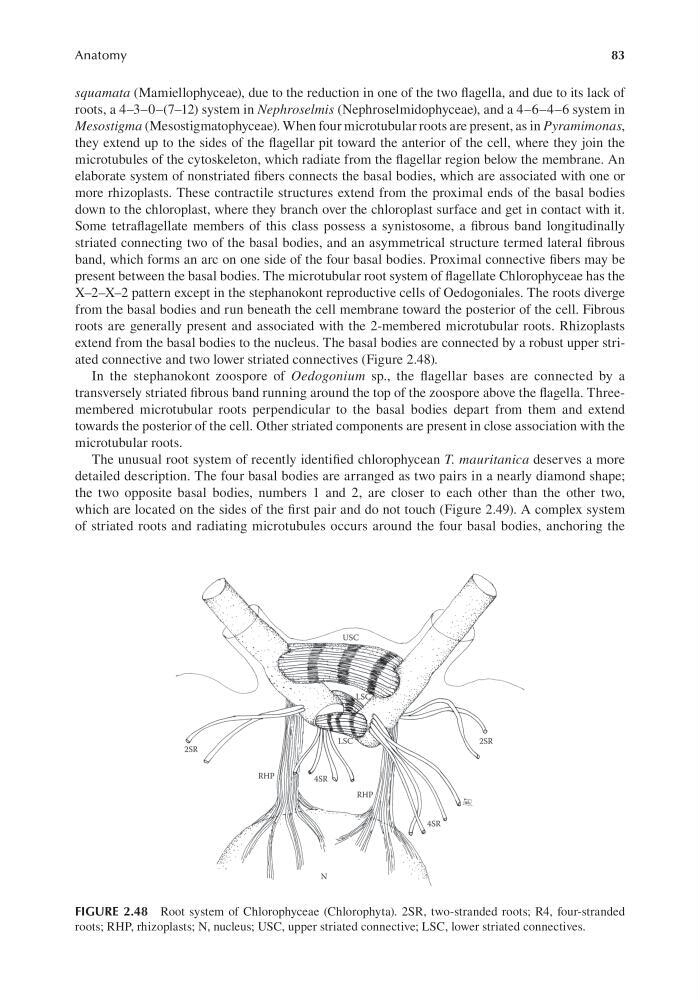
extend from the basal bodies to the nucleus. The basal bodies are connected by a robust upper striated connective and two lower striated connectives (Figure 2.48).
In the stephanokont zoospore of Oedogonium sp., the flagellar bases are connected by a
transversely striated fibrous band running around the top of the zoospore above the flagella. Threemembered microtubular roots perpendicular to the basal bodies depart from them and extend
towards the posterior of the cell. Other striated components are present in close association with the
microtubular roots.
The unusual root system of recently identified chlorophycean T. mauritanica deserves a more
detailed description. The four basal bodies are arranged as two pairs in a nearly diamond shape;
the two opposite basal bodies, numbers 1 and 2, are closer to each other than the other two,
which are located on the sides of the first pair and do not touch (Figure 2.49). A complex system
of striated roots and radiating microtubules occurs around the four basal bodies, anchoring the
FIGURE 2.48 Root system of Chlorophyceae (Chlorophyta). 2SR, two-stranded roots; R4, four-stranded
roots; RHP, rhizoplasts; N, nucleus; USC, upper striated connective; LSC, lower striated connectives.
Anatomy
squamata (Mamiellophyceae), due to the reduction in one of the two flagella, and due to its lack of
roots, a 4–3–0–(7–12) system in Nephroselmis (Nephroselmidophyceae), and a 4–6–4–6 system in
Mesostigma (Mesostigmatophyceae). When four microtubular roots are present, as in Pyramimonas,
they extend up to the sides of the flagellar pit toward the anterior of the cell, where they join the
microtubules of the cytoskeleton, which radiate from the flagellar region below the membrane. An
elaborate system of nonstriated fibers connects the basal bodies, which are associated with one or
more rhizoplasts. These contractile structures extend from the proximal ends of the basal bodies
down to the chloroplast, where they branch over the chloroplast surface and get in contact with it.
Some tetraflagellate members of this class possess a synistosome, a fibrous band longitudinally
striated connecting two of the basal bodies, and an asymmetrical structure termed lateral fibrous
band, which forms an arc on one side of the four basal bodies. Proximal connective fibers may be
present between the basal bodies. The microtubular root system of flagellate Chlorophyceae has the
X–2–X–2 pattern except in the stephanokont reproductive cells of Oedogoniales. The roots diverge
from the basal bodies and run beneath the cell membrane toward the posterior of the cell. Fibrous
roots are generally present and associated with the 2-membered microtubular roots. Rhizoplasts
extend from the basal bodies to the nucleus. The basal bodies are connected by a robust upper striated connective and two lower striated connectives (Figure 2.48).
In the stephanokont zoospore of Oedogonium sp., the flagellar bases are connected by a
transversely striated fibrous band running around the top of the zoospore above the flagella. Threemembered microtubular roots perpendicular to the basal bodies depart from them and extend
towards the posterior of the cell. Other striated components are present in close association with the
microtubular roots.
The unusual root system of recently identified chlorophycean T. mauritanica deserves a more
detailed description. The four basal bodies are arranged as two pairs in a nearly diamond shape;
the two opposite basal bodies, numbers 1 and 2, are closer to each other than the other two,
which are located on the sides of the first pair and do not touch (Figure 2.49). A complex system
of striated roots and radiating microtubules occurs around the four basal bodies, anchoring the
FIGURE 2.48 Root system of Chlorophyceae (Chlorophyta). 2SR, two-stranded roots; R4, four-stranded
roots; RHP, rhizoplasts; N, nucleus; USC, upper striated connective; LSC, lower striated connectives.