

4.2.2 Future Energy Projections and Carbon Mitigation
4.2.2.1 Energy Projections
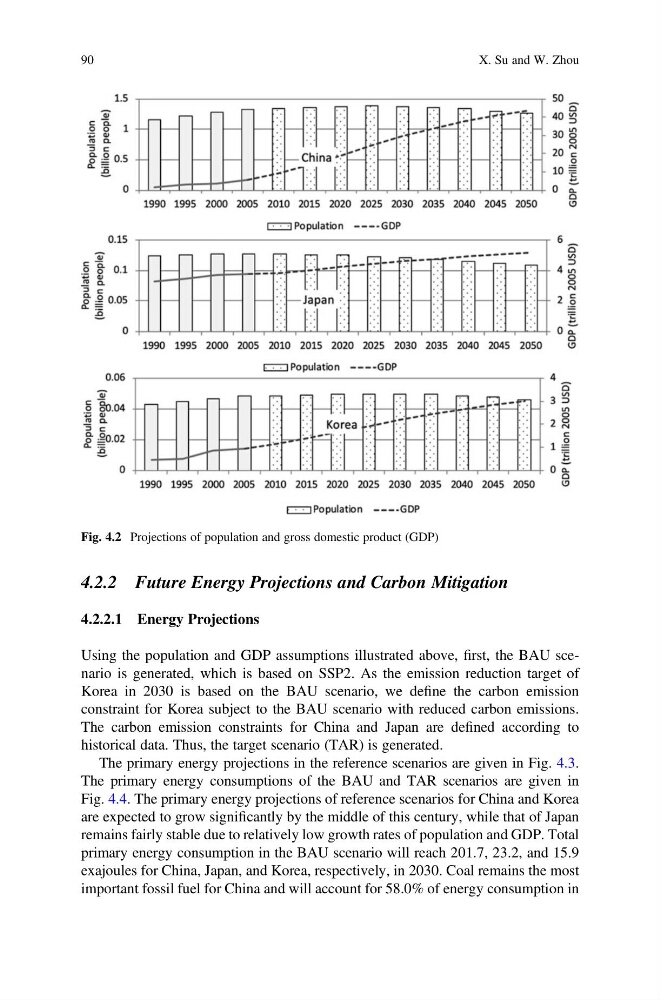
Using the population and GDP assumptions illustrated above, first, the BAU scenario is generated, which is based on SSP2. As the emission reduction target of
Korea in 2030 is based on the BAU scenario, we define the carbon emission
constraint for Korea subject to the BAU scenario with reduced carbon emissions.
The carbon emission constraints for China and Japan are defined according to
historical data. Thus, the target scenario (TAR) is generated.
The primary energy projections in the reference scenarios are given in Fig. 4.3.
The primary energy consumptions of the BAU and TAR scenarios are given in
Fig. 4.4. The primary energy projections of reference scenarios for China and Korea
are expected to grow significantly by the middle of this century, while that of Japan
remains fairly stable due to relatively low growth rates of population and GDP. Total
primary energy consumption in the BAU scenario will reach 201.7, 23.2, and 15.9
exajoules for China, Japan, and Korea, respectively, in 2030. Coal remains the most
important fossil fuel for China and will account for 58.0% of energy consumption in
Fig. 4.2 Projections of population and gross domestic product (GDP)
90
X. Su and W. Zhou
4.2.2.1 Energy Projections
Using the population and GDP assumptions illustrated above, first, the BAU scenario is generated, which is based on SSP2. As the emission reduction target of
Korea in 2030 is based on the BAU scenario, we define the carbon emission
constraint for Korea subject to the BAU scenario with reduced carbon emissions.
The carbon emission constraints for China and Japan are defined according to
historical data. Thus, the target scenario (TAR) is generated.
The primary energy projections in the reference scenarios are given in Fig. 4.3.
The primary energy consumptions of the BAU and TAR scenarios are given in
Fig. 4.4. The primary energy projections of reference scenarios for China and Korea
are expected to grow significantly by the middle of this century, while that of Japan
remains fairly stable due to relatively low growth rates of population and GDP. Total
primary energy consumption in the BAU scenario will reach 201.7, 23.2, and 15.9
exajoules for China, Japan, and Korea, respectively, in 2030. Coal remains the most
important fossil fuel for China and will account for 58.0% of energy consumption in
Fig. 4.2 Projections of population and gross domestic product (GDP)
90
X. Su and W. Zhou