

to global problems. Especially in developing countries, poverty, pollution, and
global environmental problems must be simultaneously addressed. For example,
the combined economies of Japan, China, and South Korea will increase to account
for 25% of the global economy, power consumption will increase to 25%, and CO 2
emissions will increase to 30%. Sulfur oxides (SO x ), dust, and ozone depletion are
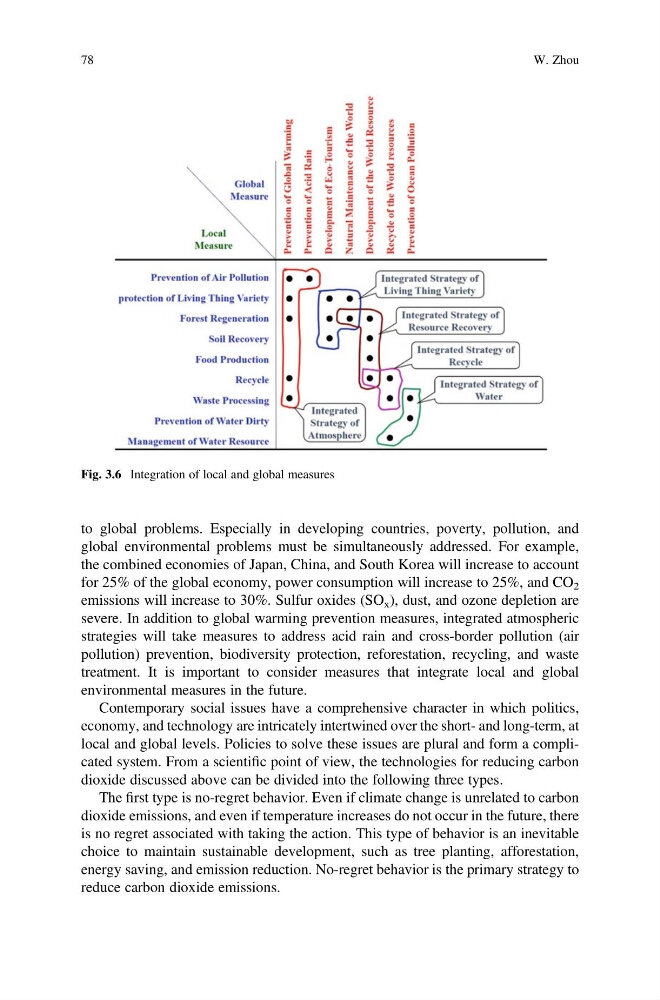
severe. In addition to global warming prevention measures, integrated atmospheric
strategies will take measures to address acid rain and cross-border pollution (air
pollution) prevention, biodiversity protection, reforestation, recycling, and waste
treatment. It is important to consider measures that integrate local and global
environmental measures in the future.
Contemporary social issues have a comprehensive character in which politics,
economy, and technology are intricately intertwined over the short- and long-term, at
local and global levels. Policies to solve these issues are plural and form a complicated system. From a scientific point of view, the technologies for reducing carbon
dioxide discussed above can be divided into the following three types.
The first type is no-regret behavior. Even if climate change is unrelated to carbon
dioxide emissions, and even if temperature increases do not occur in the future, there
is no regret associated with taking the action. This type of behavior is an inevitable
choice to maintain sustainable development, such as tree planting, afforestation,
energy saving, and emission reduction. No-regret behavior is the primary strategy to
reduce carbon dioxide emissions.
Fig. 3.6 Integration of local and global measures
78
W. Zhou
global environmental problems must be simultaneously addressed. For example,
the combined economies of Japan, China, and South Korea will increase to account
for 25% of the global economy, power consumption will increase to 25%, and CO 2
emissions will increase to 30%. Sulfur oxides (SO x ), dust, and ozone depletion are
severe. In addition to global warming prevention measures, integrated atmospheric
strategies will take measures to address acid rain and cross-border pollution (air
pollution) prevention, biodiversity protection, reforestation, recycling, and waste
treatment. It is important to consider measures that integrate local and global
environmental measures in the future.
Contemporary social issues have a comprehensive character in which politics,
economy, and technology are intricately intertwined over the short- and long-term, at
local and global levels. Policies to solve these issues are plural and form a complicated system. From a scientific point of view, the technologies for reducing carbon
dioxide discussed above can be divided into the following three types.
The first type is no-regret behavior. Even if climate change is unrelated to carbon
dioxide emissions, and even if temperature increases do not occur in the future, there
is no regret associated with taking the action. This type of behavior is an inevitable
choice to maintain sustainable development, such as tree planting, afforestation,
energy saving, and emission reduction. No-regret behavior is the primary strategy to
reduce carbon dioxide emissions.
Fig. 3.6 Integration of local and global measures
78
W. Zhou