

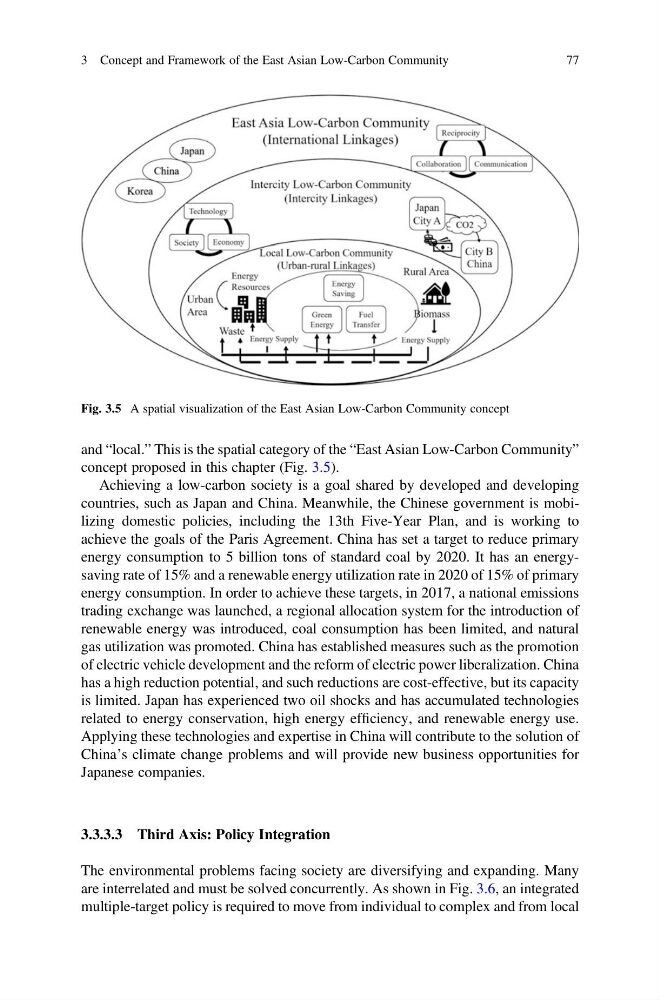
and “local.” This is the spatial category of the “East Asian Low-Carbon Community”
concept proposed in this chapter (Fig. 3.5).
Achieving a low-carbon society is a goal shared by developed and developing
countries, such as Japan and China. Meanwhile, the Chinese government is mobilizing domestic policies, including the 13th Five-Year Plan, and is working to
achieve the goals of the Paris Agreement. China has set a target to reduce primary
energy consumption to 5 billion tons of standard coal by 2020. It has an energysaving rate of 15% and a renewable energy utilization rate in 2020 of 15% of primary
energy consumption. In order to achieve these targets, in 2017, a national emissions
trading exchange was launched, a regional allocation system for the introduction of
renewable energy was introduced, coal consumption has been limited, and natural
gas utilization was promoted. China has established measures such as the promotion
of electric vehicle development and the reform of electric power liberalization. China
has a high reduction potential, and such reductions are cost-effective, but its capacity
is limited. Japan has experienced two oil shocks and has accumulated technologies
related to energy conservation, high energy efficiency, and renewable energy use.
Applying these technologies and expertise in China will contribute to the solution of
China’s climate change problems and will provide new business opportunities for
Japanese companies.
3.3.3.3 Third Axis: Policy Integration
The environmental problems facing society are diversifying and expanding. Many
are interrelated and must be solved concurrently. As shown in Fig. 3.6, an integrated
multiple-target policy is required to move from individual to complex and from local
Fig. 3.5 A spatial visualization of the East Asian Low-Carbon Community concept
3 Concept and Framework of the East Asian Low-Carbon Community
77
concept proposed in this chapter (Fig. 3.5).
Achieving a low-carbon society is a goal shared by developed and developing
countries, such as Japan and China. Meanwhile, the Chinese government is mobilizing domestic policies, including the 13th Five-Year Plan, and is working to
achieve the goals of the Paris Agreement. China has set a target to reduce primary
energy consumption to 5 billion tons of standard coal by 2020. It has an energysaving rate of 15% and a renewable energy utilization rate in 2020 of 15% of primary
energy consumption. In order to achieve these targets, in 2017, a national emissions
trading exchange was launched, a regional allocation system for the introduction of
renewable energy was introduced, coal consumption has been limited, and natural
gas utilization was promoted. China has established measures such as the promotion
of electric vehicle development and the reform of electric power liberalization. China
has a high reduction potential, and such reductions are cost-effective, but its capacity
is limited. Japan has experienced two oil shocks and has accumulated technologies
related to energy conservation, high energy efficiency, and renewable energy use.
Applying these technologies and expertise in China will contribute to the solution of
China’s climate change problems and will provide new business opportunities for
Japanese companies.
3.3.3.3 Third Axis: Policy Integration
The environmental problems facing society are diversifying and expanding. Many
are interrelated and must be solved concurrently. As shown in Fig. 3.6, an integrated
multiple-target policy is required to move from individual to complex and from local
Fig. 3.5 A spatial visualization of the East Asian Low-Carbon Community concept
3 Concept and Framework of the East Asian Low-Carbon Community
77