

benefits of greenhouse gas concentrations (non-exclusivity), and the enjoyment of
others cannot change the total concentration of greenhouse gases. Since greenhouse
gas concentrations are non-competitive, this provides a typical example of a public
good, and since it has global spread, it is a global public good. Thus, all humans have
universal rights and responsibilities for this global public good that is characterized
by non-competitiveness and non-exclusivity. The right to emit CO 2 is equal to all
humans; all people have equivalent CO 2 emission rights.
A regulation of equal permissible emission per capita under the total amount is
used to equalize per capita emission rights. For example, atmospheric CO 2 concentration in 2100 is the permissible range for global climate change prevention. The
permissible amount of per capita emissions divided by the predicted global population gives the total amount of permissible emissions allowing stabilization at the
target 450 ppm (approximately twice the amount before the Industrial Revolution)
(Zhou 2006).
According to the principle of “common but differentiated responsibilities” stipulated in the Framework Convention on Climate Change, equity must be sought
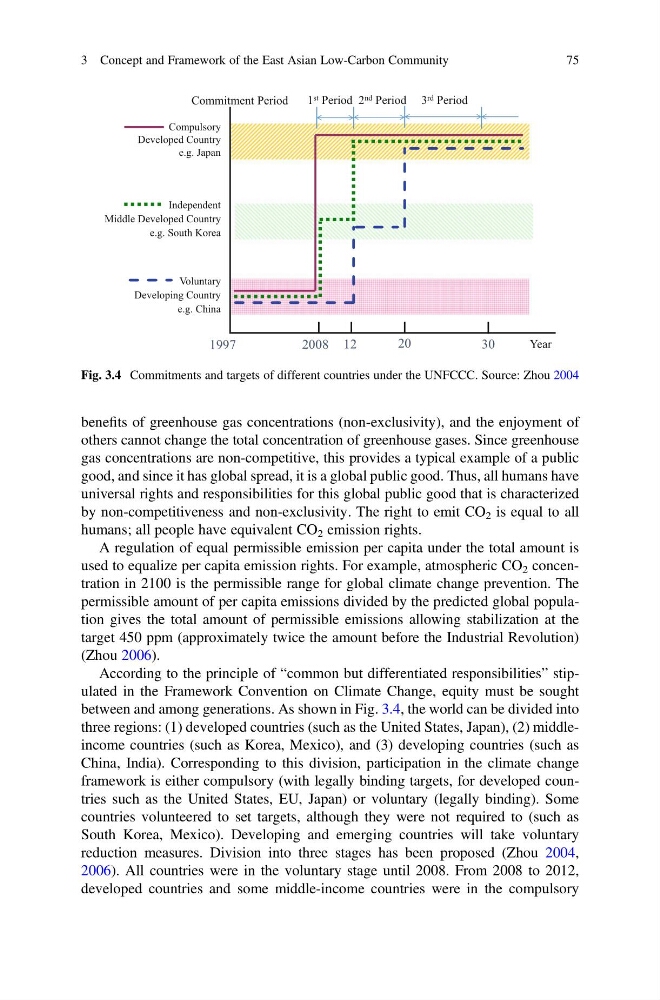
between and among generations. As shown in Fig. 3.4, the world can be divided into
three regions: (1) developed countries (such as the United States, Japan), (2) middleincome countries (such as Korea, Mexico), and (3) developing countries (such as
China, India). Corresponding to this division, participation in the climate change
framework is either compulsory (with legally binding targets, for developed countries such as the United States, EU, Japan) or voluntary (legally binding). Some
countries volunteered to set targets, although they were not required to (such as
South Korea, Mexico). Developing and emerging countries will take voluntary
reduction measures. Division into three stages has been proposed (Zhou 2004,
2006). All countries were in the voluntary stage until 2008. From 2008 to 2012,
developed countries and some middle-income countries were in the compulsory
Compulsory
Developed Country
e.g. Japan
Independent
Middle Developed Country
e.g. South Korea
Voluntary
Developing Country
e.g. China
1997
12
20
30
Year
2008
1 st Period 2 nd Period 3 rd Period
Commitment Period
Fig. 3.4 Commitments and targets of different countries under the UNFCCC. Source: Zhou 2004
3 Concept and Framework of the East Asian Low-Carbon Community
75
others cannot change the total concentration of greenhouse gases. Since greenhouse
gas concentrations are non-competitive, this provides a typical example of a public
good, and since it has global spread, it is a global public good. Thus, all humans have
universal rights and responsibilities for this global public good that is characterized
by non-competitiveness and non-exclusivity. The right to emit CO 2 is equal to all
humans; all people have equivalent CO 2 emission rights.
A regulation of equal permissible emission per capita under the total amount is
used to equalize per capita emission rights. For example, atmospheric CO 2 concentration in 2100 is the permissible range for global climate change prevention. The
permissible amount of per capita emissions divided by the predicted global population gives the total amount of permissible emissions allowing stabilization at the
target 450 ppm (approximately twice the amount before the Industrial Revolution)
(Zhou 2006).
According to the principle of “common but differentiated responsibilities” stipulated in the Framework Convention on Climate Change, equity must be sought
between and among generations. As shown in Fig. 3.4, the world can be divided into
three regions: (1) developed countries (such as the United States, Japan), (2) middleincome countries (such as Korea, Mexico), and (3) developing countries (such as
China, India). Corresponding to this division, participation in the climate change
framework is either compulsory (with legally binding targets, for developed countries such as the United States, EU, Japan) or voluntary (legally binding). Some
countries volunteered to set targets, although they were not required to (such as
South Korea, Mexico). Developing and emerging countries will take voluntary
reduction measures. Division into three stages has been proposed (Zhou 2004,
2006). All countries were in the voluntary stage until 2008. From 2008 to 2012,
developed countries and some middle-income countries were in the compulsory
Compulsory
Developed Country
e.g. Japan
Independent
Middle Developed Country
e.g. South Korea
Voluntary
Developing Country
e.g. China
1997
12
20
30
Year
2008
1 st Period 2 nd Period 3 rd Period
Commitment Period
Fig. 3.4 Commitments and targets of different countries under the UNFCCC. Source: Zhou 2004
3 Concept and Framework of the East Asian Low-Carbon Community
75