

3.3.3 Framework for the East Asian Low-Carbon Community
In the climate framework, Japan, South Korea, and China are developed, middleincome, and developing (emerging) countries, respectively. East Asia needs to
simultaneously address global issues of climate change and local issues of economic
development and pollution control. The concept of the East Asian Low-Carbon
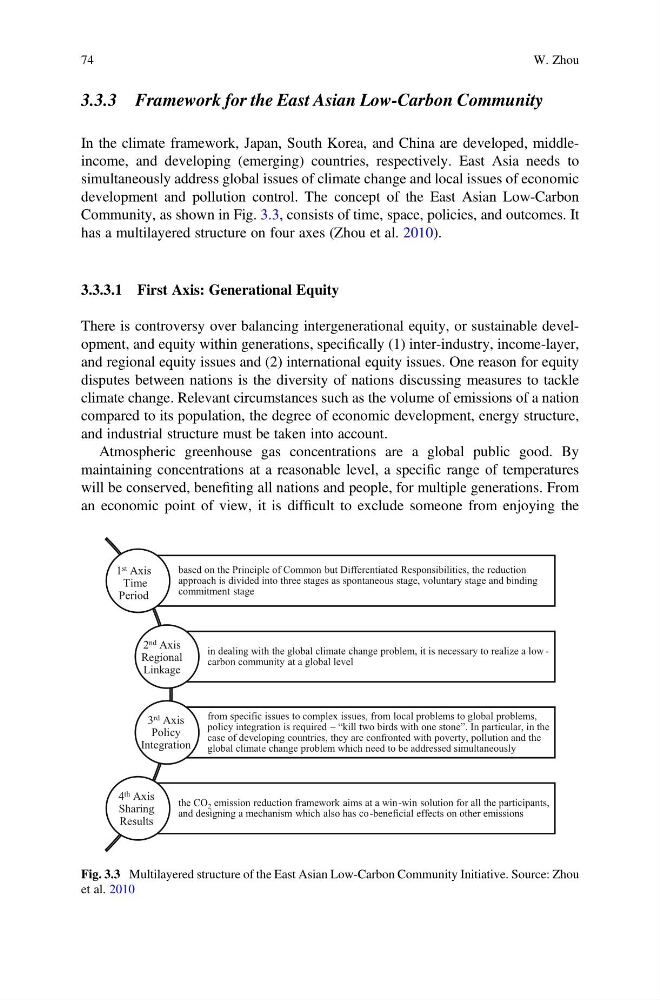
Community, as shown in Fig. 3.3, consists of time, space, policies, and outcomes. It
has a multilayered structure on four axes (Zhou et al. 2010).
3.3.3.1 First Axis: Generational Equity
There is controversy over balancing intergenerational equity, or sustainable development, and equity within generations, specifically (1) inter-industry, income-layer,
and regional equity issues and (2) international equity issues. One reason for equity
disputes between nations is the diversity of nations discussing measures to tackle
climate change. Relevant circumstances such as the volume of emissions of a nation
compared to its population, the degree of economic development, energy structure,
and industrial structure must be taken into account.
Atmospheric greenhouse gas concentrations are a global public good. By
maintaining concentrations at a reasonable level, a specific range of temperatures
will be conserved, benefiting all nations and people, for multiple generations. From
an economic point of view, it is difficult to exclude someone from enjoying the
based on the Principle of Common but Differentiated Responsibilities, the reduction
approach is divided into three stages as spontaneous stage, voluntary stage and binding
commitment stage
in dealing with the global climate change problem, it is necessary to realize a low -
carbon community at a global level
from specific issues to complex issues, from local problems to global problems,
policy integration is required – “kill two birds with one stone”. In particular, in the
case of developing countries, they are confronted with poverty, pollution and the
global climate change problem which need to be addressed simultaneously
the CO 2 emission reduction framework aims at a win-win solution for all the participants,
and designing a mechanism which also has co-beneficial effects on other emissions
1 st Axis
Time
Period
2 nd Axis
Regional
Linkage
3 rd Axis
Policy
Integration
4 th Axis
Sharing
Results
Fig. 3.3 Multilayered structure of the East Asian Low-Carbon Community Initiative. Source: Zhou
et al. 2010
74
W. Zhou
In the climate framework, Japan, South Korea, and China are developed, middleincome, and developing (emerging) countries, respectively. East Asia needs to
simultaneously address global issues of climate change and local issues of economic
development and pollution control. The concept of the East Asian Low-Carbon
Community, as shown in Fig. 3.3, consists of time, space, policies, and outcomes. It
has a multilayered structure on four axes (Zhou et al. 2010).
3.3.3.1 First Axis: Generational Equity
There is controversy over balancing intergenerational equity, or sustainable development, and equity within generations, specifically (1) inter-industry, income-layer,
and regional equity issues and (2) international equity issues. One reason for equity
disputes between nations is the diversity of nations discussing measures to tackle
climate change. Relevant circumstances such as the volume of emissions of a nation
compared to its population, the degree of economic development, energy structure,
and industrial structure must be taken into account.
Atmospheric greenhouse gas concentrations are a global public good. By
maintaining concentrations at a reasonable level, a specific range of temperatures
will be conserved, benefiting all nations and people, for multiple generations. From
an economic point of view, it is difficult to exclude someone from enjoying the
based on the Principle of Common but Differentiated Responsibilities, the reduction
approach is divided into three stages as spontaneous stage, voluntary stage and binding
commitment stage
in dealing with the global climate change problem, it is necessary to realize a low -
carbon community at a global level
from specific issues to complex issues, from local problems to global problems,
policy integration is required – “kill two birds with one stone”. In particular, in the
case of developing countries, they are confronted with poverty, pollution and the
global climate change problem which need to be addressed simultaneously
the CO 2 emission reduction framework aims at a win-win solution for all the participants,
and designing a mechanism which also has co-beneficial effects on other emissions
1 st Axis
Time
Period
2 nd Axis
Regional
Linkage
3 rd Axis
Policy
Integration
4 th Axis
Sharing
Results
Fig. 3.3 Multilayered structure of the East Asian Low-Carbon Community Initiative. Source: Zhou
et al. 2010
74
W. Zhou