

coal-fired power generation in China can be improved to be higher than that of
Japan, the amount of CO 2 reduction would be equivalent to approximately half of
Japan’s annual emissions. This would also significantly reduce coal consumption in
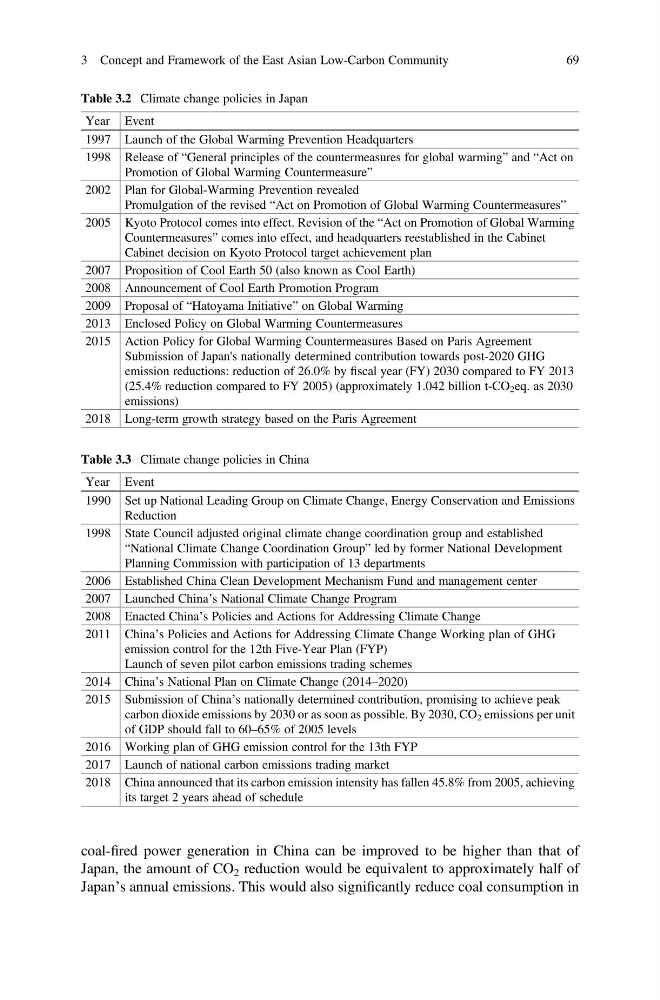
Table 3.2 Climate change policies in Japan
Year Event
1997 Launch of the Global Warming Prevention Headquarters
1998 Release of “General principles of the countermeasures for global warming” and “Act on
Promotion of Global Warming Countermeasure”
2002 Plan for Global-Warming Prevention revealed
Promulgation of the revised “Act on Promotion of Global Warming Countermeasures”
2005 Kyoto Protocol comes into effect. Revision of the “Act on Promotion of Global Warming
Countermeasures” comes into effect, and headquarters reestablished in the Cabinet
Cabinet decision on Kyoto Protocol target achievement plan
2007 Proposition of Cool Earth 50 (also known as Cool Earth)
2008 Announcement of Cool Earth Promotion Program
2009 Proposal of “Hatoyama Initiative” on Global Warming
2013 Enclosed Policy on Global Warming Countermeasures
2015 Action Policy for Global Warming Countermeasures Based on Paris Agreement
Submission of Japan's nationally determined contribution towards post-2020 GHG
emission reductions: reduction of 26.0% by fiscal year (FY) 2030 compared to FY 2013
(25.4% reduction compared to FY 2005) (approximately 1.042 billion t-CO 2 eq. as 2030
emissions)
2018 Long-term growth strategy based on the Paris Agreement
Table 3.3 Climate change policies in China
Year Event
1990 Set up National Leading Group on Climate Change, Energy Conservation and Emissions
Reduction
1998 State Council adjusted original climate change coordination group and established
“National Climate Change Coordination Group” led by former National Development
Planning Commission with participation of 13 departments
2006 Established China Clean Development Mechanism Fund and management center
2007 Launched China’s National Climate Change Program
2008 Enacted China’s Policies and Actions for Addressing Climate Change
2011 China’s Policies and Actions for Addressing Climate Change Working plan of GHG
emission control for the 12th Five-Year Plan (FYP)
Launch of seven pilot carbon emissions trading schemes
2014 China’s National Plan on Climate Change (2014–2020)
2015 Submission of China’s nationally determined contribution, promising to achieve peak
carbon dioxide emissions by 2030 or as soon as possible. By 2030, CO 2 emissions per unit
of GDP should fall to 60–65% of 2005 levels
2016 Working plan of GHG emission control for the 13th FYP
2017 Launch of national carbon emissions trading market
2018 China announced that its carbon emission intensity has fallen 45.8% from 2005, achieving
its target 2 years ahead of schedule
3 Concept and Framework of the East Asian Low-Carbon Community
69
Japan, the amount of CO 2 reduction would be equivalent to approximately half of
Japan’s annual emissions. This would also significantly reduce coal consumption in
Table 3.2 Climate change policies in Japan
Year Event
1997 Launch of the Global Warming Prevention Headquarters
1998 Release of “General principles of the countermeasures for global warming” and “Act on
Promotion of Global Warming Countermeasure”
2002 Plan for Global-Warming Prevention revealed
Promulgation of the revised “Act on Promotion of Global Warming Countermeasures”
2005 Kyoto Protocol comes into effect. Revision of the “Act on Promotion of Global Warming
Countermeasures” comes into effect, and headquarters reestablished in the Cabinet
Cabinet decision on Kyoto Protocol target achievement plan
2007 Proposition of Cool Earth 50 (also known as Cool Earth)
2008 Announcement of Cool Earth Promotion Program
2009 Proposal of “Hatoyama Initiative” on Global Warming
2013 Enclosed Policy on Global Warming Countermeasures
2015 Action Policy for Global Warming Countermeasures Based on Paris Agreement
Submission of Japan's nationally determined contribution towards post-2020 GHG
emission reductions: reduction of 26.0% by fiscal year (FY) 2030 compared to FY 2013
(25.4% reduction compared to FY 2005) (approximately 1.042 billion t-CO 2 eq. as 2030
emissions)
2018 Long-term growth strategy based on the Paris Agreement
Table 3.3 Climate change policies in China
Year Event
1990 Set up National Leading Group on Climate Change, Energy Conservation and Emissions
Reduction
1998 State Council adjusted original climate change coordination group and established
“National Climate Change Coordination Group” led by former National Development
Planning Commission with participation of 13 departments
2006 Established China Clean Development Mechanism Fund and management center
2007 Launched China’s National Climate Change Program
2008 Enacted China’s Policies and Actions for Addressing Climate Change
2011 China’s Policies and Actions for Addressing Climate Change Working plan of GHG
emission control for the 12th Five-Year Plan (FYP)
Launch of seven pilot carbon emissions trading schemes
2014 China’s National Plan on Climate Change (2014–2020)
2015 Submission of China’s nationally determined contribution, promising to achieve peak
carbon dioxide emissions by 2030 or as soon as possible. By 2030, CO 2 emissions per unit
of GDP should fall to 60–65% of 2005 levels
2016 Working plan of GHG emission control for the 13th FYP
2017 Launch of national carbon emissions trading market
2018 China announced that its carbon emission intensity has fallen 45.8% from 2005, achieving
its target 2 years ahead of schedule
3 Concept and Framework of the East Asian Low-Carbon Community
69