

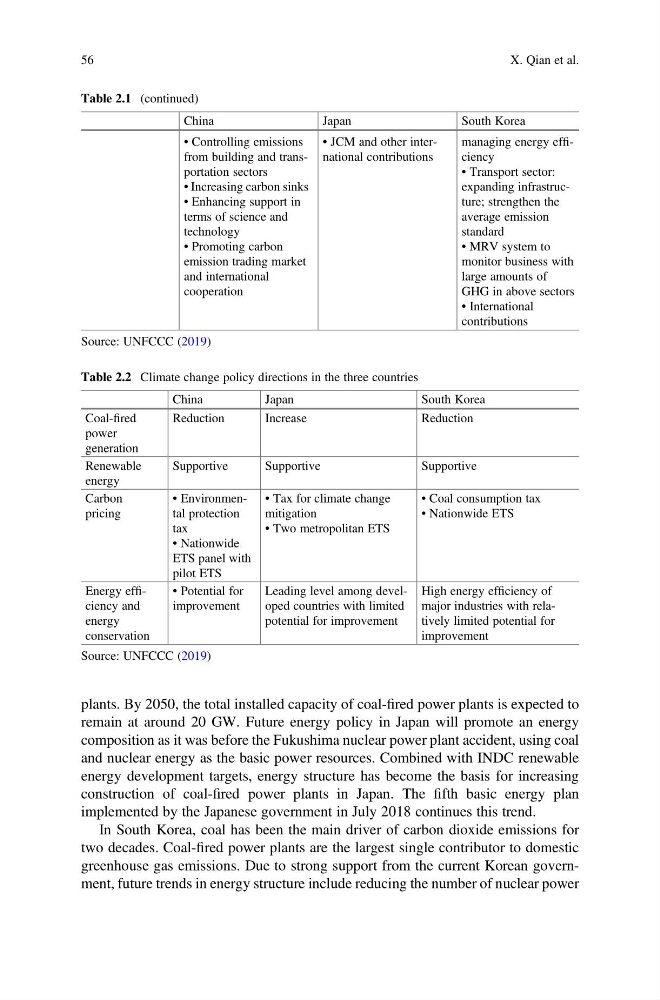
plants. By 2050, the total installed capacity of coal-fired power plants is expected to
remain at around 20 GW. Future energy policy in Japan will promote an energy
composition as it was before the Fukushima nuclear power plant accident, using coal
and nuclear energy as the basic power resources. Combined with INDC renewable
energy development targets, energy structure has become the basis for increasing
construction of coal-fired power plants in Japan. The fifth basic energy plan
implemented by the Japanese government in July 2018 continues this trend.
In South Korea, coal has been the main driver of carbon dioxide emissions for
two decades. Coal-fired power plants are the largest single contributor to domestic
greenhouse gas emissions. Due to strong support from the current Korean government, future trends in energy structure include reducing the number of nuclear power
Table 2.1 (continued)
China
Japan
South Korea
• Controlling emissions
from building and transportation sectors
• Increasing carbon sinks
• Enhancing support in
terms of science and
technology
• Promoting carbon
emission trading market
and international
cooperation
• JCM and other international contributions
managing energy efficiency
• Transport sector:
expanding infrastructure; strengthen the
average emission
standard
• MRV system to
monitor business with
large amounts of
GHG in above sectors
• International
contributions
Source: UNFCCC (2019)
Table 2.2 Climate change policy directions in the three countries
China
Japan
South Korea
Coal-fired
power
generation
Reduction
Increase
Reduction
Renewable
energy
Supportive
Supportive
Supportive
Carbon
pricing
• Environmental protection
tax
• Nationwide
ETS panel with
pilot ETS
• Tax for climate change
mitigation
• Two metropolitan ETS
• Coal consumption tax
• Nationwide ETS
Energy efficiency and
energy
conservation
• Potential for
improvement
Leading level among developed countries with limited
potential for improvement
High energy efficiency of
major industries with relatively limited potential for
improvement
Source: UNFCCC (2019)
56
X. Qian et al.
remain at around 20 GW. Future energy policy in Japan will promote an energy
composition as it was before the Fukushima nuclear power plant accident, using coal
and nuclear energy as the basic power resources. Combined with INDC renewable
energy development targets, energy structure has become the basis for increasing
construction of coal-fired power plants in Japan. The fifth basic energy plan
implemented by the Japanese government in July 2018 continues this trend.
In South Korea, coal has been the main driver of carbon dioxide emissions for
two decades. Coal-fired power plants are the largest single contributor to domestic
greenhouse gas emissions. Due to strong support from the current Korean government, future trends in energy structure include reducing the number of nuclear power
Table 2.1 (continued)
China
Japan
South Korea
• Controlling emissions
from building and transportation sectors
• Increasing carbon sinks
• Enhancing support in
terms of science and
technology
• Promoting carbon
emission trading market
and international
cooperation
• JCM and other international contributions
managing energy efficiency
• Transport sector:
expanding infrastructure; strengthen the
average emission
standard
• MRV system to
monitor business with
large amounts of
GHG in above sectors
• International
contributions
Source: UNFCCC (2019)
Table 2.2 Climate change policy directions in the three countries
China
Japan
South Korea
Coal-fired
power
generation
Reduction
Increase
Reduction
Renewable
energy
Supportive
Supportive
Supportive
Carbon
pricing
• Environmental protection
tax
• Nationwide
ETS panel with
pilot ETS
• Tax for climate change
mitigation
• Two metropolitan ETS
• Coal consumption tax
• Nationwide ETS
Energy efficiency and
energy
conservation
• Potential for
improvement
Leading level among developed countries with limited
potential for improvement
High energy efficiency of
major industries with relatively limited potential for
improvement
Source: UNFCCC (2019)
56
X. Qian et al.