

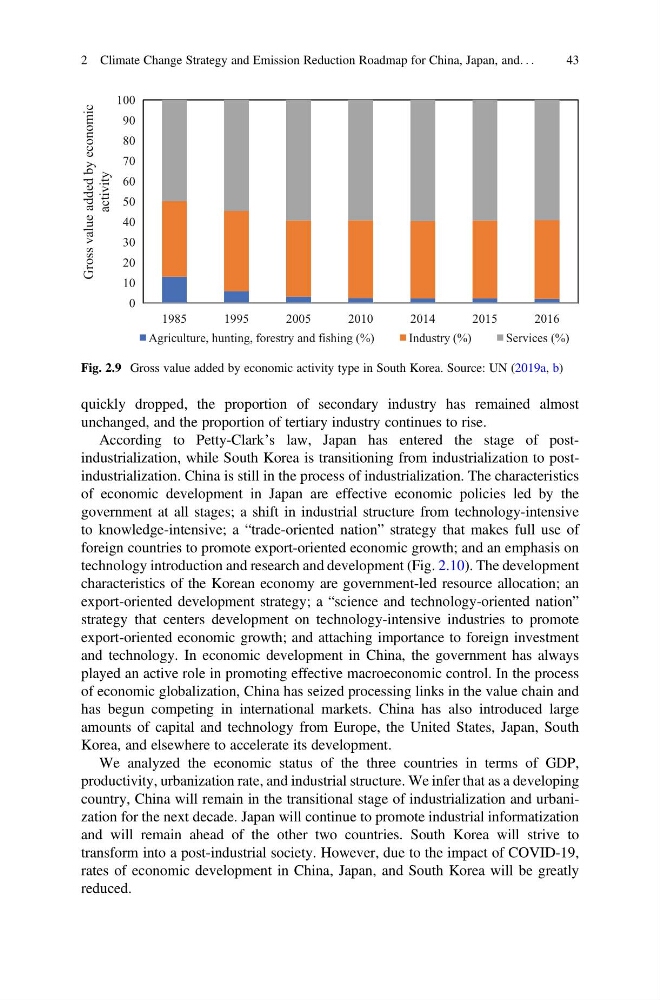
quickly dropped, the proportion of secondary industry has remained almost
unchanged, and the proportion of tertiary industry continues to rise.
According to Petty-Clark’s law, Japan has entered the stage of postindustrialization, while South Korea is transitioning from industrialization to postindustrialization. China is still in the process of industrialization. The characteristics
of economic development in Japan are effective economic policies led by the
government at all stages; a shift in industrial structure from technology-intensive
to knowledge-intensive; a “trade-oriented nation” strategy that makes full use of
foreign countries to promote export-oriented economic growth; and an emphasis on
technology introduction and research and development (Fig. 2.10). The development
characteristics of the Korean economy are government-led resource allocation; an
export-oriented development strategy; a “science and technology-oriented nation”
strategy that centers development on technology-intensive industries to promote
export-oriented economic growth; and attaching importance to foreign investment
and technology. In economic development in China, the government has always
played an active role in promoting effective macroeconomic control. In the process
of economic globalization, China has seized processing links in the value chain and
has begun competing in international markets. China has also introduced large
amounts of capital and technology from Europe, the United States, Japan, South
Korea, and elsewhere to accelerate its development.
We analyzed the economic status of the three countries in terms of GDP,
productivity, urbanization rate, and industrial structure. We infer that as a developing
country, China will remain in the transitional stage of industrialization and urbanization for the next decade. Japan will continue to promote industrial informatization
and will remain ahead of the other two countries. South Korea will strive to
transform into a post-industrial society. However, due to the impact of COVID-19,
rates of economic development in China, Japan, and South Korea will be greatly
reduced.
0
10
20
30
40
50
60
70
80
90
100
1985
1995
2005
2010
2014
2015
2016
Gross value added by economic
activity
Agriculture, hunting, forestry and fishing (%)
Industry (%)
Services (%)
Fig. 2.9 Gross value added by economic activity type in South Korea. Source: UN (2019a, b)
2 Climate Change Strategy and Emission Reduction Roadmap for China, Japan, and. . .
43
unchanged, and the proportion of tertiary industry continues to rise.
According to Petty-Clark’s law, Japan has entered the stage of postindustrialization, while South Korea is transitioning from industrialization to postindustrialization. China is still in the process of industrialization. The characteristics
of economic development in Japan are effective economic policies led by the
government at all stages; a shift in industrial structure from technology-intensive
to knowledge-intensive; a “trade-oriented nation” strategy that makes full use of
foreign countries to promote export-oriented economic growth; and an emphasis on
technology introduction and research and development (Fig. 2.10). The development
characteristics of the Korean economy are government-led resource allocation; an
export-oriented development strategy; a “science and technology-oriented nation”
strategy that centers development on technology-intensive industries to promote
export-oriented economic growth; and attaching importance to foreign investment
and technology. In economic development in China, the government has always
played an active role in promoting effective macroeconomic control. In the process
of economic globalization, China has seized processing links in the value chain and
has begun competing in international markets. China has also introduced large
amounts of capital and technology from Europe, the United States, Japan, South
Korea, and elsewhere to accelerate its development.
We analyzed the economic status of the three countries in terms of GDP,
productivity, urbanization rate, and industrial structure. We infer that as a developing
country, China will remain in the transitional stage of industrialization and urbanization for the next decade. Japan will continue to promote industrial informatization
and will remain ahead of the other two countries. South Korea will strive to
transform into a post-industrial society. However, due to the impact of COVID-19,
rates of economic development in China, Japan, and South Korea will be greatly
reduced.
0
10
20
30
40
50
60
70
80
90
100
1985
1995
2005
2010
2014
2015
2016
Gross value added by economic
activity
Agriculture, hunting, forestry and fishing (%)
Industry (%)
Services (%)
Fig. 2.9 Gross value added by economic activity type in South Korea. Source: UN (2019a, b)
2 Climate Change Strategy and Emission Reduction Roadmap for China, Japan, and. . .
43