

Eliminating the upper limit on solar power generation facilities has certainly
increased the number of solar power installations. As of 2008, the cumulative
installed capacity of German solar power generation facilities became the highest
in the world (REN21 2009). However, there was a rapid increase in levies required
due to mass introduction of expensive solar power generation. In neighboring Spain,
vocal opposition to the government resulted in an effective reduction in the purchase
price by imposing an environmental tax on renewable power generation businesses.
Since 2009 in Germany, solar power levies have accounted for more than half of all
levies. Under these circumstances, EEG 2009, which was implemented in January
2009, applied a large reduction rate to the purchase price for photovoltaic power
generation, especially for facilities of 1 MW or more. Although the purchase price
reduction for solar power generation slowed the rate of increase in solar power
generation, the ratio of solar power to total renewable energy power generation
facilities continued to expand. As Germany, like Japan, had not reflected the cost
reduction of solar power generation systems in purchase prices at that time, investing
in solar power generation returned a higher rate of profit than other forms of
renewable energy. For this reason, EEG 2012 changed the frequency of purchase
price revision from once every 6 months to monthly. In addition, a reduction rate of
À0.5 to 2.8% was applied to the purchase price according to newly installed capacity
in the most recent year.
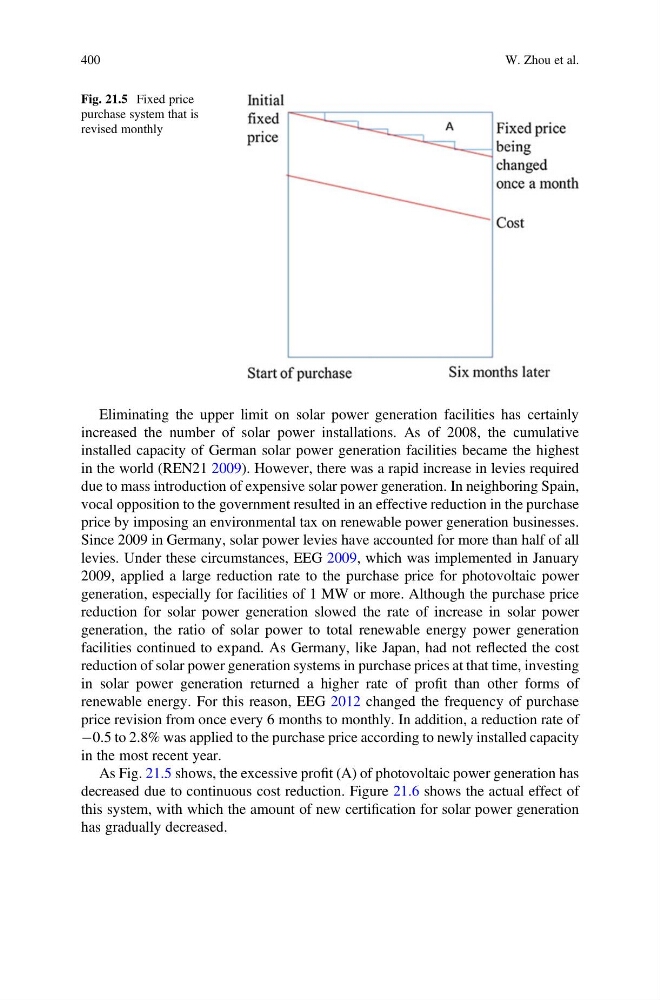
As Fig. 21.5 shows, the excessive profit (A) of photovoltaic power generation has
decreased due to continuous cost reduction. Figure 21.6 shows the actual effect of
this system, with which the amount of new certification for solar power generation
has gradually decreased.
Fig. 21.5 Fixed price
purchase system that is
revised monthly
400
W. Zhou et al.
increased the number of solar power installations. As of 2008, the cumulative
installed capacity of German solar power generation facilities became the highest
in the world (REN21 2009). However, there was a rapid increase in levies required
due to mass introduction of expensive solar power generation. In neighboring Spain,
vocal opposition to the government resulted in an effective reduction in the purchase
price by imposing an environmental tax on renewable power generation businesses.
Since 2009 in Germany, solar power levies have accounted for more than half of all
levies. Under these circumstances, EEG 2009, which was implemented in January
2009, applied a large reduction rate to the purchase price for photovoltaic power
generation, especially for facilities of 1 MW or more. Although the purchase price
reduction for solar power generation slowed the rate of increase in solar power
generation, the ratio of solar power to total renewable energy power generation
facilities continued to expand. As Germany, like Japan, had not reflected the cost
reduction of solar power generation systems in purchase prices at that time, investing
in solar power generation returned a higher rate of profit than other forms of
renewable energy. For this reason, EEG 2012 changed the frequency of purchase
price revision from once every 6 months to monthly. In addition, a reduction rate of
À0.5 to 2.8% was applied to the purchase price according to newly installed capacity
in the most recent year.
As Fig. 21.5 shows, the excessive profit (A) of photovoltaic power generation has
decreased due to continuous cost reduction. Figure 21.6 shows the actual effect of
this system, with which the amount of new certification for solar power generation
has gradually decreased.
Fig. 21.5 Fixed price
purchase system that is
revised monthly
400
W. Zhou et al.