

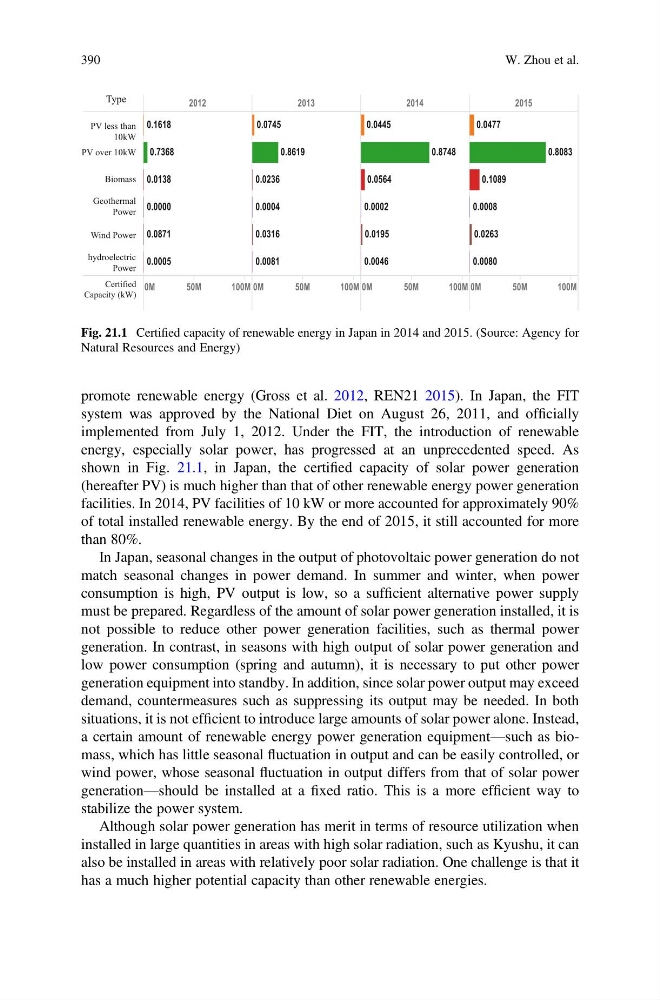
promote renewable energy (Gross et al. 2012, REN21 2015). In Japan, the FIT
system was approved by the National Diet on August 26, 2011, and officially
implemented from July 1, 2012. Under the FIT, the introduction of renewable
energy, especially solar power, has progressed at an unprecedented speed. As
shown in Fig. 21.1, in Japan, the certified capacity of solar power generation
(hereafter PV) is much higher than that of other renewable energy power generation
facilities. In 2014, PV facilities of 10 kW or more accounted for approximately 90%
of total installed renewable energy. By the end of 2015, it still accounted for more
than 80%.
In Japan, seasonal changes in the output of photovoltaic power generation do not
match seasonal changes in power demand. In summer and winter, when power
consumption is high, PV output is low, so a sufficient alternative power supply
must be prepared. Regardless of the amount of solar power generation installed, it is
not possible to reduce other power generation facilities, such as thermal power
generation. In contrast, in seasons with high output of solar power generation and
low power consumption (spring and autumn), it is necessary to put other power
generation equipment into standby. In addition, since solar power output may exceed
demand, countermeasures such as suppressing its output may be needed. In both
situations, it is not efficient to introduce large amounts of solar power alone. Instead,
a certain amount of renewable energy power generation equipment—such as biomass, which has little seasonal fluctuation in output and can be easily controlled, or
wind power, whose seasonal fluctuation in output differs from that of solar power
generation—should be installed at a fixed ratio. This is a more efficient way to
stabilize the power system.
Although solar power generation has merit in terms of resource utilization when
installed in large quantities in areas with high solar radiation, such as Kyushu, it can
also be installed in areas with relatively poor solar radiation. One challenge is that it
has a much higher potential capacity than other renewable energies.
Type
Certified
Capacity (kW)
PV less than
10kW
PV over 10kW
Biomass
Geothermal
Power
Wind Power
hydroelectric
Power
Fig. 21.1 Certified capacity of renewable energy in Japan in 2014 and 2015. (Source: Agency for
Natural Resources and Energy)
390
W. Zhou et al.
system was approved by the National Diet on August 26, 2011, and officially
implemented from July 1, 2012. Under the FIT, the introduction of renewable
energy, especially solar power, has progressed at an unprecedented speed. As
shown in Fig. 21.1, in Japan, the certified capacity of solar power generation
(hereafter PV) is much higher than that of other renewable energy power generation
facilities. In 2014, PV facilities of 10 kW or more accounted for approximately 90%
of total installed renewable energy. By the end of 2015, it still accounted for more
than 80%.
In Japan, seasonal changes in the output of photovoltaic power generation do not
match seasonal changes in power demand. In summer and winter, when power
consumption is high, PV output is low, so a sufficient alternative power supply
must be prepared. Regardless of the amount of solar power generation installed, it is
not possible to reduce other power generation facilities, such as thermal power
generation. In contrast, in seasons with high output of solar power generation and
low power consumption (spring and autumn), it is necessary to put other power
generation equipment into standby. In addition, since solar power output may exceed
demand, countermeasures such as suppressing its output may be needed. In both
situations, it is not efficient to introduce large amounts of solar power alone. Instead,
a certain amount of renewable energy power generation equipment—such as biomass, which has little seasonal fluctuation in output and can be easily controlled, or
wind power, whose seasonal fluctuation in output differs from that of solar power
generation—should be installed at a fixed ratio. This is a more efficient way to
stabilize the power system.
Although solar power generation has merit in terms of resource utilization when
installed in large quantities in areas with high solar radiation, such as Kyushu, it can
also be installed in areas with relatively poor solar radiation. One challenge is that it
has a much higher potential capacity than other renewable energies.
Type
Certified
Capacity (kW)
PV less than
10kW
PV over 10kW
Biomass
Geothermal
Power
Wind Power
hydroelectric
Power
Fig. 21.1 Certified capacity of renewable energy in Japan in 2014 and 2015. (Source: Agency for
Natural Resources and Energy)
390
W. Zhou et al.