

20.6 Conclusion
This chapter shows that India and Russia have enormous potential for reductions in
energy use and environmental impact when using Japanese technology in a thirdcountry market. If India had matched the energy consumption per GDP and carbon
dioxide emissions per GDP of Japan from 1992 to 2016, there would have been
reductions of 57,718 Mt CO 2 emissions and 23,402 oil-equivalent Mt energy
consumption. If India had achieved the same level of power generation efficiency
as Japan in the same period, a total of 743 oil-equivalent Mt energy consumption and
556 Mt CO 2 emissions could have been eliminated. Similarly, Russia had the
potential to reduce 3950 petroleum-equivalent Mt energy consumption and
1367 Mtoe CO 2 over the same period and would have generated more than 727.3
billion USD in economic benefits every year after the shale gas revolution.
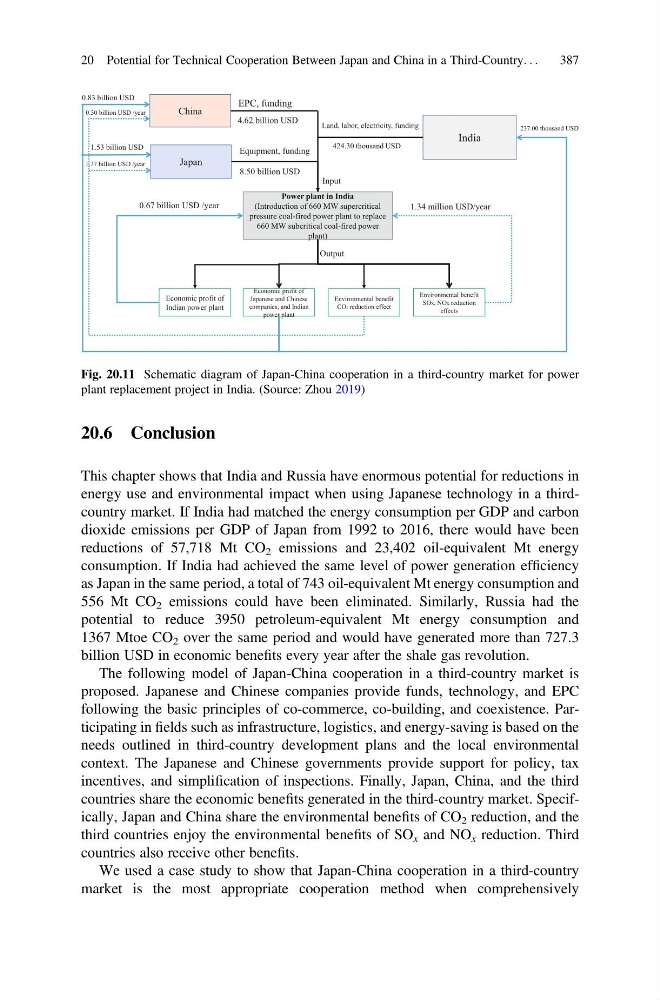
The following model of Japan-China cooperation in a third-country market is
proposed. Japanese and Chinese companies provide funds, technology, and EPC
following the basic principles of co-commerce, co-building, and coexistence. Participating in fields such as infrastructure, logistics, and energy-saving is based on the
needs outlined in third-country development plans and the local environmental
context. The Japanese and Chinese governments provide support for policy, tax
incentives, and simplification of inspections. Finally, Japan, China, and the third
countries share the economic benefits generated in the third-country market. Specifically, Japan and China share the environmental benefits of CO 2 reduction, and the
third countries enjoy the environmental benefits of SO x and NO x reduction. Third
countries also receive other benefits.
We used a case study to show that Japan-China cooperation in a third-country
market is the most appropriate cooperation method when comprehensively
China
Japan
Power plant in India
(Introduction of 660 MW supercritical
pressure coal-fired power plant to replace
660 MW subcritical coal-fired power
plant)
Economic profit of
Indian power plant
Economic profit of
Japanese and Chinese
companies, and Indian
power plant
Environmental benefit
CO2 reduction effect
Environmental benefit
SOx, NOx reduction
effects
India
EPC, funding
Equipment, funding
Land, labor, electricity, funding
Input
Output
0.83 billion USD
1.77 billion USD /year
1.53 billion USD
1.34 million USD/year
0.67 billion USD /year
424.30 thousand USD
237.00 thousand USD
0.30 billion USD /year
4.62 billion USD
8.50 billion USD
Fig. 20.11 Schematic diagram of Japan-China cooperation in a third-country market for power
plant replacement project in India. (Source: Zhou 2019)
20 Potential for Technical Cooperation Between Japan and China in a Third-Country. . .
387
This chapter shows that India and Russia have enormous potential for reductions in
energy use and environmental impact when using Japanese technology in a thirdcountry market. If India had matched the energy consumption per GDP and carbon
dioxide emissions per GDP of Japan from 1992 to 2016, there would have been
reductions of 57,718 Mt CO 2 emissions and 23,402 oil-equivalent Mt energy
consumption. If India had achieved the same level of power generation efficiency
as Japan in the same period, a total of 743 oil-equivalent Mt energy consumption and
556 Mt CO 2 emissions could have been eliminated. Similarly, Russia had the
potential to reduce 3950 petroleum-equivalent Mt energy consumption and
1367 Mtoe CO 2 over the same period and would have generated more than 727.3
billion USD in economic benefits every year after the shale gas revolution.
The following model of Japan-China cooperation in a third-country market is
proposed. Japanese and Chinese companies provide funds, technology, and EPC
following the basic principles of co-commerce, co-building, and coexistence. Participating in fields such as infrastructure, logistics, and energy-saving is based on the
needs outlined in third-country development plans and the local environmental
context. The Japanese and Chinese governments provide support for policy, tax
incentives, and simplification of inspections. Finally, Japan, China, and the third
countries share the economic benefits generated in the third-country market. Specifically, Japan and China share the environmental benefits of CO 2 reduction, and the
third countries enjoy the environmental benefits of SO x and NO x reduction. Third
countries also receive other benefits.
We used a case study to show that Japan-China cooperation in a third-country
market is the most appropriate cooperation method when comprehensively
China
Japan
Power plant in India
(Introduction of 660 MW supercritical
pressure coal-fired power plant to replace
660 MW subcritical coal-fired power
plant)
Economic profit of
Indian power plant
Economic profit of
Japanese and Chinese
companies, and Indian
power plant
Environmental benefit
CO2 reduction effect
Environmental benefit
SOx, NOx reduction
effects
India
EPC, funding
Equipment, funding
Land, labor, electricity, funding
Input
Output
0.83 billion USD
1.77 billion USD /year
1.53 billion USD
1.34 million USD/year
0.67 billion USD /year
424.30 thousand USD
237.00 thousand USD
0.30 billion USD /year
4.62 billion USD
8.50 billion USD
Fig. 20.11 Schematic diagram of Japan-China cooperation in a third-country market for power
plant replacement project in India. (Source: Zhou 2019)
20 Potential for Technical Cooperation Between Japan and China in a Third-Country. . .
387