

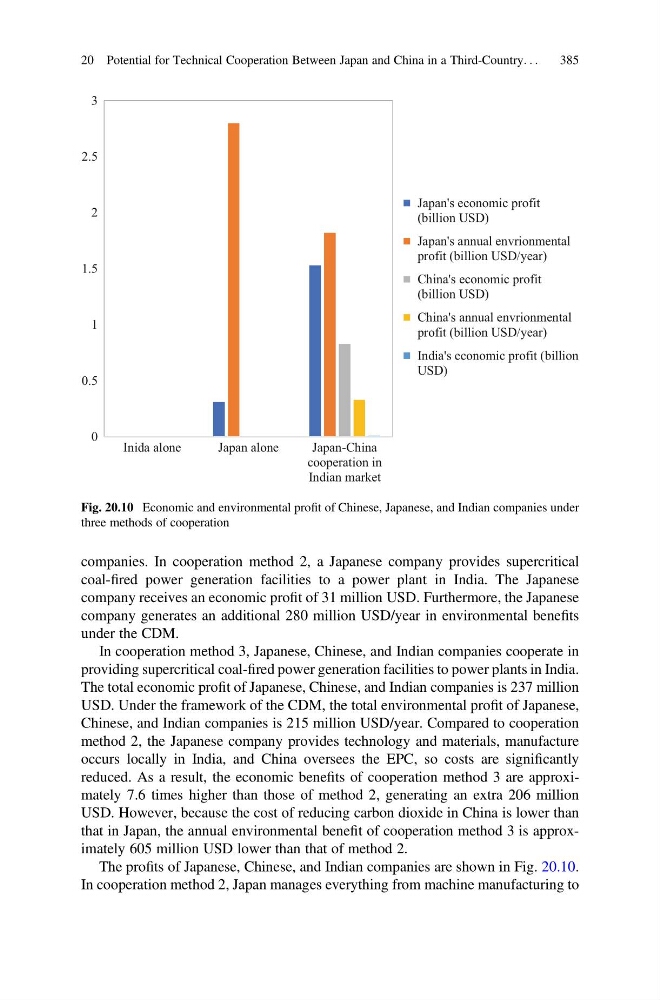
companies. In cooperation method 2, a Japanese company provides supercritical
coal-fired power generation facilities to a power plant in India. The Japanese
company receives an economic profit of 31 million USD. Furthermore, the Japanese
company generates an additional 280 million USD/year in environmental benefits
under the CDM.
In cooperation method 3, Japanese, Chinese, and Indian companies cooperate in
providing supercritical coal-fired power generation facilities to power plants in India.
The total economic profit of Japanese, Chinese, and Indian companies is 237 million
USD. Under the framework of the CDM, the total environmental profit of Japanese,
Chinese, and Indian companies is 215 million USD/year. Compared to cooperation
method 2, the Japanese company provides technology and materials, manufacture
occurs locally in India, and China oversees the EPC, so costs are significantly
reduced. As a result, the economic benefits of cooperation method 3 are approximately 7.6 times higher than those of method 2, generating an extra 206 million
USD. However, because the cost of reducing carbon dioxide in China is lower than
that in Japan, the annual environmental benefit of cooperation method 3 is approximately 605 million USD lower than that of method 2.
The profits of Japanese, Chinese, and Indian companies are shown in Fig. 20.10.
In cooperation method 2, Japan manages everything from machine manufacturing to
0
0.5
1
1.5
2
2.5
3
Inida alone
Japan alone
Japan-China
cooperation in
Indian market
Japan's economic profit
(billion USD)
Japan's annual envrionmental
profit (billion USD/year)
China's economic profit
(billion USD)
China's annual envrionmental
profit (billion USD/year)
India's economic profit (billion
USD)
Fig. 20.10 Economic and environmental profit of Chinese, Japanese, and Indian companies under
three methods of cooperation
20 Potential for Technical Cooperation Between Japan and China in a Third-Country. . .
385
coal-fired power generation facilities to a power plant in India. The Japanese
company receives an economic profit of 31 million USD. Furthermore, the Japanese
company generates an additional 280 million USD/year in environmental benefits
under the CDM.
In cooperation method 3, Japanese, Chinese, and Indian companies cooperate in
providing supercritical coal-fired power generation facilities to power plants in India.
The total economic profit of Japanese, Chinese, and Indian companies is 237 million
USD. Under the framework of the CDM, the total environmental profit of Japanese,
Chinese, and Indian companies is 215 million USD/year. Compared to cooperation
method 2, the Japanese company provides technology and materials, manufacture
occurs locally in India, and China oversees the EPC, so costs are significantly
reduced. As a result, the economic benefits of cooperation method 3 are approximately 7.6 times higher than those of method 2, generating an extra 206 million
USD. However, because the cost of reducing carbon dioxide in China is lower than
that in Japan, the annual environmental benefit of cooperation method 3 is approximately 605 million USD lower than that of method 2.
The profits of Japanese, Chinese, and Indian companies are shown in Fig. 20.10.
In cooperation method 2, Japan manages everything from machine manufacturing to
0
0.5
1
1.5
2
2.5
3
Inida alone
Japan alone
Japan-China
cooperation in
Indian market
Japan's economic profit
(billion USD)
Japan's annual envrionmental
profit (billion USD/year)
China's economic profit
(billion USD)
China's annual envrionmental
profit (billion USD/year)
India's economic profit (billion
USD)
Fig. 20.10 Economic and environmental profit of Chinese, Japanese, and Indian companies under
three methods of cooperation
20 Potential for Technical Cooperation Between Japan and China in a Third-Country. . .
385