

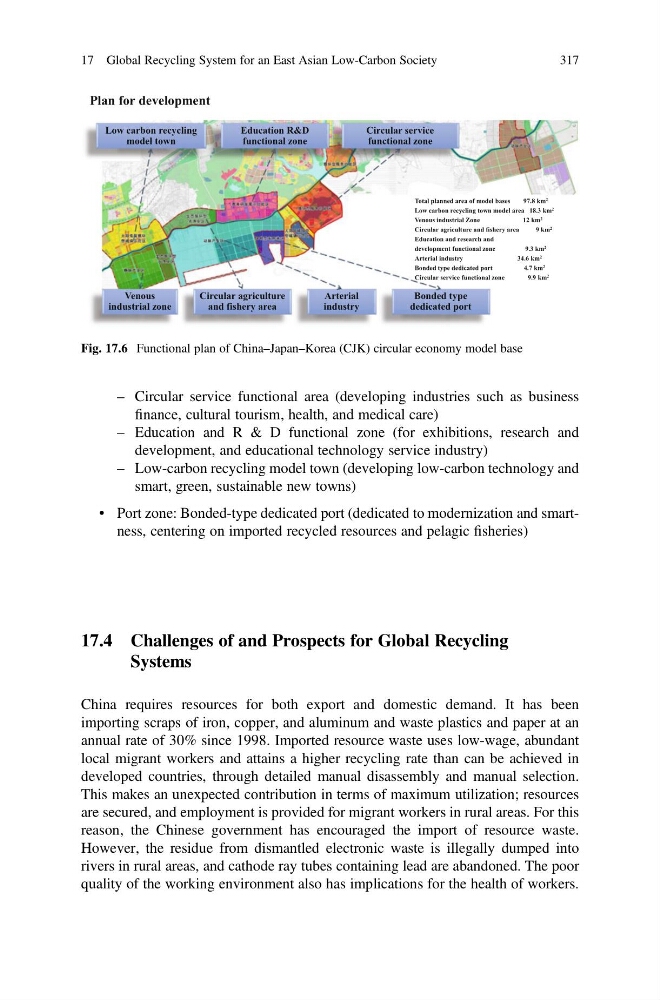
– Circular service functional area (developing industries such as business
finance, cultural tourism, health, and medical care)
– Education and R & D functional zone (for exhibitions, research and
development, and educational technology service industry)
– Low-carbon recycling model town (developing low-carbon technology and
smart, green, sustainable new towns)
• Port zone: Bonded-type dedicated port (dedicated to modernization and smartness, centering on imported recycled resources and pelagic fisheries)
17.4 Challenges of and Prospects for Global Recycling
Systems
China requires resources for both export and domestic demand. It has been
importing scraps of iron, copper, and aluminum and waste plastics and paper at an
annual rate of 30% since 1998. Imported resource waste uses low-wage, abundant
local migrant workers and attains a higher recycling rate than can be achieved in
developed countries, through detailed manual disassembly and manual selection.
This makes an unexpected contribution in terms of maximum utilization; resources
are secured, and employment is provided for migrant workers in rural areas. For this
reason, the Chinese government has encouraged the import of resource waste.
However, the residue from dismantled electronic waste is illegally dumped into
rivers in rural areas, and cathode ray tubes containing lead are abandoned. The poor
quality of the working environment also has implications for the health of workers.
Plan for development
Total planned area of model bases
97.8 km 2
Low carbon recycling town model area 18.3 km 2
Venous industrial Zone
12 km 2
Circular agriculture and fishery area
9 km 2
Education and research and
development functional zone
9.3 km 2
Arterial industry
34.6 km 2
Bonded type dedicated port
4.7 km 2
Circular service functional zone
9.9 km 2
Low carbon recycling
model town
Bonded type
dedicated port
Arterial
industry
Education R&D
functional zone
Circular service
functional zone
Venous
industrial zone
Circular agriculture
and fishery area
Fig. 17.6 Functional plan of China–Japan–Korea (CJK) circular economy model base
17 Global Recycling System for an East Asian Low-Carbon Society
317
finance, cultural tourism, health, and medical care)
– Education and R & D functional zone (for exhibitions, research and
development, and educational technology service industry)
– Low-carbon recycling model town (developing low-carbon technology and
smart, green, sustainable new towns)
• Port zone: Bonded-type dedicated port (dedicated to modernization and smartness, centering on imported recycled resources and pelagic fisheries)
17.4 Challenges of and Prospects for Global Recycling
Systems
China requires resources for both export and domestic demand. It has been
importing scraps of iron, copper, and aluminum and waste plastics and paper at an
annual rate of 30% since 1998. Imported resource waste uses low-wage, abundant
local migrant workers and attains a higher recycling rate than can be achieved in
developed countries, through detailed manual disassembly and manual selection.
This makes an unexpected contribution in terms of maximum utilization; resources
are secured, and employment is provided for migrant workers in rural areas. For this
reason, the Chinese government has encouraged the import of resource waste.
However, the residue from dismantled electronic waste is illegally dumped into
rivers in rural areas, and cathode ray tubes containing lead are abandoned. The poor
quality of the working environment also has implications for the health of workers.
Plan for development
Total planned area of model bases
97.8 km 2
Low carbon recycling town model area 18.3 km 2
Venous industrial Zone
12 km 2
Circular agriculture and fishery area
9 km 2
Education and research and
development functional zone
9.3 km 2
Arterial industry
34.6 km 2
Bonded type dedicated port
4.7 km 2
Circular service functional zone
9.9 km 2
Low carbon recycling
model town
Bonded type
dedicated port
Arterial
industry
Education R&D
functional zone
Circular service
functional zone
Venous
industrial zone
Circular agriculture
and fishery area
Fig. 17.6 Functional plan of China–Japan–Korea (CJK) circular economy model base
17 Global Recycling System for an East Asian Low-Carbon Society
317