

environmental pollution. By constructing an international resource recycling system and
system operation rules, an international resource recycling social system that maximizes
resource productivity and minimizes environmental impact can be realized. (Koizumi and
Zhou 2005, Koizumi 2006)
A recycling society is one in which economic, resource, and environmental policies
are integrated, promoting a circular economy from the three aspects of small cycle,
middle cycle, and general circulation. The whole production consumption pattern,
including clean production technology, material circulation between urban and rural
areas, utilization of local resources, and utilization of natural energy, is considered,
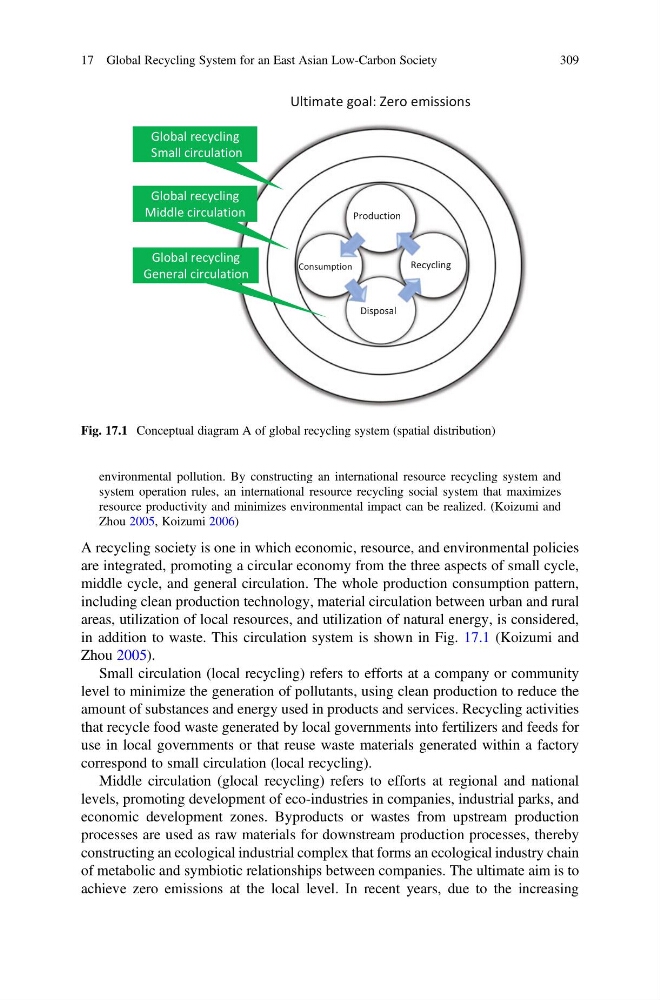
in addition to waste. This circulation system is shown in Fig. 17.1 (Koizumi and
Zhou 2005).
Small circulation (local recycling) refers to efforts at a company or community
level to minimize the generation of pollutants, using clean production to reduce the
amount of substances and energy used in products and services. Recycling activities
that recycle food waste generated by local governments into fertilizers and feeds for
use in local governments or that reuse waste materials generated within a factory
correspond to small circulation (local recycling).
Middle circulation (glocal recycling) refers to efforts at regional and national
levels, promoting development of eco-industries in companies, industrial parks, and
economic development zones. Byproducts or wastes from upstream production
processes are used as raw materials for downstream production processes, thereby
constructing an ecological industrial complex that forms an ecological industry chain
of metabolic and symbiotic relationships between companies. The ultimate aim is to
achieve zero emissions at the local level. In recent years, due to the increasing
Production
Recycling
Consumption
Disposal
Global recycling
Small circulation
Ultimate goal: Zero emissions
Global recycling
General circulation
Global recycling
Middle circulation
Fig. 17.1 Conceptual diagram A of global recycling system (spatial distribution)
17 Global Recycling System for an East Asian Low-Carbon Society
309
system operation rules, an international resource recycling social system that maximizes
resource productivity and minimizes environmental impact can be realized. (Koizumi and
Zhou 2005, Koizumi 2006)
A recycling society is one in which economic, resource, and environmental policies
are integrated, promoting a circular economy from the three aspects of small cycle,
middle cycle, and general circulation. The whole production consumption pattern,
including clean production technology, material circulation between urban and rural
areas, utilization of local resources, and utilization of natural energy, is considered,
in addition to waste. This circulation system is shown in Fig. 17.1 (Koizumi and
Zhou 2005).
Small circulation (local recycling) refers to efforts at a company or community
level to minimize the generation of pollutants, using clean production to reduce the
amount of substances and energy used in products and services. Recycling activities
that recycle food waste generated by local governments into fertilizers and feeds for
use in local governments or that reuse waste materials generated within a factory
correspond to small circulation (local recycling).
Middle circulation (glocal recycling) refers to efforts at regional and national
levels, promoting development of eco-industries in companies, industrial parks, and
economic development zones. Byproducts or wastes from upstream production
processes are used as raw materials for downstream production processes, thereby
constructing an ecological industrial complex that forms an ecological industry chain
of metabolic and symbiotic relationships between companies. The ultimate aim is to
achieve zero emissions at the local level. In recent years, due to the increasing
Production
Recycling
Consumption
Disposal
Global recycling
Small circulation
Ultimate goal: Zero emissions
Global recycling
General circulation
Global recycling
Middle circulation
Fig. 17.1 Conceptual diagram A of global recycling system (spatial distribution)
17 Global Recycling System for an East Asian Low-Carbon Society
309