

emissions and energy consumption. This shows that while developing a low-carbon
economy and improving technology levels, carbon dioxide emissions can be effectively controlled and reduced. As a result of investment in technology development
projects, energy efficiency is improved, thereby reducing energy consumption. In
summary, most control variable coefficients are significant and in line with
expectations.
15.4.2 Discussion
15.4.2.1 Trends in CO 2 Emissions, Carbon Intensity, Energy
Consumption, and Energy Intensity
The compelling premise of the difference-in-differences method adopted in this
chapter is that if the ETS pilot policy is implemented, trends in the growth of carbon
dioxide emissions and energy consumption in pilot provinces and cities and
non-pilot regions will be broadly similar. Carbon emissions, carbon intensity, energy
consumption, and energy intensity in pilot and non-pilot regions from 2008 to 2017
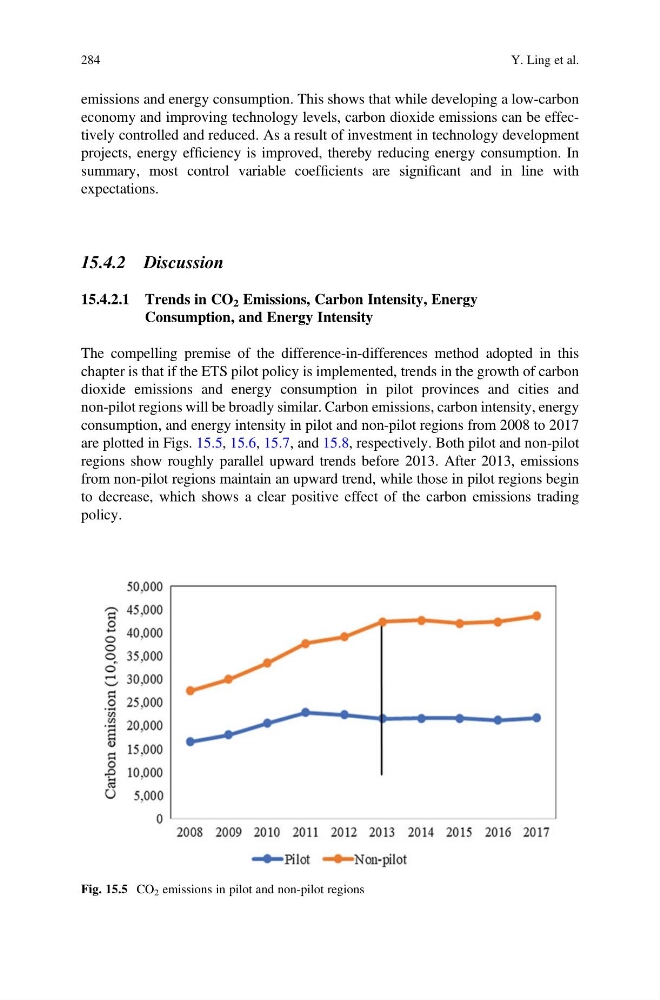
are plotted in Figs. 15.5, 15.6, 15.7, and 15.8, respectively. Both pilot and non-pilot
regions show roughly parallel upward trends before 2013. After 2013, emissions
from non-pilot regions maintain an upward trend, while those in pilot regions begin
to decrease, which shows a clear positive effect of the carbon emissions trading
policy.
Fig. 15.5 CO 2 emissions in pilot and non-pilot regions
284
Y. Ling et al.
economy and improving technology levels, carbon dioxide emissions can be effectively controlled and reduced. As a result of investment in technology development
projects, energy efficiency is improved, thereby reducing energy consumption. In
summary, most control variable coefficients are significant and in line with
expectations.
15.4.2 Discussion
15.4.2.1 Trends in CO 2 Emissions, Carbon Intensity, Energy
Consumption, and Energy Intensity
The compelling premise of the difference-in-differences method adopted in this
chapter is that if the ETS pilot policy is implemented, trends in the growth of carbon
dioxide emissions and energy consumption in pilot provinces and cities and
non-pilot regions will be broadly similar. Carbon emissions, carbon intensity, energy
consumption, and energy intensity in pilot and non-pilot regions from 2008 to 2017
are plotted in Figs. 15.5, 15.6, 15.7, and 15.8, respectively. Both pilot and non-pilot
regions show roughly parallel upward trends before 2013. After 2013, emissions
from non-pilot regions maintain an upward trend, while those in pilot regions begin
to decrease, which shows a clear positive effect of the carbon emissions trading
policy.
Fig. 15.5 CO 2 emissions in pilot and non-pilot regions
284
Y. Ling et al.