

2018. Shanghai Phoenix, a renowned bicycle supplier, experienced overproduction
and underproduction of bicycles and parts in the first half of 2018, with revenue and
profits decreasing by more than 50% year on year. Affected by the bankruptcy of
some bicycle-sharing companies, the operating profit of Cronus Bike fell by 82.3%
in the first half of 2018 compared to the previous year. The company was unable to
collect a large amount of its receivables, resulting in a significant decrease in
liquidity and profits. It was down 220.4% from the same period in the previous year.
The impact of dramatic changes in the bicycle-sharing market over such a short
period of time has triggered questions about the industry and the sharing economy
itself. The sharing economy has been the subject of a deluge of pseudopropositions,
short-lived, cold winter theories, and death theories. Other negative stories and
comments have directly impacted public and market confidence in the development
of the sharing economy. These controversies are inevitable in the growth of new
business formats. Objectively speaking, however, “survival of the fittest” is a
fundamental principle of market competition. The dilemmas faced by particular
applications are equated with the overall state of the sharing economy rather than
the failure of particular models. This is a failure of the sharing model as a whole, and
developmental issues may be seen as overstated.
13.2.2 Shared Vehicles
Another important market in the area of shared mobility is shared vehicles. A typical
company is DiDi Chuxing, which focuses on an objective of “making the journey
better” and has enhanced its innovation and business layout. Several widely reported
incidents in the past 2 years caused a considerable loss of confidence among its
users. Since then, the company has comprehensively integrated its safety infrastructure, improved its service quality, and gradually restored user trust. In 2018, DiDi
showed steady development. More than ten million car drivers operate on the DiDi
platform each year, transporting more than ten billion passengers over 48.8 billion
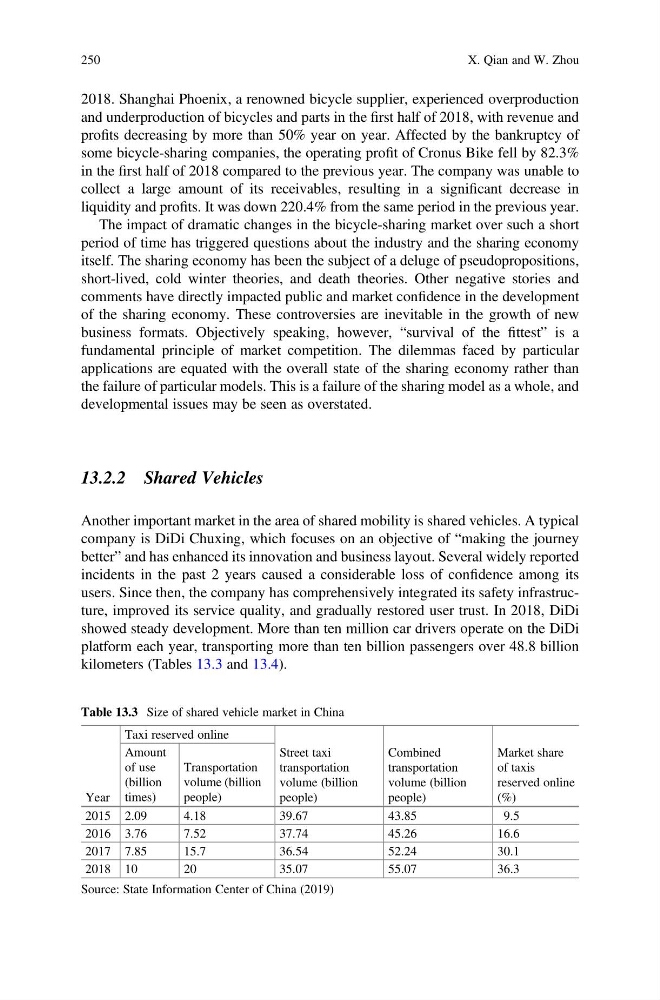
kilometers (Tables 13.3 and 13.4).
Table 13.3 Size of shared vehicle market in China
Year
Taxi reserved online
Street taxi
transportation
volume (billion
people)
Combined
transportation
volume (billion
people)
Market share
of taxis
reserved online
(%)
Amount
of use
(billion
times)
Transportation
volume (billion
people)
2015 2.09
4.18
39.67
43.85
9.5
2016 3.76
7.52
37.74
45.26
16.6
2017 7.85
15.7
36.54
52.24
30.1
2018 10
20
35.07
55.07
36.3
Source: State Information Center of China (2019)
250
X. Qian and W. Zhou
and underproduction of bicycles and parts in the first half of 2018, with revenue and
profits decreasing by more than 50% year on year. Affected by the bankruptcy of
some bicycle-sharing companies, the operating profit of Cronus Bike fell by 82.3%
in the first half of 2018 compared to the previous year. The company was unable to
collect a large amount of its receivables, resulting in a significant decrease in
liquidity and profits. It was down 220.4% from the same period in the previous year.
The impact of dramatic changes in the bicycle-sharing market over such a short
period of time has triggered questions about the industry and the sharing economy
itself. The sharing economy has been the subject of a deluge of pseudopropositions,
short-lived, cold winter theories, and death theories. Other negative stories and
comments have directly impacted public and market confidence in the development
of the sharing economy. These controversies are inevitable in the growth of new
business formats. Objectively speaking, however, “survival of the fittest” is a
fundamental principle of market competition. The dilemmas faced by particular
applications are equated with the overall state of the sharing economy rather than
the failure of particular models. This is a failure of the sharing model as a whole, and
developmental issues may be seen as overstated.
13.2.2 Shared Vehicles
Another important market in the area of shared mobility is shared vehicles. A typical
company is DiDi Chuxing, which focuses on an objective of “making the journey
better” and has enhanced its innovation and business layout. Several widely reported
incidents in the past 2 years caused a considerable loss of confidence among its
users. Since then, the company has comprehensively integrated its safety infrastructure, improved its service quality, and gradually restored user trust. In 2018, DiDi
showed steady development. More than ten million car drivers operate on the DiDi
platform each year, transporting more than ten billion passengers over 48.8 billion
kilometers (Tables 13.3 and 13.4).
Table 13.3 Size of shared vehicle market in China
Year
Taxi reserved online
Street taxi
transportation
volume (billion
people)
Combined
transportation
volume (billion
people)
Market share
of taxis
reserved online
(%)
Amount
of use
(billion
times)
Transportation
volume (billion
people)
2015 2.09
4.18
39.67
43.85
9.5
2016 3.76
7.52
37.74
45.26
16.6
2017 7.85
15.7
36.54
52.24
30.1
2018 10
20
35.07
55.07
36.3
Source: State Information Center of China (2019)
250
X. Qian and W. Zhou