

13.1.3 Market Size of the Sharing Economy
The sharing economy in China has continued to grow at a rapid pace in 2018;
penetration of the manufacturing sector is accelerating, and capacity sharing is
showing rapid development. Since 2017, the rate of development of livelihood
services in the sharing economy has slowed. The sharing economy is becoming an
important choice for people seeking flexible employment and also offers a wide
range of employment opportunities previously unavailable to certain social groups.
New business models, such as online car rental, shared accommodation, online
takeout, shared medical care, and shared logistics, are updating the structure of the
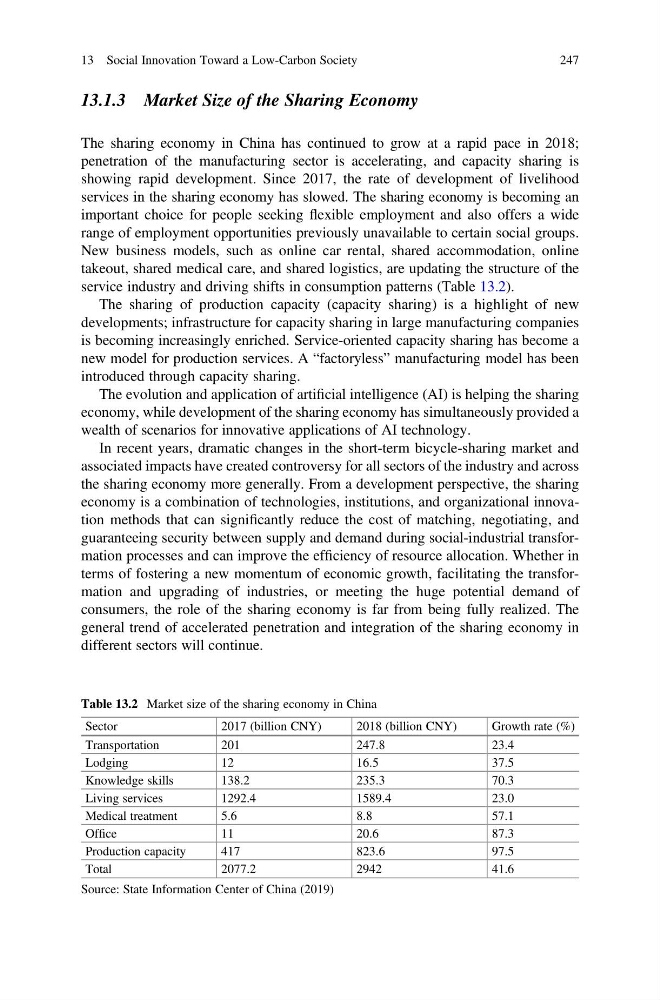
service industry and driving shifts in consumption patterns (Table 13.2).
The sharing of production capacity (capacity sharing) is a highlight of new
developments; infrastructure for capacity sharing in large manufacturing companies
is becoming increasingly enriched. Service-oriented capacity sharing has become a
new model for production services. A “factoryless” manufacturing model has been
introduced through capacity sharing.
The evolution and application of artificial intelligence (AI) is helping the sharing
economy, while development of the sharing economy has simultaneously provided a
wealth of scenarios for innovative applications of AI technology.
In recent years, dramatic changes in the short-term bicycle-sharing market and
associated impacts have created controversy for all sectors of the industry and across
the sharing economy more generally. From a development perspective, the sharing
economy is a combination of technologies, institutions, and organizational innovation methods that can significantly reduce the cost of matching, negotiating, and
guaranteeing security between supply and demand during social-industrial transformation processes and can improve the efficiency of resource allocation. Whether in
terms of fostering a new momentum of economic growth, facilitating the transformation and upgrading of industries, or meeting the huge potential demand of
consumers, the role of the sharing economy is far from being fully realized. The
general trend of accelerated penetration and integration of the sharing economy in
different sectors will continue.
Table 13.2 Market size of the sharing economy in China
Sector
2017 (billion CNY)
2018 (billion CNY)
Growth rate (%)
Transportation
201
247.8
23.4
Lodging
12
16.5
37.5
Knowledge skills
138.2
235.3
70.3
Living services
1292.4
1589.4
23.0
Medical treatment
5.6
8.8
57.1
Office
11
20.6
87.3
Production capacity
417
823.6
97.5
Total
2077.2
2942
41.6
Source: State Information Center of China (2019)
13 Social Innovation Toward a Low-Carbon Society
247
The sharing economy in China has continued to grow at a rapid pace in 2018;
penetration of the manufacturing sector is accelerating, and capacity sharing is
showing rapid development. Since 2017, the rate of development of livelihood
services in the sharing economy has slowed. The sharing economy is becoming an
important choice for people seeking flexible employment and also offers a wide
range of employment opportunities previously unavailable to certain social groups.
New business models, such as online car rental, shared accommodation, online
takeout, shared medical care, and shared logistics, are updating the structure of the
service industry and driving shifts in consumption patterns (Table 13.2).
The sharing of production capacity (capacity sharing) is a highlight of new
developments; infrastructure for capacity sharing in large manufacturing companies
is becoming increasingly enriched. Service-oriented capacity sharing has become a
new model for production services. A “factoryless” manufacturing model has been
introduced through capacity sharing.
The evolution and application of artificial intelligence (AI) is helping the sharing
economy, while development of the sharing economy has simultaneously provided a
wealth of scenarios for innovative applications of AI technology.
In recent years, dramatic changes in the short-term bicycle-sharing market and
associated impacts have created controversy for all sectors of the industry and across
the sharing economy more generally. From a development perspective, the sharing
economy is a combination of technologies, institutions, and organizational innovation methods that can significantly reduce the cost of matching, negotiating, and
guaranteeing security between supply and demand during social-industrial transformation processes and can improve the efficiency of resource allocation. Whether in
terms of fostering a new momentum of economic growth, facilitating the transformation and upgrading of industries, or meeting the huge potential demand of
consumers, the role of the sharing economy is far from being fully realized. The
general trend of accelerated penetration and integration of the sharing economy in
different sectors will continue.
Table 13.2 Market size of the sharing economy in China
Sector
2017 (billion CNY)
2018 (billion CNY)
Growth rate (%)
Transportation
201
247.8
23.4
Lodging
12
16.5
37.5
Knowledge skills
138.2
235.3
70.3
Living services
1292.4
1589.4
23.0
Medical treatment
5.6
8.8
57.1
Office
11
20.6
87.3
Production capacity
417
823.6
97.5
Total
2077.2
2942
41.6
Source: State Information Center of China (2019)
13 Social Innovation Toward a Low-Carbon Society
247