

time is valued equally. In contrast to other platforms, time banks are not growing
rapidly. This is due in part to the harsh nature of maintaining the same transaction
ratio and due to competition with services such as TaskRabbit and Zaarly, who pair
users requiring services with those that can provide them.
The fourth kind of sharing economy consists of initiatives that focus on sharing
assets, or space, to facilitate production rather than consumption. Historically, these
efforts have taken the form of coops and have been present in the United States since
the nineteenth century. Related initiatives include maker spaces, co-working spaces,
and co-offices providing shared tools. Other production sites include educational
platforms such as Skillshare.com and Peer 2 Peer University, which aim to replace
traditional educational institutions by democratizing access to skills and knowledge
and facilitating peer instruction.
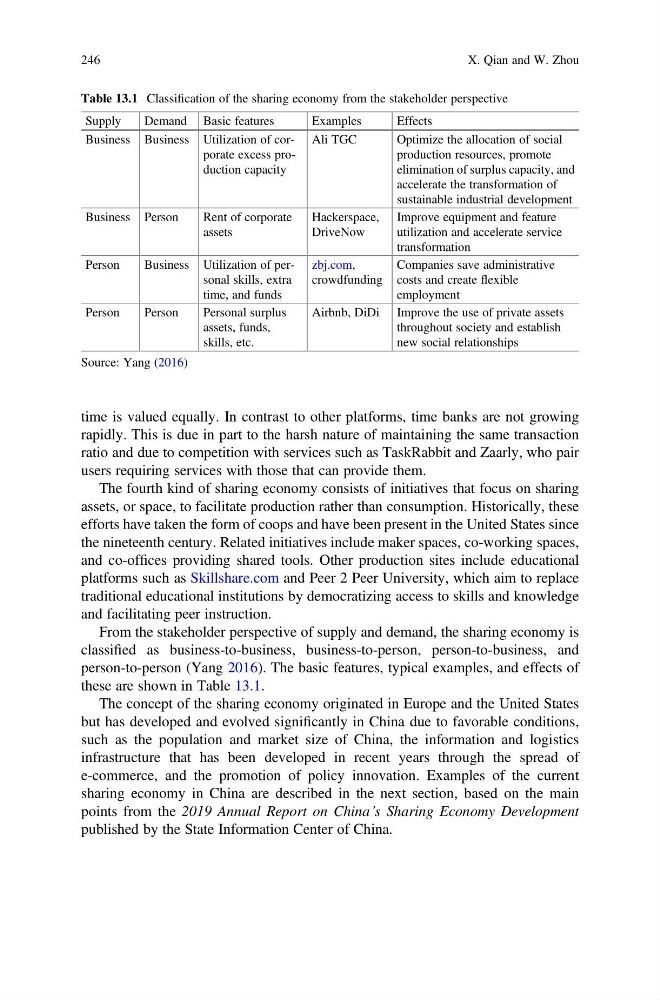
From the stakeholder perspective of supply and demand, the sharing economy is
classified as business-to-business, business-to-person, person-to-business, and
person-to-person (Yang 2016). The basic features, typical examples, and effects of
these are shown in Table 13.1.
The concept of the sharing economy originated in Europe and the United States
but has developed and evolved significantly in China due to favorable conditions,
such as the population and market size of China, the information and logistics
infrastructure that has been developed in recent years through the spread of
e-commerce, and the promotion of policy innovation. Examples of the current
sharing economy in China are described in the next section, based on the main
points from the 2019 Annual Report on China’s Sharing Economy Development
published by the State Information Center of China.
Table 13.1 Classification of the sharing economy from the stakeholder perspective
Supply
Demand Basic features
Examples
Effects
Business Business Utilization of corporate excess production capacity
Ali TGC
Optimize the allocation of social
production resources, promote
elimination of surplus capacity, and
accelerate the transformation of
sustainable industrial development
Business Person
Rent of corporate
assets
Hackerspace,
DriveNow
Improve equipment and feature
utilization and accelerate service
transformation
Person
Business Utilization of personal skills, extra
time, and funds
zbj.com,
crowdfunding
Companies save administrative
costs and create flexible
employment
Person
Person
Personal surplus
assets, funds,
skills, etc.
Airbnb, DiDi Improve the use of private assets
throughout society and establish
new social relationships
Source: Yang (2016)
246
X. Qian and W. Zhou
rapidly. This is due in part to the harsh nature of maintaining the same transaction
ratio and due to competition with services such as TaskRabbit and Zaarly, who pair
users requiring services with those that can provide them.
The fourth kind of sharing economy consists of initiatives that focus on sharing
assets, or space, to facilitate production rather than consumption. Historically, these
efforts have taken the form of coops and have been present in the United States since
the nineteenth century. Related initiatives include maker spaces, co-working spaces,
and co-offices providing shared tools. Other production sites include educational
platforms such as Skillshare.com and Peer 2 Peer University, which aim to replace
traditional educational institutions by democratizing access to skills and knowledge
and facilitating peer instruction.
From the stakeholder perspective of supply and demand, the sharing economy is
classified as business-to-business, business-to-person, person-to-business, and
person-to-person (Yang 2016). The basic features, typical examples, and effects of
these are shown in Table 13.1.
The concept of the sharing economy originated in Europe and the United States
but has developed and evolved significantly in China due to favorable conditions,
such as the population and market size of China, the information and logistics
infrastructure that has been developed in recent years through the spread of
e-commerce, and the promotion of policy innovation. Examples of the current
sharing economy in China are described in the next section, based on the main
points from the 2019 Annual Report on China’s Sharing Economy Development
published by the State Information Center of China.
Table 13.1 Classification of the sharing economy from the stakeholder perspective
Supply
Demand Basic features
Examples
Effects
Business Business Utilization of corporate excess production capacity
Ali TGC
Optimize the allocation of social
production resources, promote
elimination of surplus capacity, and
accelerate the transformation of
sustainable industrial development
Business Person
Rent of corporate
assets
Hackerspace,
DriveNow
Improve equipment and feature
utilization and accelerate service
transformation
Person
Business Utilization of personal skills, extra
time, and funds
zbj.com,
crowdfunding
Companies save administrative
costs and create flexible
employment
Person
Person
Personal surplus
assets, funds,
skills, etc.
Airbnb, DiDi Improve the use of private assets
throughout society and establish
new social relationships
Source: Yang (2016)
246
X. Qian and W. Zhou