

1.2.3.2 Changes in Chinese Civilization and Climate Change
There are many theories regarding the origin of Chinese civilization and the length of
Chinese history. Chinese history is approximately 3300 years (from 1300 B.C.). This
spans from the mid-Shang (Yin) dynasty, when the oracle bone inscriptions first
appeared in the history of Chinese characters; the Erlitou culture site (the central
plains of China, the core of the culture spanning the Neolithic and Bronze Ages,
~3700 years old). It was approximately 4100 years from the legendary Xia Dynasty
in Western Zhou literature (from 2070 B.C.); according to Confucius, the legendary
age of the Three Emperors and Five Sovereigns was approximately 4700 years (from
2698 B.C.). From ~5300 years ago from the site of the earliest discovered city in
Liangzhu culture (one of the Neolithic cultures in China developed on the coast of
Taihu Lake in the lower reaches of the Yangtze River). From the Neolithic Pujiang
Shangshan culture (located in Pujiang County in the upper reaches of the Puyang
River), discovered in 2001, it is the earliest origin of rice farming. From the Hemudu
culture ~7000 years ago (the Neolithic in the area south of the lower reaches of the
Yangtze River in China), and other prehistoric civilizations dating back 3000 years
between ~11,400 and 8400 years ago. It also spans from the Paleolithic period of
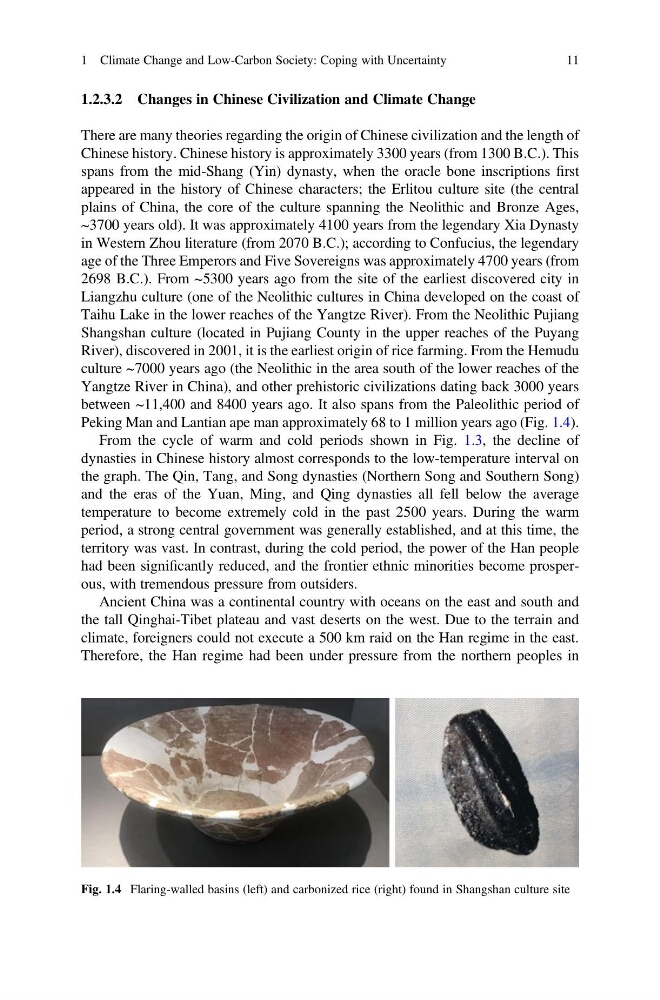
Peking Man and Lantian ape man approximately 68 to 1 million years ago (Fig. 1.4).
From the cycle of warm and cold periods shown in Fig. 1.3, the decline of
dynasties in Chinese history almost corresponds to the low-temperature interval on
the graph. The Qin, Tang, and Song dynasties (Northern Song and Southern Song)
and the eras of the Yuan, Ming, and Qing dynasties all fell below the average
temperature to become extremely cold in the past 2500 years. During the warm
period, a strong central government was generally established, and at this time, the
territory was vast. In contrast, during the cold period, the power of the Han people
had been significantly reduced, and the frontier ethnic minorities become prosperous, with tremendous pressure from outsiders.
Ancient China was a continental country with oceans on the east and south and
the tall Qinghai-Tibet plateau and vast deserts on the west. Due to the terrain and
climate, foreigners could not execute a 500 km raid on the Han regime in the east.
Therefore, the Han regime had been under pressure from the northern peoples in
Fig. 1.4 Flaring-walled basins (left) and carbonized rice (right) found in Shangshan culture site
1 Climate Change and Low-Carbon Society: Coping with Uncertainty
11
There are many theories regarding the origin of Chinese civilization and the length of
Chinese history. Chinese history is approximately 3300 years (from 1300 B.C.). This
spans from the mid-Shang (Yin) dynasty, when the oracle bone inscriptions first
appeared in the history of Chinese characters; the Erlitou culture site (the central
plains of China, the core of the culture spanning the Neolithic and Bronze Ages,
~3700 years old). It was approximately 4100 years from the legendary Xia Dynasty
in Western Zhou literature (from 2070 B.C.); according to Confucius, the legendary
age of the Three Emperors and Five Sovereigns was approximately 4700 years (from
2698 B.C.). From ~5300 years ago from the site of the earliest discovered city in
Liangzhu culture (one of the Neolithic cultures in China developed on the coast of
Taihu Lake in the lower reaches of the Yangtze River). From the Neolithic Pujiang
Shangshan culture (located in Pujiang County in the upper reaches of the Puyang
River), discovered in 2001, it is the earliest origin of rice farming. From the Hemudu
culture ~7000 years ago (the Neolithic in the area south of the lower reaches of the
Yangtze River in China), and other prehistoric civilizations dating back 3000 years
between ~11,400 and 8400 years ago. It also spans from the Paleolithic period of
Peking Man and Lantian ape man approximately 68 to 1 million years ago (Fig. 1.4).
From the cycle of warm and cold periods shown in Fig. 1.3, the decline of
dynasties in Chinese history almost corresponds to the low-temperature interval on
the graph. The Qin, Tang, and Song dynasties (Northern Song and Southern Song)
and the eras of the Yuan, Ming, and Qing dynasties all fell below the average
temperature to become extremely cold in the past 2500 years. During the warm
period, a strong central government was generally established, and at this time, the
territory was vast. In contrast, during the cold period, the power of the Han people
had been significantly reduced, and the frontier ethnic minorities become prosperous, with tremendous pressure from outsiders.
Ancient China was a continental country with oceans on the east and south and
the tall Qinghai-Tibet plateau and vast deserts on the west. Due to the terrain and
climate, foreigners could not execute a 500 km raid on the Han regime in the east.
Therefore, the Han regime had been under pressure from the northern peoples in
Fig. 1.4 Flaring-walled basins (left) and carbonized rice (right) found in Shangshan culture site
1 Climate Change and Low-Carbon Society: Coping with Uncertainty
11